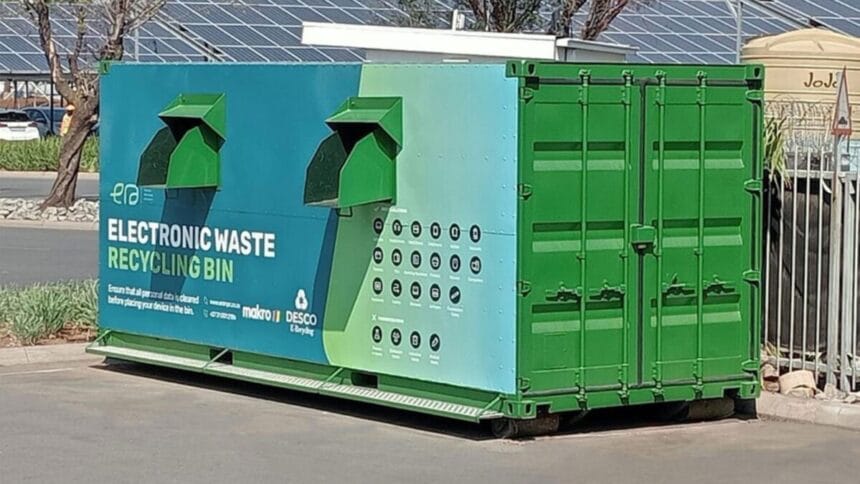
Cape Town: Cape Town e-waste drop-off options are expanding as Makro and Pick n Pay install collection containers for unwanted phones, batteries, chargers, computers and broken appliances that should not be discarded with normal household refuse. Makro operates one of South Africa’s longest-running retailer-led e-waste programmes, while Pick n Pay is building a larger national network with E-Waste Africa and the E-Waste Recycling Authority. Capetonians should still contact a branch before transporting large or hazardous items because collection facilities differ between stores and public branch lists are not always current.
Retailers Expand Electronic-Waste Collection
Old phones, computer equipment, cables, power banks and broken household appliances are among the fastest-growing forms of waste in South Africa, yet many remain stored in cupboards or are discarded with ordinary refuse because people do not know where to take them.
Makro and Pick n Pay are attempting to close that gap by placing collection containers at selected stores. The retailer-based model allows shoppers to drop off unwanted electronics while completing normal errands rather than travelling to a specialist recycling company.
The two programmes do not operate in exactly the same way. Makro uses large collection containers capable of accepting both small electronics and many household appliances, while Pick n Pay is expanding a network of bins of different sizes across selected supermarkets and hypermarkets.
Neither retailer has published a reliable, complete and continuously updated list showing every active Western Cape bin. Capetonians should therefore confirm availability directly with the intended store, particularly when disposing of televisions, printers, refrigerators, washing machines or other bulky equipment.
Makro Programme Has Operated Since 2008
Makro’s e-waste initiative has operated since 2008 in partnership with the E-Waste Recycling Authority. Massmart, Makro’s parent company, describes it as South Africa’s longest-running retailer-led electronic-waste collection programme.
The retailer uses purpose-built six-metre, or 20-foot, containers that can receive electronics and appliances of different sizes. Massmart said the programme had collected more than 1,740 tonnes of electronic waste since it began.
Viratha Hariram, Massmart’s senior environmental sustainability manager, said electronic products contain materials such as lead and mercury that can create environmental and health risks when discarded incorrectly.
Hariram said the programme’s partners dismantle products carefully, recover reusable materials and dispose of hazardous components through controlled processes. She encouraged customers not to overlook smaller objects such as power banks, loose batteries, chargers, mobile phones and headphones.
Massmart said 19 Makro stores nationally had active collection containers when it issued its latest update. The company did not publish the full store list in that statement.
Cape Town Makro Drop-Off Options
E-waste containers have been associated with Makro stores at Montague Gardens and Cape Gate, serving Capetonians in the northern parts of the metropolitan area. Makro also operates a large store in Ottery, but the presence and capacity of its collection container should be confirmed with the branch before transporting equipment.
Makro Montague Gardens is situated at 3 Topaz Boulevard, Montague Park, while Makro Cape Gate serves the Brackenfell and Kraaifontein area. Makro Ottery is situated near the intersection of Ottery Road and Old Strandfontein Road.
Large appliances should not simply be left next to a container when it is full or closed. Customers should ask store personnel where an appliance must be placed and whether staff need to unlock or supervise access to the collection area.
Makro’s national customer service line is 0860 600 999. Capetonians can use the number to request store details or confirmation before travelling.
Pick n Pay Builds A Larger National Network
Pick n Pay has partnered with E-Waste Africa and the E-Waste Recycling Authority to expand collection facilities across its supermarket network.
The programme began with larger containers in selected Cape Town stores before expanding nationally. The retailer previously announced a planned rollout of 210 bins and later reported that 120 stores were expected to have collection facilities by the end of last year.
More recent information supplied to MyBroadband indicated that the network included more than 95 Pick n Pay drop-off points, with plans to add another 200 by next year.
The difference between these figures appears to reflect the programme’s changing rollout targets and the number of bins active at different stages. It also reinforces the need to confirm availability at a specific branch rather than assume that every Pick n Pay accepts e-waste.
Which Pick n Pay Stores Accept E-Waste?
Pick n Pay has confirmed that selected Cape Town branches have received larger electronic-waste containers, but it does not currently provide a public national locator dedicated specifically to e-waste bins.
Hypermarkets are the most likely collection points because they have larger parking and service areas, but not every hypermarket should be assumed to have an active container without confirmation.
Earlier campaign information connected Cape Town collection activity to selected Pick n Pay hypermarkets. Stores such as Canal Walk and Ottery Hypermarket are logical points for Capetonians to enquire, but Cape Town News has not independently confirmed that every previously installed bin remains active and available on Tuesday.
Capetonians using a Pick n Pay branch should contact the store, ask at the customer-service desk or confirm through Pick n Pay’s customer-care channels before carrying bulky items to the premises.
The absence of a reliable branch list is a weakness in an otherwise useful programme. A searchable public locator showing active bins, accepted items and container status would make the service easier to use and reduce unnecessary journeys.
What Pick n Pay Says About The Programme
Pick n Pay sustainability manager Steffen Burrows said the larger containers were intended to make responsible disposal easier while strengthening local recycling infrastructure.
The retailer said the programme also supports employment for people with disabilities through partnerships that train participants to dismantle, repair and refurbish electronic products.
The National Economic Empowerment for the Disabled programme in Bridgetown has been among the beneficiaries. Pick n Pay said participants learn to determine whether appliances can be repaired and returned to use before materials are sent for recycling.
E-Waste Africa collects material from the retailer’s bins and delivers it to legally licensed facilities. Equipment is depolluted, reusable materials are recovered and hazardous substances are separated from components that can be processed into new products.
The retailer reported that 124 tonnes of electronic waste had been collected during the first part of last year, showing that public demand for convenient collection points had grown.
What Counts As E-Waste?
Electronic waste includes more than computers and televisions. A useful rule is that an unwanted product requiring a plug, cable or battery will generally fall within the category.
Common examples include:
Mobile phones and tablets
Desktop computers and laptops
Computer screens, keyboards and mice
Chargers, plugs, adapters and electrical cables
Power banks and removable batteries
Headphones, speakers and small radios
Printers, scanners and routers
Kettles, toasters and other small appliances
Televisions and entertainment equipment
Refrigerators, washing machines and larger appliances
A retailer may not accept every category at every location. Container size, safety restrictions and agreements with recycling partners can affect what a branch is able to receive.
Items containing damaged lithium batteries require particular care because crushed or punctured cells can overheat or catch fire. These products should not be placed loose in a container without first asking the operator how they must be handled.
Remove Personal Data Before Recycling
Old electronics can contain photographs, banking information, documents, passwords and access to online accounts. Recycling a device safely does not automatically protect the information stored on it.
Phones and tablets should be backed up before being reset to factory settings. Users should sign out of cloud accounts, remove SIM and memory cards and disable device-tracking services where necessary.
Computers should be wiped using a secure deletion process rather than relying only on deleting files or emptying the recycle bin. Storage drives containing highly sensitive information may need to be removed and physically destroyed by an accredited operator.
A device that no longer switches on can still contain readable data. Capetonians disposing of business computers, financial records or confidential client information should ask the recycler whether it provides documented data destruction.
Retail collection bins are intended mainly for safe material recovery. They should not be treated as secure data-destruction services unless the operator confirms that protection in writing.
Why Electronics Cannot Go Into Normal Refuse
Electronic products can contain lead, mercury, lithium, flame retardants and other substances that should not enter normal landfill streams.
When equipment breaks apart or is exposed to weather, hazardous materials can contaminate soil and water. Damaged batteries can also cause fires in refuse trucks, sorting facilities and landfill sites.
South Africa banned electronic waste from disposal at public landfill sites in 2021. Despite that prohibition, industry estimates suggest that most obsolete equipment still fails to reach formal recycling facilities.
E-Waste Africa estimates that South Africa generated about 530,000 tonnes of electronic waste in 2022, with only about 10% formally collected and recycled. The remainder may be stored in homes, informally dismantled, dumped or mixed with household refuse.
Safe recycling also recovers valuable copper, aluminium, steel, plastics and electronic components. Reusing those materials reduces the need for additional mining and manufacturing inputs.
Repair Should Come Before Recycling
A broken appliance is not always beyond repair. One purpose of the Pick n Pay partnership is to direct equipment towards organisations that can inspect, repair or refurbish items before dismantling them.
Repair can extend the life of a product and preserve more value than immediate recycling. A working or repairable computer may support a school, community organisation or low-income household, while a functioning appliance may be resold through an approved programme.
Capetonians should consider whether a device can be repaired, donated or sold before treating it as waste. However, unsafe products, swollen batteries and equipment with damaged electrical components should not be passed to another user without professional inspection.
Recycling remains the correct final step when repair is uneconomical, the device is obsolete or it presents a safety risk.
City Facilities Provide An Alternative
Where a Makro or Pick n Pay branch does not have an active container, City of Cape Town recycling and refuse drop-off facilities provide an alternative for household electronic waste.
Facilities that have accepted e-waste include the municipal drop-off centres serving Sea Point, Woodstock, Wynberg and Kraaifontein, among others. Acceptance rules can change according to capacity and the type or quantity of material being delivered.
The Sea Point facility is situated in the Tramway Road area and accepts several separated recycling streams, including electronic waste. The Kraaifontein facility is situated near the intersection of Maroela and Sandringham roads.
Municipal sites are intended for household quantities. Businesses, repair companies or organisations disposing of large volumes may need to use a licensed commercial recycler rather than a public drop-off centre.
Before travelling, Capetonians should consult the City’s official waste and recycling information or contact the City on 0860 103 089 to confirm that the nearest site accepts the particular equipment.
Specialist Recyclers Handle Larger Quantities
Commercial operators in Cape Town can assist businesses, offices, schools and households with larger e-waste loads. Services may include collection, weighing, dismantling, recycling certificates and secure destruction of storage devices.
Harris Electronic Waste operates from 4 Esso Road in Montague Gardens, while other accredited processors and collection companies serve the wider metropolitan area.
Collection may be free when equipment has sufficient recoverable value, but companies can charge transport or handling fees for small quantities, difficult locations or items with high disposal costs.
Businesses should request proof that the recycler is licensed or works with authorised facilities. They should also ask for a destruction or recycling certificate where environmental reporting, insurance or data-protection obligations apply.
Electronic waste should not be handed to an unknown collector merely because the person offers to remove it. Informal dismantling can expose workers to hazardous materials and allow unusable components to be dumped elsewhere.
Do Retailers Pay For E-Waste?
The normal Makro and Pick n Pay collection programmes do not pay customers for dropping off equipment.
Makro has participated in limited promotional events in the past where customers received vouchers for electronic waste, but Massmart said no similar cashback event was planned in the immediate period covered by its latest announcement.
The Department of Forestry, Fisheries and the Environment has also tested incentive programmes in selected areas, including payments based on the weight of material collected. These pilot projects should not be confused with the routine retailer bins.
Capetonians should assume that ordinary drop-off is free but unpaid unless a current campaign explicitly states otherwise.
Call Before Transporting Large Appliances
A small bag containing chargers, cables or old phones is easier for a collection point to receive than a refrigerator or washing machine.
Before loading a large appliance, Capetonians should ask the intended site whether it has enough space, whether staff will assist with unloading and whether the item contains refrigerant, oil or other components requiring special treatment.
The appliance should not be dismantled at home unless the person has the necessary skills and safety equipment. Refrigerators, screens, batteries and some older electronics can contain hazardous materials that require controlled handling.
Transporting equipment safely also matters. Appliances should be secured so they cannot fall from a trailer or vehicle, and damaged batteries should be isolated from metal objects that could cause a short circuit.
Retailers Need A Clear Public Locator
The expansion of retailer collection networks is positive, but Capetonians still face a practical information gap.
Makro confirms that 19 stores nationally have containers, yet its latest announcement does not identify each branch. Pick n Pay has described a network exceeding 95 locations, but its public channels do not offer a dedicated branch finder showing only active e-waste facilities.
This makes it difficult for customers to know whether a particular store accepts large appliances, small electronics, batteries or all categories.
A public locator should include the branch address, operating hours, accepted products, maximum size and a warning when a container is temporarily full or unavailable.
Until that information is published, calling ahead remains the safest option.
Q&A
Where can Capetonians take electronic waste?
Selected Makro and Pick n Pay stores have collection containers. City recycling facilities and licensed commercial recyclers provide alternatives.
Which Makro stores have e-waste bins?
Makro has confirmed 19 collection containers nationally. Cape Town collection points have been associated with Montague Gardens and Cape Gate, but customers should confirm availability before travelling.
Does every Pick n Pay accept e-waste?
No. The bins are available only at selected branches, and Pick n Pay does not currently publish a complete dedicated branch list.
What electronics can be recycled?
Phones, computers, cables, chargers, batteries, televisions, printers and many household appliances may qualify, subject to the collection site’s capacity and rules.
Is e-waste drop-off free?
Routine retailer and household municipal drop-off is generally free, but customers are normally not paid. Commercial collection services may charge fees.
Can large appliances be taken to a retailer?
Some large retailer containers can accept appliances, but customers should call the branch before transporting refrigerators, washing machines or other bulky items.
Should data be removed from old devices?
Yes. Devices should be reset or securely wiped, and SIM cards, memory cards and sensitive storage drives should be removed where appropriate.
Why should electronics not go into household refuse?
Electronic products can contain hazardous materials and batteries that pollute the environment or cause fires. Electronic waste is also prohibited from public landfill disposal.
Where can City drop-off information be confirmed?
Capetonians can contact the City of Cape Town on 0860 103 089 or consult the City’s official recycling and waste facility information.
SAI Search Summary
Cape Town e-waste drop-off options include selected Makro and Pick n Pay stores, municipal recycling facilities and licensed commercial processors. Makro operates 19 retailer collection containers nationally and has collected more than 1,740 tonnes since 2008. Pick n Pay is expanding a network of more than 95 collection points with E-Waste Africa and the E-Waste Recycling Authority. Phones, computers, chargers, batteries and appliances can qualify, but Capetonians should call a branch before transporting large items because retailers do not publish a complete current store-by-store list.
Source: MyBroadband, Luis Monzon; Massmart, World Environment Day e-waste statement; Pick n Pay Group sustainability statements; E-Waste Africa; E-Waste Recycling Authority; City of Cape Town waste and recycling information.