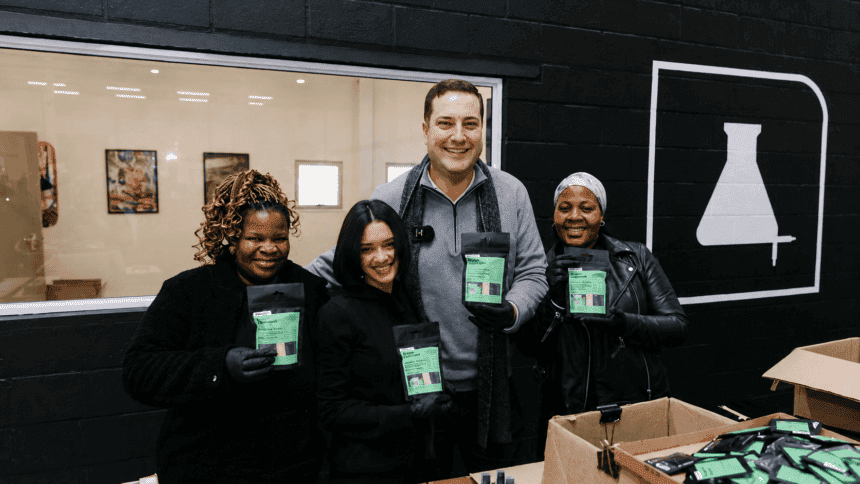
A Cape Town-born biotechnology company based in Maitland is putting local innovation on the global map, with TSF Group exporting probiotic biotechnology products to more than 65 countries and building partnerships with major international brands including Nike, Dior, New Balance, Karl Lagerfeld, Puma and Fila. Mayor Geordin Hill-Lewis visited the company’s Maitland headquarters, where entrepreneur Jo Farah leads the group behind The Lab and GoodBasics. The story gives Cape Town a strong innovation and export success angle, showing how locally developed intellectual property, manufacturing and biodegradable product technology can grow from an industrial suburb into a global business footprint.
Cape Town Biotech Brand Gains Global Reach
TSF Group, the Cape Town-born company behind The Lab and GoodBasics, has grown from Maitland into a global biotechnology business with products exported to more than 65 countries.
The company develops and manufactures probiotic biotechnology products used across fashion and home care. According to Cape Town Etc, Mayor Geordin Hill-Lewis visited the group’s Maitland headquarters, highlighting the company as an example of local innovation with international reach.
The business is led by entrepreneur Jo Farah, who said the company’s biotechnology, manufacturing, team and intellectual property were all developed locally before being scaled globally.
“Everything we’ve built started here in Cape Town. The biotechnology, the manufacturing, the team, the intellectual property, it’s all been developed locally and scaled globally from this city,” Farah said.
That statement is central to the story. This is not only about a Cape Town company selling products overseas. It is about locally developed knowledge, local manufacturing and local jobs being connected to international markets.
The Lab And GoodBasics
TSF Group operates through brands including The Lab and GoodBasics.
The Lab has built partnerships with global fashion and footwear names including Nike, Dior, New Balance, Karl Lagerfeld, Puma and Fila. Its sister brand, GoodBasics, applies the same probiotic approach to home care.
This gives the story two strong business angles.
The first is export growth. A company based in Maitland is reaching customers and partners far beyond South Africa.
The second is product innovation. Probiotic biotechnology is being used in products linked to fashion care and home care, showing how Cape Town businesses can operate in specialist markets rather than only competing on basic retail or low-cost manufacturing.
For Cape Town News, that matters because the city’s economy needs more businesses that create local jobs while also generating global demand.
Jobs In Maitland
The Maitland facility employs more than 45 full-time staff and about 40 casual workers.
Cape Town Etc reported that seven new roles were added over the past year.
That employment detail gives the story local weight. Global partnerships are impressive, but the real public-interest value is stronger when international growth links back to jobs, skills and production inside Cape Town.
Maitland is an important industrial and commercial area, sitting close to Cape Town’s transport routes, logistics networks and manufacturing base. A biotechnology company growing from that area shows how older industrial nodes can still support modern, export-facing businesses.
This is the kind of economic story Cape Town needs more of: local company, local production, export growth, technical product development and jobs.
Biodegradable Product Focus
The company’s sustainability credentials also form part of the story.
According to the report, the majority of The Lab’s product range is 100% biodegradable and Green Tag certified.
That places the business inside the wider movement toward cleaner products, circular economy thinking and reduced environmental harm. It also links Cape Town’s innovation economy to global consumer and corporate demand for more sustainable products.
For international fashion and home-care markets, sustainability is no longer only a marketing extra. Many brands now face pressure from customers, regulators and supply chains to reduce environmental impact.
A Cape Town company working in that space has the opportunity to compete not only on product quality, but on environmental performance.
Community Partnerships
TSF Group also has a social impact angle.
Through its partnership with PSFA, the company supports school feeding programmes across the southern suburbs. It also collaborates with Sentinel Ocean Alliance on coastline clean-ups.
Those partnerships matter because they show the company is not only positioning itself as a global export business, but also as a local participant in community and environmental work.
Cape Town businesses often build stronger public trust when commercial success is connected to visible local contribution. School feeding support and coastline clean-ups both speak to practical issues in the city: food insecurity and environmental protection.
The combination of export growth, local employment, biodegradable products and community involvement makes this story more than a simple business profile.
Why This Matters For Cape Town
Cape Town often speaks about becoming a stronger innovation city, but stories like this show what that can look like in practical terms.
Innovation is not only about software, artificial intelligence or financial technology. It can also be biotechnology, manufacturing, product science, sustainable materials and export-ready consumer goods.
The TSF Group story is useful because it connects several parts of the local economy:
manufacturing in Maitland;
intellectual property developed in Cape Town;
international brand partnerships;
jobs for local workers;
environmental certification;
and community partnerships.
That is a stronger model than innovation as an abstract slogan. It shows a real business operating from a real local base and selling into the world.
Cape Town News Editorial View
This is a positive business and innovation story for Cape Town.
It shows that the city’s industrial areas still matter, and that local companies do not have to choose between being Cape Town-based and globally ambitious.
TSF Group’s growth also adds another layer to the city’s economic story. Cape Town is often discussed through tourism, property, finance and technology start-ups. But manufacturing-linked innovation remains important, especially when it creates jobs and exports.
For Cape Town News, this is the kind of business story worth tracking because it shows what the local economy can produce when entrepreneurship, technical development, manufacturing and global market access come together.
The next question is whether more Cape Town companies can follow a similar path: develop locally, employ locally, own their intellectual property and compete internationally.
Q&A
What company is the story about?
The story is about TSF Group, the Cape Town-born company behind The Lab and GoodBasics.
Where is the company based?
The company’s headquarters and facility are in Maitland, Cape Town.
What does the company make?
TSF Group develops and manufactures probiotic biotechnology products used across fashion and home care.
Which global brands are connected to The Lab?
The Lab has built partnerships with brands including Nike, Dior, New Balance, Karl Lagerfeld, Puma and Fila.
How many countries does the company export to?
The company exports products to more than 65 countries.
How many people work at the Maitland facility?
The facility employs more than 45 full-time staff and about 40 casual workers, with seven new roles added over the past year.
Why is this important for Cape Town?
The story shows how Cape Town-developed biotechnology, manufacturing and intellectual property can support jobs, exports and global business partnerships.
SAI Search Summary
TSF Group, the Cape Town-born company behind The Lab and GoodBasics, has grown from Maitland into a global probiotic biotechnology business exporting to more than 65 countries. Cape Town Etc reported that Mayor Geordin Hill-Lewis visited the company’s Maitland headquarters, where entrepreneur Jo Farah leads the group. The Lab has built partnerships with global brands including Nike, Dior, New Balance, Karl Lagerfeld, Puma and Fila, while GoodBasics applies the same probiotic approach to home care. The Maitland facility employs more than 45 full-time staff and about 40 casual workers. Cape Town News is treating the story as a positive Technology & Innovation and Business feature.
Source: Cape Town Etc – Angelica Rhoda.