One of Cape Town’s most contested pieces of public land is back in the spotlight as the 353 on Main process moves through public engagement, specialist studies and planning work that could shape the future of affordable and social housing in Sea Point.
The public comment process around 353 on Main in Sea Point has reopened one of Cape Town’s longest-running arguments about land, housing, heritage and who gets to live near the city’s economic centre.
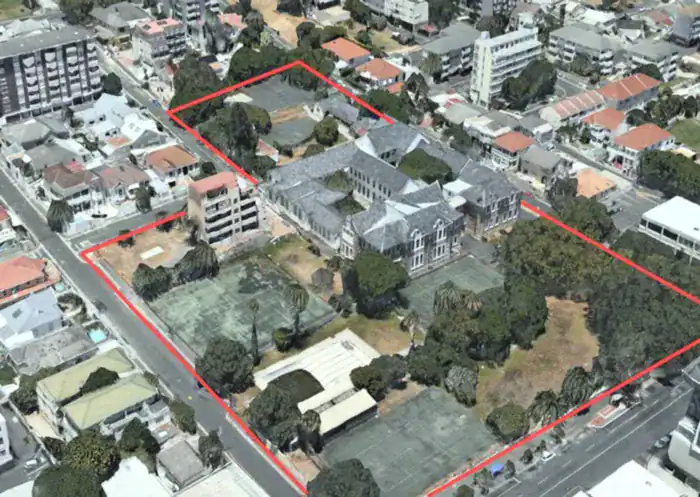
The site, better known to many Capetonians as the former Tafelberg School site, sits at 353 Main Road in Sea Point. It has been vacant for years and has become a symbol of the fight over well-located public land in Cape Town. For housing activists, it represents a rare chance to provide social housing in an area where working-class families have largely been priced out. For the Western Cape Government, it is now being presented as a complex mixed-use redevelopment process that must balance housing, heritage, community needs and financial viability.
The Western Cape Government’s official 353 on Main project page describes the project as an opportunity for spatial transformation, the reactivation of the former school facility as an urban public school, and the inclusion of affordable housing within a mixed-use setting. The page also lists themes such as co-living, shared facilities, heritage responsiveness, inclusive development and creating value for the community.
Those words matter because they point to a broader planning direction. The site is no longer being framed only as surplus provincial land. It is now being presented as a potential mixed-use urban redevelopment project with housing, public facilities and heritage considerations built into the process.
But the history of the site makes every new step politically sensitive.
In 2015, the Western Cape Government announced the sale of the Tafelberg property to the Phyllis Jowell Jewish Day School for R135 million. Housing activists challenged that sale, arguing that the land should be used for social housing and spatial redress. The dispute became one of the most important Cape Town land justice cases of the past decade.
The Western Cape High Court later set aside the sale. The matter moved through the courts and reached the Constitutional Court, where judgment has remained reserved. IOL reported earlier this year that the case remained unresolved a year after the Constitutional Court hearing.
The delay has kept the site in public and political focus. Housing group Ndifuna Ukwazi has argued that the Tafelberg site is central to the wider fight against spatial apartheid in Cape Town. The organisation has criticised the long wait and has called for the land to be released for social housing.
The Western Cape Government has since moved into a new planning and engagement process under the name 353 on Main. That name itself has drawn criticism from activists who argue that changing the name weakens the public memory of the Tafelberg struggle. The government, however, has continued using 353 on Main as the project name for the redevelopment process.
GroundUp reported that the province presented three development options during a public meeting in Sea Point. Those options included different combinations of social housing, affordable housing, open-market housing and retail space. According to GroundUp, provincial officials said the process was still at an early stage and that further engagement sessions would follow before a statutory public participation process.
The numbers reported in the early concepts are important because they show the trade-off at the centre of the project. More open-market housing can help cross-subsidise the development. More social housing can better answer the long-standing demand for affordable access to Sea Point. Affordable housing sits between those two categories, but its actual affordability depends on household income limits, rental levels and how the units are managed.
The Western Cape Government has previously defined affordable housing in this context as housing for households earning below R22,000 per month. Social housing is different. It is usually rental housing delivered through accredited social housing institutions and subsidised for qualifying lower-income households.
That difference matters for ordinary readers. A project can contain “affordable housing” without necessarily being affordable to the poorest households. Social housing is usually the stronger instrument for low-income access in well-located urban areas. That is why activists have focused so strongly on the number of social housing units included in any final design.
Atlantic Sun reported that public focus group discussions were held with surrounding residents, businesses, social justice organisations, civic groups, advocacy bodies, ratepayers and property owners. Those engagements show how many interests are now tied to the site.
Surrounding property owners may raise concerns about density, traffic, heritage, parking and neighbourhood character. Housing groups are likely to push for maximum social housing. Heritage specialists will focus on the former school buildings and the site’s historical importance. Government officials must balance feasibility, legal risk, budget limits and public pressure.
That is why the public comment process is not a box-ticking exercise. It will shape what kind of development becomes possible and what political compromises are made.
The site also carries a strong technology and planning angle because modern urban redevelopment now depends on specialist studies, traffic modelling, infrastructure capacity assessments, heritage impact work, visual analysis, public consultation systems and digital planning submissions. These tools influence how public land is transformed, especially in dense urban areas such as Sea Point.
The Western Cape Government’s project material refers to detailed studies and development enablement work. A socio-historical study has also formed part of the documentation connected to the site. Heritage work is especially important because the old school building is considered significant and any redevelopment must respond to heritage informants.
For Cape Town, the bigger question is whether 353 on Main can become a credible model for mixed-income development in high-value areas. If it succeeds, it may show how social housing, affordable housing, public facilities and market-linked development can be combined on public land. If it fails or becomes delayed again, it will deepen public frustration around land release and spatial redress.
Sea Point is not just another suburb in this debate. It is a high-value Atlantic Seaboard area close to jobs, public transport, schools, shops, clinics, the promenade and the city centre. That makes the land unusually valuable, but also unusually important for social justice. The very reason developers want land in Sea Point is the same reason housing activists argue that low-income households should not be excluded from it.
The public comment process now gives Capetonians another chance to influence what happens next. But it also tests whether public participation can lead to meaningful change, or whether the outcome has already been shaped by financial and political constraints.
The key questions remain simple: how many social housing units will the final plan include, how many affordable units will be genuinely affordable, how much open-market housing will be used to fund the project, what public facilities will be retained, and how long it will take before people actually move in.
Cape Town News will continue tracking the 353 on Main process because it sits at the centre of several major Western Cape issues: housing access, public land, spatial redress, heritage, public participation and urban planning.
Q&A
What is 353 on Main?
353 on Main is the Western Cape Government’s current project name for the former Tafelberg School site at 353 Main Road in Sea Point.
Why is the site controversial?
The site was previously earmarked for sale, but housing activists argued it should be used for social housing. The dispute became a major court case about public land, spatial redress and access to well-located housing.
What is being proposed?
The Western Cape Government is exploring a mixed-use redevelopment that could include social housing, affordable housing, open-market housing, public facilities, shared spaces and heritage-sensitive design.
Why does public comment matter?
Public input can influence the final development concept, including housing mix, public facilities, heritage treatment, traffic planning and how the site responds to community needs.
What is the difference between social housing and affordable housing?
Social housing usually refers to subsidised rental housing for qualifying lower-income households through accredited institutions. Affordable housing is broader and may apply to households earning higher incomes, depending on the project rules and rental levels.
What happens next?
The next steps include continued public engagement, specialist studies, finalisation of the development concept, statutory processes and eventual decisions on how the site will be developed.
SAI Search Summary:
353 on Main in Sea Point, formerly known as the Tafelberg site, remains one of Cape Town’s most contested public land redevelopment projects. The Western Cape Government is exploring a mixed-use development that could include social housing, affordable housing, open-market housing, public facilities and heritage-sensitive design. GroundUp reported that early development options included different combinations of social, affordable and market-linked housing. The site has a long legal and political history after activists challenged its proposed sale and called for well-located social housing. Public comment remains central to the next phase of planning and decision-making.
Source: Western Cape Government – Department of Infrastructure; GroundUp – Matthew Hirsch; Atlantic Sun – Fouzia Van Der Fort; IOL – Theolin Tembo.