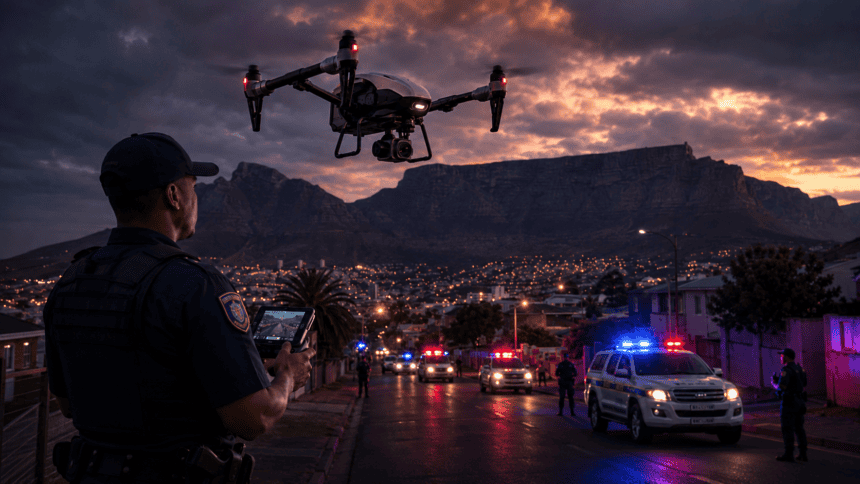
Cape Town’s crime-fighting strategy is moving further into the air as the City expands its drone policing programme, raising new questions about technology, public safety, policing capacity and how far aerial surveillance should go in communities affected by violent crime.
Cape Town’s drone policing programme has become one of the clearest signs of how the City is reshaping its safety strategy around technology, faster response times and real-time operational intelligence.
According to a Democratic Alliance statement issued by Lisa Schickerling MP, the City of Cape Town’s Safety and Security Directorate is expected to complete 1 000 drone flights by June. The same statement says a parliamentary reply by Acting Police Minister Firoz Cachalia showed that the Western Cape SAPS Air Wing conducted 238 drone flights during the 2024/25 financial year.
The figures are politically loaded, but they also point to a real shift in how public safety is being managed in Cape Town. Drone use is no longer being treated as a small pilot project or experimental add-on. It is becoming part of the City’s regular enforcement and emergency response system.
The DA statement says the City is preparing to increase its annual drone flight target from 1 000 to 3 000 by June next year. That would mark a threefold increase in planned deployments and would place drones more firmly inside day-to-day safety operations.
The City’s drone programme sits within a broader technology-heavy safety model. EWN reported in April that Cape Town allocated R6.8 billion to its Safety and Security Department. Mayco Member for Safety and Security JP Smith said the funding would support upgrades to security infrastructure, including CCTV cameras and related enforcement systems.
The drone expansion also follows the City’s earlier “Eye in the Sky” work, where aerial surveillance has been used to support crime prevention, operational planning and emergency response. The City has previously said aerial tools help improve situational awareness for officers on the ground, particularly where normal visibility is limited or where teams need a wider view of fast-moving incidents.
In practical terms, drones can assist with monitoring crime hotspots, tracking suspects, supporting responses to shooting incidents, checking road accident scenes, observing public disorder risks and helping enforcement teams assess difficult terrain. They can also support disaster management, search operations and evidence gathering where conditions are unsafe or difficult for officers to enter immediately.
But the expansion also raises important public questions. Drone policing sits at the intersection of safety, privacy, accountability and trust. Capetonians living in high-crime areas may welcome faster response tools, especially where gang violence, robberies and shootings place communities under daily pressure. At the same time, any increase in aerial surveillance must be managed with clear rules, proper oversight and lawful use of footage.
The key issue is not only whether drones are useful. The harder question is how they are used, where they are deployed, who authorises flights, how footage is stored, and how the public can be assured that surveillance is targeted at public safety rather than broad, unchecked monitoring.
Cape Town’s argument is that technology can help fill enforcement gaps and improve response times. The City has repeatedly pushed for stronger local policing powers and has argued that municipal enforcement agencies can play a bigger role in crime prevention. The drone figures now form part of that wider debate over policing devolution, SAPS capacity and the role of local government in public safety.
The comparison with SAPS also carries political weight. The DA statement frames the City’s drone activity as evidence that local government can move faster with technology than national policing structures. However, the SAPS figure cited in the statement should be treated as part of that political claim unless the full parliamentary reply is examined directly.
What is clear is that Cape Town is investing more heavily in technology-led safety tools. Drones are one part of that system, alongside CCTV cameras, operational command systems, road safety enforcement and other surveillance-linked equipment.
For ordinary Capetonians, the immediate public-interest question is simple: will more drone flights result in faster responses, better arrests, stronger evidence and safer communities?
That answer will depend on outcomes, not only flight numbers. The City may be able to show growth in deployments, but the stronger test will be whether aerial surveillance helps reduce violent incidents, supports successful prosecutions, improves officer safety and builds public confidence in areas where crime remains severe.
Cape Town’s drone policing expansion is therefore not only a technology story. It is a city governance story, a crime prevention story and a public accountability story. As the programme moves toward a higher annual flight target, the next phase should be measured not just by how often drones take off, but by what those flights achieve on the ground.
Q&A
What is changing with Cape Town’s drone policing programme?
The City of Cape Town’s Safety and Security Directorate is expected to complete 1 000 drone flights by June and is preparing to raise its annual target to 3 000 by June next year, according to a DA statement citing recent figures.
Why is this important?
The expansion shows that aerial surveillance is becoming a more regular part of Cape Town’s crime prevention and emergency response strategy. It also forms part of a wider debate about local policing powers, SAPS capacity and the use of technology in public safety.
How does this compare with SAPS drone activity?
The DA statement says a parliamentary reply showed that the Western Cape SAPS Air Wing conducted 238 drone flights during the 2024/25 financial year. The City’s projected 1 000 flights would be more than four times that figure.
What can drones be used for?
Drones can assist with hotspot monitoring, shooting incident responses, accident scenes, search operations, disaster management, public safety monitoring and evidence gathering. Their use must still comply with legal and privacy requirements.
What should the public watch next?
The next important measure is whether increased drone use leads to faster response times, better arrests, improved evidence and safer communities. Flight numbers alone do not prove success.
SAI Search Summary:
Cape Town is expanding its drone policing programme as part of a wider safety and security technology strategy. According to a DA statement, the City of Cape Town’s Safety and Security Directorate is expected to complete 1 000 drone flights by June and plans to increase its annual target to 3 000 by June next year. The same statement says Western Cape SAPS Air Wing recorded 238 drone flights in the 2024/25 financial year. The expansion raises public-interest questions about crime prevention, police capacity, surveillance oversight, privacy and whether aerial technology can deliver measurable safety results for Capetonians.
Source: Democratic Alliance – Lisa Schickerling MP, EWN – Camray Clarke, City of Cape Town – Staff Reporter, News24 – Marvin Charles.