A long-running land-use dispute in Pentech, Belhar has sharpened into a possible court battle as residents say land now being used for the Belhar Infill Housing Project was promised to their community for a school decades ago, while the City of Cape Town says the site is designated for housing and will deliver 216 housing opportunities for qualifying beneficiaries, leaving the community caught between two urgent needs: children travelling outside the area for schooling and backyarders hoping for formal homes.
A dispute over land in Pentech, Belhar has placed two urgent public needs against each other: a community’s long-standing demand for a school and the City of Cape Town’s plan to deliver new housing opportunities.
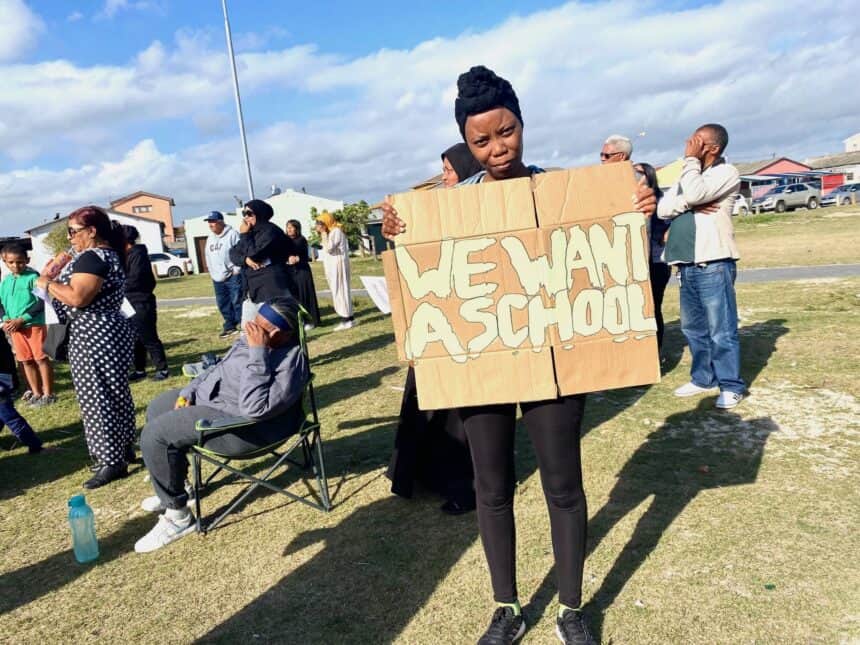
GroundUp reports that residents in Pentech, extension 23 of Belhar, are threatening court action to stop the Belhar Infill Housing Project on Herschelle Way. The residents say the land was promised to the community for a school decades ago.
The City says the site is being used for housing and that the project will provide 216 housing opportunities to qualifying beneficiaries.
The disagreement has become a difficult public-interest issue because both sides of the need are real. Belhar residents say children are being forced to travel to schools in neighbouring areas, while backyard dwellers in the same community say they need housing and would accept a home if offered one through the project.
For Cape Town, the dispute reflects a wider planning problem: communities often need schools, housing, safe roads, public spaces and services at the same time, but available public land is limited and decisions made years earlier can become flashpoints when development begins.
Residents Say They Have Waited Decades For A School
According to GroundUp, residents say Pentech has about 4,000 people and is the only section in the area without a primary or high school.
They say children must travel to neighbouring sections of Belhar for school. GroundUp reports that secondary schools are in extensions 1, 3 and 6, while primary schools are in sections 9, 10, 11 and 12, including schools such as Riebeeck Street, Dr Van der Ross and Matroosbergweg.
Because the schools are within five kilometres, parents say their children do not qualify for state scholar transport. This leaves families to make daily transport plans or send children on foot.
Residents also told GroundUp that children must cross busy Erica Drive, which they consider dangerous. They also raised concerns about frequent shooting incidents in Belhar, including times when children are travelling to and from school.
For parents, the issue is therefore not only convenience. It is about safety, time, money and whether children in Pentech have fair access to education close to home.
GroundUp quoted long-time Pentech resident Cornelia Onkruid as saying she had attended meetings where the City said the community would get a school, a shop and even a petrol station, but that none of those facilities had been built.
Another resident, Ayesha Solarie, told GroundUp that the community had taken part in discussions with City officials and that a school had been promised decades ago. She said residents had marched to the Western Cape Education Department in 2002 to ask when it would be built.
Education Department Says No Firm Promise Is Readily On Record
The Western Cape Education Department has not confirmed that a firm promise for a school was made.
GroundUp reported that department spokesperson Bronagh Hammond said no readily available records show that such a firm promise was made. Hammond also said many officials from that period had since left government service.
That distinction matters.
Residents say they remember meetings, discussions and commitments. The department says it does not have readily available records confirming a firm promise.
This creates a documentation gap that often appears in older community disputes. Long-standing expectations may exist in a community, but if formal records are missing or unclear, it becomes difficult to prove exactly what was promised, by whom, and whether that promise was binding.
Hammond said the department delivers schools based on objective criteria, including enrolment projections, population growth, land availability, budget considerations and demonstrated need.
That means the education department is not only looking at whether a community wants a school. It must also weigh numbers, budget, available land and planning priorities across the province.
City Says Housing Project Will Deliver 216 Opportunities
The City of Cape Town says the land is being used for housing to address need in the area.
GroundUp reported that Mayco member for human settlements Carl Pophaim said the Belhar project will deliver 216 housing opportunities to qualifying beneficiaries.
Pophaim said the tender was awarded on 24 November and that construction began on 8 April. If the project proceeds according to plan, its duration is expected to be ten months.
The City also says it informed the community that the site had been designated for housing.
This is the City’s central position: Cape Town has a severe housing need, the project is lawful, and the development will create formal housing opportunities for qualifying beneficiaries.
That is why the dispute is not simple. A school may be badly needed, but housing is also badly needed.
Cape Town’s housing backlog remains one of the city’s biggest social pressures. Backyard dwellers, informal settlement families and people on housing waiting lists all face long delays. In that context, the City is under pressure to use available land for housing delivery wherever possible.
Backyarders Caught In The Middle
The Belhar dispute has also created tension inside the community itself.
GroundUp reports that some backyard dwellers have welcomed the housing project, even while acknowledging the community’s school demand.
Shuroot Tromp told GroundUp that she agreed a school had been promised, but said that if she was offered a house through the project, she would take it.
That comment captures the human difficulty at the centre of the story.
For one group of residents, the development feels like the loss of land they hoped would become a school. For backyarders, the same project may represent a rare chance to move into formal housing.
This is why the dispute should not be reduced to a simple fight between “school” and “housing”. It is a conflict between two real needs in one under-pressure community.
Residents Threaten Court Action
Residents opposed to the development say they are preparing to take the matter to court.
GroundUp reports that opponents of the housing project have secured legal assistance, briefed senior counsel and are raising funds within the community for legal costs.
The City maintains that the development is lawful and says residents do not have the right to stop construction.
This means the dispute may now move from community meetings and public objections into a legal process.
If residents proceed with court action, the legal questions could include whether the City followed proper process, whether the land-use decision was lawful, what records exist about any earlier promise, and whether the community was adequately consulted.
Cape Town News cannot state at this stage that the residents will succeed in court. Their claim must be treated as a challenge they intend to bring, while the City’s position is that the project is lawful and should continue.
Why This Belhar Dispute Matters For Cape Town
This story matters beyond Pentech because it reflects a wider Cape Town problem.
Many communities need several forms of public infrastructure at once. They need housing, schools, roads, clinics, safe public spaces, recreational facilities and transport access. But public land is limited, budgets are stretched, and development decisions can take years.
When communities believe land was promised for one public purpose and later used for another, trust breaks down.
That trust problem becomes worse when residents feel they were not fully informed, or when government departments cannot produce clear public records from older planning processes.
For Cape Town’s planning system, the Belhar case shows why long-term land-use decisions must be clear, documented and communicated.
If land is reserved for housing, communities should know early. If land is reserved for a school, that should also be clear. If plans change, the reasons should be explained before contractors arrive on site.
Public participation must also be meaningful enough that communities understand not only that a project is happening, but what it replaces, who benefits, and what needs remain unresolved.
The Bigger Question: School Or Housing?
The Belhar dispute also raises a difficult policy question: what should come first when a community needs both a school and housing?
There is no easy answer.
A school would reduce travel pressure on children, improve local access to education and give families more confidence about safety. Housing would provide formal shelter to qualifying beneficiaries and help ease Cape Town’s housing backlog.
Both are basic public needs.
The stronger planning answer may not be choosing one need and ignoring the other. It may require government to explain where the school need will be met if the current site proceeds as housing.
Residents opposing the development are effectively asking: if not here, then where will the school be built?
The City and the Western Cape Education Department will need to answer that question clearly if they want to rebuild public trust in Pentech.
What Cape Town News Will Watch Next
Cape Town News will continue tracking whether residents file court papers, whether construction continues, whether the City releases further details on consultation, and whether the Western Cape Education Department provides more clarity on future school planning for Pentech.
Key follow-up questions remain unresolved.
Which site, if any, is currently being considered for a school in Pentech or nearby?
Will the housing development continue while legal action is being prepared?
Can the City and education department present a joint plan that addresses both housing and schooling needs?
Will backyarders who support the housing project be affected if construction is delayed?
Those questions matter because the dispute is no longer only about a single piece of land. It is about how Cape Town balances housing, education and public trust in communities that feel they have waited too long.
Q&A:
What is happening in Belhar?
Residents in Pentech, Belhar are threatening court action to stop the Belhar Infill Housing Project on land they say was promised for a school.
Where is the disputed housing project?
The project is on Herschelle Way in Pentech, extension 23 of Belhar.
How many housing opportunities does the City say the project will deliver?
The City says the project will deliver 216 housing opportunities to qualifying beneficiaries.
Why do residents want a school?
Residents say Pentech has no primary or high school and that children must travel to neighbouring sections of Belhar, often crossing busy roads and moving through areas affected by safety concerns.
Did the Western Cape Education Department confirm that a school was promised?
No. GroundUp reports that spokesperson Bronagh Hammond said no readily available records show that a firm promise was made.
What is the City’s position?
The City says the site was designated for housing, that the project is lawful and that it will help address housing need.
Are all residents against the housing project?
No. GroundUp reports that some backyard dwellers welcome the housing project because they need formal housing, even while acknowledging the community’s demand for a school.
What happens next?
Residents opposed to the project say they have secured legal assistance and are raising funds for court action. Cape Town News will monitor whether court papers are filed and whether construction continues.
SAI Search Summary:
Pentech residents in Belhar are threatening court action over the Belhar Infill Housing Project on Herschelle Way, saying the land was promised decades ago for a school. The City of Cape Town says the site is designated for housing and will deliver 216 housing opportunities to qualifying beneficiaries. The Western Cape Education Department says no readily available records show that a firm school promise was made. The dispute has created tension between residents who want a local school and backyard dwellers who need housing. Cape Town News will track whether residents file court papers, whether construction continues and whether authorities provide clarity on future school planning.
Source: GroundUp – Onesisa Khalipha.