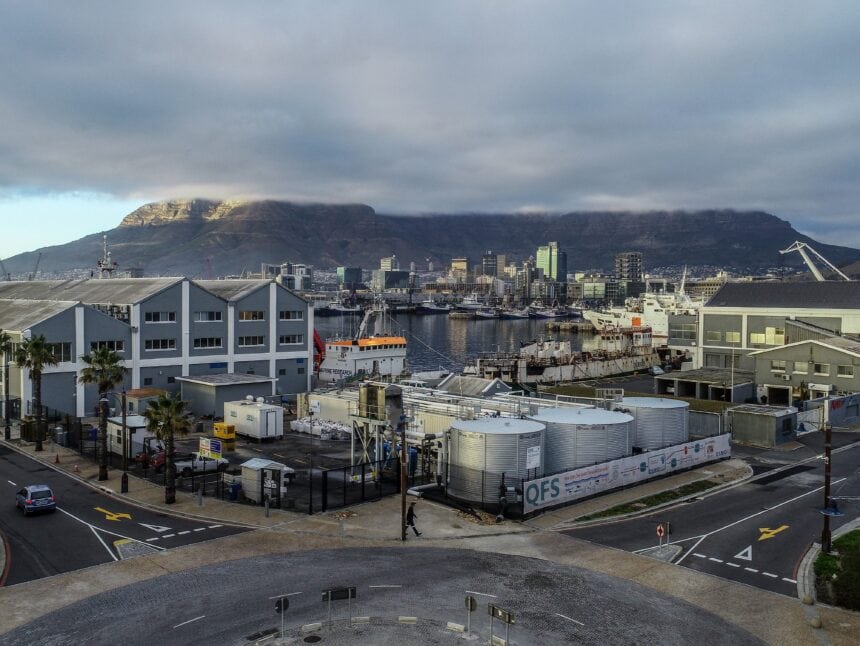
Cape Town’s proposed R5 billion Paarden Eiland desalination plant is meant to protect the city from future droughts, but the project is now raising sharp questions over water tariffs, household affordability and long-term public-private payment obligations, with City Mayco Member Zahid Badroodien saying the plant forms part of Cape Town’s plan to diversify water supply, while ratepayer groups, political voices and civic activists warn that Capetonians need clearer answers on how much desalinated water will cost, who will carry the financial risk, and whether future water bills will rise once the project moves from planning into procurement and eventual operation.
Cape Town’s proposed R5 billion desalination plant at Paarden Eiland has moved from technical planning into public concern, as questions grow over what the project could mean for water tariffs and household costs.
The City of Cape Town says the project is part of its long-term water security plan. The concern from ratepayers and some political voices is more direct: if desalinated water is expensive to produce, Capetonians want to know how much of that cost will eventually appear on their municipal accounts.
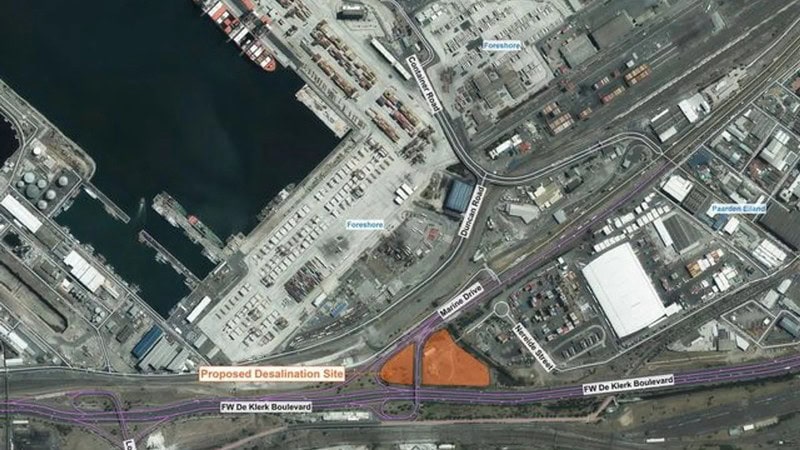
The proposed permanent plant is planned for Paarden Eiland and is expected to produce between 50 million and 70 million litres of drinking water per day. It would use seawater reverse osmosis technology to convert seawater into potable water and would form part of the City’s wider plan to add new water sources beyond rainfall-dependent dams.
City Mayco Member for Water and Sanitation Zahid Badroodien has said the plant is still in its preparation phase, with water delivery expected in the mid-2030s. He said the project forms part of Cape Town’s broader New Water Programme, which aims to diversify supply through desalination, water reuse, groundwater extraction and the clearing of invasive alien plants.
Badroodien has also said the City’s long-term aim is to add about 300 million litres of water per day from diversified sources. That target sits at the heart of the City’s post-Day Zero water strategy. The City argues that Cape Town cannot rely only on rain-fed dams when climate patterns are shifting, population growth continues and future drought risk remains real.
The City’s official public participation material describes the planned Paarden Eiland plant as a 50 to 70 million litre per day facility that forms part of the City’s water augmentation projects under its Water Strategy. The project has also been linked to an external service delivery mechanism, meaning the City is exploring how the plant could be delivered through a long-term partnership model.
According to reporting by Smart Water Magazine, the City is proposing a 20-year public-private partnership model in which a private partner would design, finance, build, operate and maintain the plant before transferring it to municipal ownership. The same report placed the project cost at about R5 billion.
That model is now one of the central points of concern.
A public-private partnership may reduce the immediate burden on the City’s capital budget, but it does not remove the cost. Someone still pays. The question is whether the long-term cost will be recovered through water tariffs, availability payments, municipal revenue, borrowing, or a mix of these mechanisms.
Cape Argus, carried by IOL, reported that residents and political parties have raised concerns over the project because of possible implications for water tariffs. The article also reported that previous temporary desalination plants at Strandfontein and Monwabisi, which were later decommissioned, had given the City operational lessons for future projects.
Those earlier temporary plants remain part of the public memory. During the Day Zero crisis, emergency desalination projects formed part of Cape Town’s response to a possible water supply collapse. But several Capetonians still associate those schemes with cost concerns, rushed procurement pressure and questions over value.
The Paarden Eiland proposal is different because it is intended as a permanent plant. That makes the public interest larger, not smaller. A permanent plant could become part of Cape Town’s water system for decades, with long-term operating, maintenance, energy and finance costs.
Sandra Dickson, founder of STOP COCT, told the Cape Argus that in-principle approval does not mean the plant has been built, that water is about to come online, or that a final contract has been awarded. Her concern is that this is exactly the stage where public scrutiny should increase, because the City is moving into the procurement and public-private partnership phase.
That is a key point. The public debate is not only about whether Cape Town needs water security. Most people accept that it does. The debate is about the price, the funding model and the effect on municipal accounts.
Dickson said Cape Town does need long-term water security, but warned that residents must understand the financial side of the project. A major infrastructure project delivered through a long-term private partnership can create payment obligations over many years. Those obligations may not always be visible to the public at the start, but they can shape tariffs and budgets later.
CAPEXIT councillor Karl Bodin also raised concerns in the Cape Argus report. He said his party had opposed water reuse projects when they came before Council and raised concerns over possible health risks. He also warned that annual water bill increases of 6% to 8% could financially overburden ratepayers.
Strandfontein Ratepayers Association member and United South Africa leader Riyad Isaac questioned why ratepayers were being asked to carry costs for a project that had not yet materialised, especially while tariffs were already rising.
The City’s position is that water security carries a cost, but water insecurity carries a cost too. A future drought could damage households, industry, tourism, construction, food supply, jobs and investor confidence. Cape Town has already lived through one severe water crisis. The City is trying to avoid being caught in that position again.
That argument has weight. But it does not remove the need for tariff honesty.
Previous IOL and Cape Times reporting on the Paarden Eiland plant referred to feasibility work indicating that the project could lead to a significant increase in water tariffs once operational. That earlier reporting also said the plant could significantly increase water bills within the first two years of operating.
That is why the public now needs a clearer answer.
How much will desalinated water cost per kilolitre? How does that compare with water reuse, groundwater, dam supply, leak reduction and demand management? How much of the cost will be fixed, even in years when dam levels are healthy? What happens if energy prices rise? What happens if construction costs increase? What risk sits with the private partner, and what risk remains with the City?
Energy is one of the biggest questions. Desalination is power-intensive. A plant that runs for decades will not only have a construction cost, but also a lifetime operating cost. Electricity supply, energy pricing and backup power planning all become part of the real cost of water.
Environmental questions also remain relevant. Desalination plants take in seawater and discharge brine back into the marine environment. The City will have to show how intake systems, brine disposal, marine monitoring and environmental approvals will be managed. For a coastal city, the environmental case cannot be treated as a minor technical detail.
The City can point to the need for resilience. Ratepayers can point to affordability. Both are valid.
Cape Town needs secure water. But Capetonians also need municipal bills they can afford. A water security project that protects the city from drought but pushes tariffs beyond the reach of ordinary households would create another kind of crisis.
The project also arrives during a period of wider cost pressure. Households are already dealing with electricity increases, food inflation, transport costs and municipal tariffs. Even middle-income households are watching service charges more closely. Lower-income households are under still greater pressure.
That is why the Paarden Eiland plant now needs more than technical explanation. It needs plain public accounting.
The City should clearly publish the expected capital cost, operating cost, cost per kilolitre, tariff impact, procurement timeline, risk allocation, public-private partnership terms, environmental safeguards and affordability protections. It should also explain how indigent households and low-consumption households would be protected if tariffs rise.
Cape Town’s water future cannot be built on slogans. It must be built on numbers the public can understand.
The City is right to plan beyond dams. Day Zero proved that waiting too long is dangerous. But ratepayers are also right to ask whether R5 billion is affordable, whether desalination is the best value option, and whether the financial model will lock Capetonians into higher water costs for years.
This is not a simple yes-or-no debate.
The Paarden Eiland desalination plant may become an important part of Cape Town’s water future. But before it does, the City must prove that the project is not only technically possible, but financially fair, environmentally responsible and publicly transparent.
For now, the project promises water security. The question is what that security will cost.
Q&A:
What is the Paarden Eiland desalination project?
It is a proposed permanent seawater desalination plant in Cape Town that would convert seawater into drinking water using reverse osmosis technology.
How much is the project expected to cost?
The project has been reported as a roughly R5 billion proposal.
How much water could the plant produce?
The planned plant is expected to produce between 50 million and 70 million litres of drinking water per day.
What has the City said?
City Mayco Member Zahid Badroodien has said the project forms part of Cape Town’s wider water diversification plan and the City’s New Water Programme, which aims to add about 300 million litres per day from alternative water sources.
Why are ratepayers concerned?
The main concern is that desalinated water is expensive to build and operate, which could place pressure on future water tariffs.
What must still be clarified?
Capetonians need clearer information on the cost per kilolitre, tariff impact, procurement model, energy cost, environmental safeguards and long-term payment obligations.
SAI Search Summary:
Cape Town’s proposed R5 billion Paarden Eiland desalination plant is raising questions over water tariffs and affordability. The City of Cape Town says the plant forms part of its New Water Programme and wider plan to add about 300 million litres per day from diversified sources, including desalination, water reuse and groundwater. The planned plant could produce between 50 million and 70 million litres of drinking water per day. City Mayco Member Zahid Badroodien has linked the project to long-term water security, while ratepayer and political voices have warned that Capetonians need clearer answers on costs, tariff impact and public-private partnership obligations.
Source: IOL / Cape Argus – Staff Reporter; City of Cape Town – Media Office; Smart Water Magazine – Staff Reporter; Cape Times – Theolin Tembo.