For years, Cape Town residents have complained about late-night racing, spinning, revving engines, and heavily modified vehicles turning quiet suburbs, industrial areas, and public parking zones into unofficial racing circuits. Complaints have flooded community groups, ward councillors, and law enforcement channels, often with the same frustration, fines alone were not working. Now, the City of Cape Town appears to be changing the rules of the game, and for illegal racers, the consequences could become far more expensive than a simple traffic ticket.
A major shift in Cape Town’s traffic enforcement strategy officially came into effect this weekend, after the City activated a new traffic by-law aimed directly at illegal street racing, reckless driving, spinning, and serious noise violations caused by excessively modified vehicles.
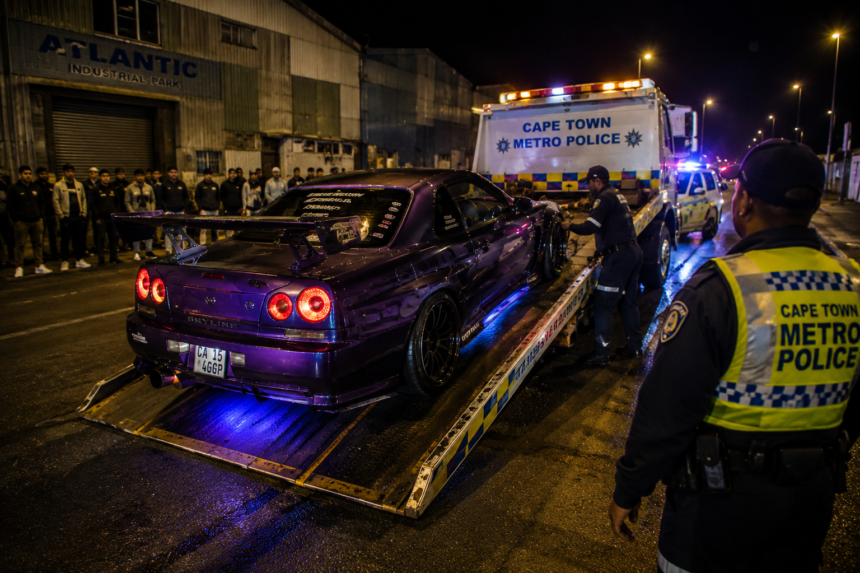
The updated regulations now give city enforcement officers stronger powers to immediately impound vehicles linked to dangerous road behaviour, a move many communities have been calling for after years of repeated complaints and late-night disruptions.
Unlike previous enforcement operations, where offenders were often issued fines under national road traffic legislation before being allowed to drive away, the new by-law introduces the possibility of offenders losing access to their vehicles altogether while investigations and enforcement processes continue.
That change alone could dramatically alter the behaviour of repeat offenders, particularly within the modified car scene where performance upgrades, custom exhaust systems, and social media-driven gatherings have become increasingly visible across parts of the metro.
The City says the move is designed to give officers stronger tools to act faster and more decisively, especially as illegal gatherings often relocate within minutes of law enforcement arriving.
Public frustration over street racing has been building for years.
Across Cape Town, residents living near industrial zones, retail parking areas, and long open stretches of road have repeatedly raised concerns over engine revving, spinning demonstrations, excessive tyre noise, and dangerous speeds, particularly during weekends and public holidays.
Many community members have also questioned whether financial penalties alone were doing enough to stop repeat offenders from returning.
That question now appears to have triggered a more aggressive response.
Mayoral Committee Member for Safety and Security, JP Smith, confirmed on social media that the first vehicles have already been seized under the newly activated regulations.
While city officials have not yet released exact seizure numbers, Smith’s announcement signals that enforcement has already moved beyond warnings and into direct action.
The development is being welcomed by many Cape Town residents who have long argued that street racing is no longer simply a traffic issue, but a wider public safety concern.
Beyond the noise, illegal racing events have increasingly raised concerns about pedestrian safety, property damage, blocked access routes, and the risks posed to ordinary motorists sharing public roads.
At the same time, some online reaction has questioned whether enforcement will remain consistent across all suburbs, or whether drivers may simply shift gatherings to quieter industrial areas away from residential complaints.
For city officials, however, the message appears clear, Cape Town’s latest traffic crackdown is designed to make dangerous driving far more costly than ever before, and for some motorists, the next race could end not with a fine, but with an empty parking space.
Source: Cape {town} Etc – Staff Reporter.