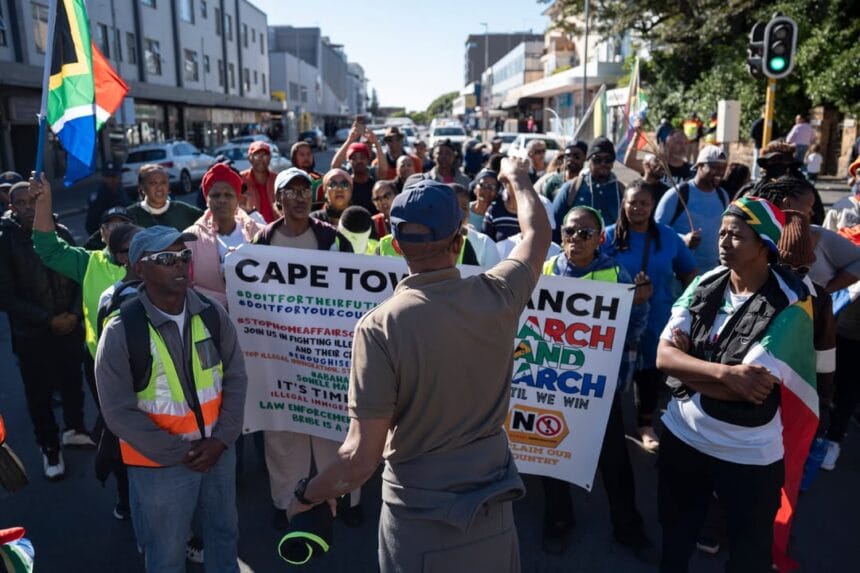
Cape Town: More than 500 immigrant traders across Cape Town plan to close their businesses and remain indoors on Tuesday after reported threats, forced document checks and warnings that shops could be attacked ahead of the controversial 30th of June anti-immigration deadline. The planned Cape Town immigrant traders shutdown is expected to affect commercial areas in Bellville and Mitchells Plain, where foreign nationals say they fear violence despite police assurances that law-enforcement agencies are on high alert and will protect lives, property and freedom of movement.
The planned stay-away marks a new stage in the immigration dispute that has spread across Cape Town and other parts of the Western Cape during recent weeks. Earlier demonstrations and threats focused mainly on demands for undocumented foreign nationals to leave South Africa, but the campaign is now beginning to affect daily trade, employment and access to local services.
News24 reported that immigrant traders working around the Bellville minibus taxi rank and Mitchells Plain Town Centre intend to close their businesses because they believe opening on Tuesday could expose them, their employees and their families to danger. Some traders have lived legally in South Africa for decades, yet say the atmosphere surrounding the approaching deadline has left them fearing that documented and undocumented immigrants could be targeted without distinction.
The shutdown is not being organised as a political strike. Traders describe it as a protective measure taken by people who believe the risk of violence outweighs the income they may lose by remaining closed.
Foreign traders in Mitchells Plain told News24 that they had been threatened with beatings, instructed by private citizens to produce immigration documents and warned that their shops could be burnt. Several said they had become increasingly nervous while working in public trading areas, despite operating near police facilities and busy transport routes.
About 150 foreign nationals met senior Mitchells Plain police officials on Tuesday to raise their concerns. Police reportedly assured those attending that their safety remained a priority and urged them to report threats, intimidation or criminal conduct immediately. Officers also indicated that people who believed they were in imminent danger could seek shelter at the police station.
The meeting shows that the concern has moved beyond social-media speculation. Traders are now changing their business plans, considering the safety of employees and preparing their families for possible unrest.
For many small businesses, closing for a full day carries a serious financial cost. Informal traders and independent shopkeepers often depend on daily turnover to replace stock, meet rental payments and pay workers. A shutdown could therefore affect not only business owners but also employees and the Capetonians who rely on local shops for food, household goods, repairs and other services.
Bellville and Mitchells Plain are among Cape Town’s busiest commercial and transport areas. Formal shops, informal stalls, taxi services and community facilities operate close together, meaning even limited closures could disrupt trading patterns and reduce access to services.
Western Cape police commissioner Lieutenant-General Thembisile Patekile has said law-enforcement agencies will not permit intimidation, violence or unlawful interference with freedom of movement. Police remain on high alert and have mobilised resources from the South African Police Service and other enforcement agencies ahead of Tuesday.
Patekile said police had not identified confirmed protest blockades or specific Cape Town hotspots at the time of the latest briefing. However, authorities continue to monitor areas where tensions could develop and have instructed police station commanders to remain in contact with community leaders and local organisations.
Police have monitored 27 anti-immigration marches across the Western Cape since the 27th of May. Twenty-one were peaceful, while six were affected by violence. Eight people were arrested on charges including public violence, assault and incitement to commit violence.
The province’s recent experience has heightened fears among traders. Two Mozambican nationals were killed during anti-immigrant unrest in Mossel Bay, while families were displaced during earlier violence in parts of the Overberg. These incidents have reinforced concerns that threatened action on Tuesday could target people regardless of their legal immigration status.
Patekile warned that police would enforce the law if anyone’s life or freedom of movement were threatened. He also said people participating in demonstrations would not be permitted to conceal their identities, as officers must be able to identify those involved in public protest action.
Immigration attorney Ijaaz Achmat told News24 that the so-called 30th of June deadline has no legal standing. No government deadline comes into effect on Tuesday, and no person’s immigration status changes automatically on that date.
Immigration enforcement remains the responsibility of authorised officials acting under South African law. Private citizens may not stop people and demand passports, work permits or other immigration documents. They may also not search businesses, remove workers or assume the powers of Home Affairs and the police.
Achmat said many legally documented immigrants remain fearful because attackers may not distinguish between people who have valid papers and those who do not. He said his clients were particularly concerned about intimidation, looting, attacks on businesses and wider unrest.
The attorney also warned about misinformation claiming that employers would automatically face new penalties of up to R100,000 for each undocumented employee from Tuesday. While employers remain responsible for making genuine efforts to ensure that foreign employees are legally entitled to work, no new law imposing those automatic penalties comes into operation on the 30th of June.
Some foreign nationals have also reported attempted extortion. According to Achmat, individuals have allegedly been threatened with harm or being reported to the authorities unless they pay money. Some victims are reluctant to report these incidents because they fear their complaints may not be treated fairly.
This creates a further challenge for police. Effective law enforcement depends on threatened people reporting crimes, supplying evidence and identifying those responsible. A lack of trust can allow intimidation and extortion to continue without intervention.
The planned Cape Town immigrant traders shutdown could also damage the city’s wider business reputation. Cape Town depends heavily on tourism, regional trade, international investment and skilled workers. Violence, forced document checks or attacks on small businesses would undermine the city’s efforts to present itself as a safe and open commercial centre.
Concerns about undocumented immigration, employment and pressure on public services remain legitimate subjects for public discussion. However, these issues must be handled through lawful immigration enforcement, labour inspections, border management and government policy.
Capetonians may campaign for changes, raise concerns and participate in peaceful protests. They may not threaten traders, burn businesses, demand payment or conduct immigration raids themselves.
Tuesday will test whether police assurances are strong enough to prevent intimidation and whether immigrant traders feel safe enough to reopen after the threatened deadline. For hundreds of business owners, the central question is no longer whether Tuesday is legally a normal working day. It is whether opening their doors will place them and their workers in danger.
Cape Town News will continue monitoring police deployments, planned demonstrations, transport disruptions and business closures as Tuesday approaches.
Q&A
Why are Cape Town immigrant traders planning to close?
More than 500 immigrants reportedly plan to remain indoors because they fear violence, intimidation, forced document checks and attacks on their businesses.
Which parts of Cape Town could be affected?
Traders in Bellville and Mitchells Plain have confirmed concerns, although the full extent of possible closures across Cape Town remains unclear.
Is the 30th of June deadline legally binding?
No. It was announced by campaigners and has no automatic force under South African immigration law.
Can members of the public demand immigration documents?
No. Immigration checks may only be conducted by authorised officials acting within their legal powers.
What have Western Cape police said?
Police say they are on high alert and will act against violence, intimidation, public disorder and interference with freedom of movement.
SAI Search Summary
More than 500 immigrant traders across Cape Town plan to close their businesses and remain indoors on Tuesday because of fears linked to the controversial 30th of June anti-immigration deadline. Traders in Bellville and Mitchells Plain have reported threats, forced document demands and warnings that shops could be attacked. Western Cape police say officers are on high alert and will not tolerate violence or intimidation. Immigration lawyers say the deadline has no legal force and private citizens may not conduct immigration checks.
Source Credits: News24, Lisalee Solomons; Western Cape SAPS, Lieutenant-General Thembisile Patekile; Ashmodien Attorneys Inc, Ijaaz Achmat