Cape Town: Cape Town foreign property purchases have come under renewed scrutiny after a Daily Maverick investigation found overseas-linked Airbnb hosts advertising modest flats as well as expensive homes, challenging the argument that foreign money affects only the city’s luxury property market. The analysis tested Mayor Geordin Hill-Lewis’s claim that foreign demand is concentrated along the Atlantic Seaboard and in wealthy parts of the Helderberg, raising broader questions about whether international buyers and short-term rentals are placing pressure on homes that local tenants and first-time buyers might otherwise afford.
Airbnb Data Challenges Luxury-Only Argument
The investigation enters one of Cape Town’s most divisive housing debates: whether overseas buyers are merely purchasing expensive homes beyond the reach of most Capetonians or whether foreign investment is also influencing ordinary apartments and rental neighbourhoods.
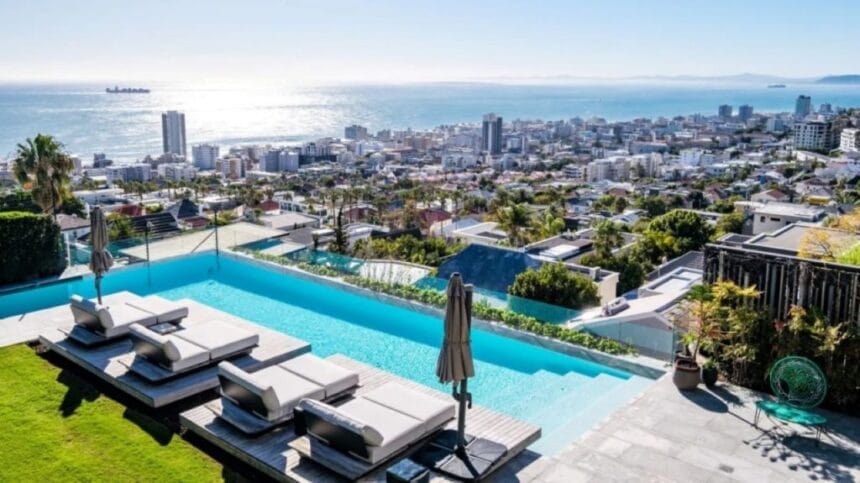
Hill-Lewis has previously argued that foreign buyers should not be treated as the main villains in Cape Town’s affordability crisis. In an opinion article published in December, he said overseas demand was overwhelmingly concentrated in luxury neighbourhoods along the Atlantic Seaboard and in parts of the Helderberg.
His argument was that foreign purchasers mainly push up prices at the top end of the market and have a limited direct effect on homes sought by most working Capetonians.
Daily Maverick tested that claim by analysing publicly available Airbnb information. The investigation found overseas-linked hosts offering comparatively modest apartments, suggesting that foreign involvement in Cape Town’s short-term rental market may extend beyond multimillion-rand villas and exclusive coastal estates.
Foreign Purchases Have Increased Since The Pandemic
Foreign buyers accounted for approximately 2.5% of Cape Town property purchases in 2020, according to figures cited by Hill-Lewis. That share reportedly rose to 4.3% between 2020 and 2024.
The percentage remains a minority of the overall market. However, the increase has attracted attention because foreign purchasers often enter the market with earnings, savings or access to finance denominated in stronger currencies such as pounds, euros and dollars.
That buying power can place overseas purchasers in a stronger position than South Africans earning in rand, particularly when sellers receive cash offers or when buyers are able to borrow at lower interest rates in their home countries.
The effect is not determined only by the number of foreign transactions. It also depends on where those purchases occur, the prices paid and whether the homes remain part of Cape Town’s long-term residential market.
A foreign buyer purchasing a holiday home used for several weeks each year has a different effect from an investor converting multiple flats into permanent short-term accommodation.
Modest Flats Raise Wider Housing Questions
The most significant finding in the Daily Maverick investigation is that overseas-linked Airbnb activity does not appear to be limited exclusively to luxury homes.
Listings connected to foreign hosts reportedly included ordinary flats that could fall within the market considered by local tenants, young professionals and some first-time buyers.
This does not prove that foreign buyers dominate those markets. It does, however, weaken the idea that their influence can be confined neatly to mountain estates, beachfront mansions and properties already beyond the reach of most Capetonians.
When a modest apartment is operated as short-term accommodation, it may no longer be available to a local household seeking a one-year lease. If enough properties are removed from the long-term market, the remaining supply becomes tighter and competition among tenants increases.
Cape Town’s housing crisis has several causes, including population growth, migration from other provinces, slow housing delivery, limited available land, construction costs and infrastructure constraints. Foreign investment and Airbnb cannot be treated as the only reasons for rising prices.
However, the investigation suggests that they may form part of the pressure affecting sections of the market below the ultra-luxury level.
Host Nationality Does Not Always Prove Ownership
Airbnb data must be interpreted carefully. A host whose profile indicates that they live overseas is not automatically the legal owner of the property being advertised.
The host could be a property manager, rental agent, family member or employee operating the listing on behalf of a South African owner. A locally owned apartment may also be managed through an international account or foreign-based company.
Similarly, a foreign owner may employ a Cape Town management business, causing the Airbnb profile to appear local.
The data therefore provides evidence of overseas-linked hosting activity, but it cannot on its own establish the nationality of every registered property owner.
A proper assessment would require Airbnb listing information to be matched against municipal valuation records, deeds-office information, company registrations and other ownership records.
The distinction is important because inaccurate conclusions could exaggerate the extent of foreign ownership or wrongly identify locally owned properties as overseas investments.
Entire Homes Dominate Cape Town’s Airbnb Market
Separate research based on Inside Airbnb data has estimated that Cape Town has more than 26,000 Airbnb listings, with more than 80% advertised as entire homes rather than individual rooms.
This matters because renting out a spare room while the owner remains in the property has a different housing impact from converting an entire flat or house into full-time visitor accommodation.
A high proportion of entire-home listings suggests that a substantial part of the short-term rental market operates as commercial accommodation rather than occasional home sharing.
Cape Town has already moved towards treating properties used primarily for short-term accommodation as commercial operations for municipal-rating purposes.
The City has argued that this is not a new Airbnb tax but an effort to enforce existing rules requiring commercial accommodation businesses to pay commercial property rates.
The rates approach may improve fairness between hotels, guest houses and short-term rental operators. It does not automatically return properties to the long-term rental market, because owners may absorb the additional cost or pass it on to visitors.
Foreign Buyers Are Not The Only Pressure
Cape Town’s rapid property inflation cannot be attributed to a single group.
The city attracts buyers and tenants from other South African provinces, retirees, remote workers, digital nomads, international investors and families relocating for employment, schools or lifestyle reasons.
At the same time, housing construction has not kept pace with demand in every part of the city. Infrastructure capacity, planning approvals, land prices and building costs restrict how quickly new homes can be added.
Hill-Lewis is therefore correct that blaming foreign buyers alone would oversimplify a much larger structural problem.
However, the Daily Maverick findings suggest that the opposite position may also be too simple. Foreign investment cannot automatically be dismissed as irrelevant to ordinary housing merely because many international buyers purchase luxury homes.
The effect must be examined neighbourhood by neighbourhood and property type by property type.
Affordability Debate Reaches Middle-Income Households
Cape Town’s housing crisis has long affected low-income households living in informal settlements or waiting for subsidised housing. Rising prices and rents are now also affecting middle-income Capetonians who previously expected to rent or buy near their workplaces.
Young professionals, teachers, nurses, police officers and service-sector workers increasingly report being priced out of established areas and forced to travel longer distances.
When ordinary apartments are purchased as investments and converted into visitor accommodation, the debate shifts from who can afford a luxury villa to whether locally employed people can remain in well-located neighbourhoods.
This has implications for traffic congestion, public transport, workforce stability and the social character of communities.
The issue is therefore not simply whether foreigners should be permitted to buy property. South African law currently allows foreign nationals to own fixed property, subject to normal legal and financial requirements.
The policy question is whether Cape Town has sufficient tools to distinguish genuine home sharing from commercial short-term letting and to prevent tourism demand from overwhelming residential supply in vulnerable areas.
Better Ownership Data Is Needed
The investigation exposes a major information gap. Public debate often relies on estate-agency sales figures, Airbnb listings and anecdotal reports, but these sources do not provide a complete picture of foreign ownership.
The City has access to property-rates information, while ownership details are recorded through the Deeds Office. National government also controls immigration and financial regulations.
A more reliable assessment would examine:
The number and value of foreign-owned properties
The suburbs and price bands where purchases occur
How many foreign-owned homes are used for short-term rentals
How many entire homes are operated by multi-property hosts
The number of units removed from long-term rental stock
Whether new rates and regulations change owner behaviour
Without this information, both sides of the debate can select figures that support their positions.
Those who blame foreign buyers may overstate their share of the market, while those defending foreign investment may understate its effect in individual neighbourhoods.
Regulation Must Protect Housing Without Discouraging Investment
Foreign investment brings benefits to Cape Town. Property purchases generate transfer duties, professional fees, renovation work, tourism spending and municipal revenue. International buyers can also support construction and development.
Poorly designed restrictions could discourage investment without solving the underlying shortage of housing.
At the same time, a city cannot ignore the effect of residential properties being converted into year-round tourism businesses while local workers struggle to find homes.
Possible measures include stronger registration of short-term rentals, clearer zoning rules, accurate commercial rates, limits on entire-home listings in heavily affected areas and greater incentives for long-term rental development.
Any policy response should be based on verified ownership and usage data rather than assumptions about nationality.
The aim should not be to treat every foreign purchaser as a threat. It should be to ensure that tourism and investment do not steadily remove well-located housing from the people who live and work in Cape Town.
Debate Is Far From Settled
The Daily Maverick investigation does not prove that foreign buyers caused Cape Town’s affordability crisis. It does show that overseas-linked Airbnb activity may reach further into the housing market than the luxury-only argument suggests.
The findings add pressure for the City to release more detailed information about foreign ownership, short-term rental concentration and the neighbourhoods most affected by the loss of long-term housing stock.
Cape Town’s property market remains attractive because the city offers natural beauty, services, investment potential and a lifestyle valued by local and international buyers.
The unresolved question is how Cape Town can preserve those advantages without allowing ordinary Capetonians to be priced out of their own communities.
Q&A
What did the Daily Maverick investigation find?
It found overseas-linked Airbnb hosts advertising modest Cape Town flats as well as luxury properties, challenging claims that foreign investment affects only the top end of the market.
How many Cape Town property purchases involve foreign buyers?
Figures cited by Mayor Geordin Hill-Lewis indicate that foreign buyers accounted for 4.3% of purchases between 2020 and 2024, up from 2.5% in 2020.
Does an overseas Airbnb host always own the property?
No. A host may be a property manager, rental agent or other representative. Airbnb data alone cannot confirm legal ownership.
Are foreign buyers responsible for Cape Town’s housing crisis?
They are one possible source of pressure, but the crisis also involves population growth, semigration, limited supply, high construction costs, infrastructure constraints and short-term rentals operated by South Africans.
Can foreign nationals legally buy Cape Town property?
Yes. Foreign nationals may generally purchase and own South African property, subject to the usual legal, tax and financial requirements.
SAI Search Summary
A Daily Maverick investigation has challenged claims that Cape Town foreign property purchases affect only the luxury market. Its analysis found overseas-linked Airbnb hosts advertising modest flats as well as expensive homes. Foreign buyers accounted for 4.3% of Cape Town property purchases between 2020 and 2024, up from 2.5%. The findings do not prove that every overseas host owns the listed property, but they raise questions about foreign investment, short-term rentals and pressure on ordinary housing stock.
Source Credits: Daily Maverick, Rebecca Davis; City of Cape Town, Mayor Geordin Hill-Lewis; Inside Airbnb, Staff Researchers