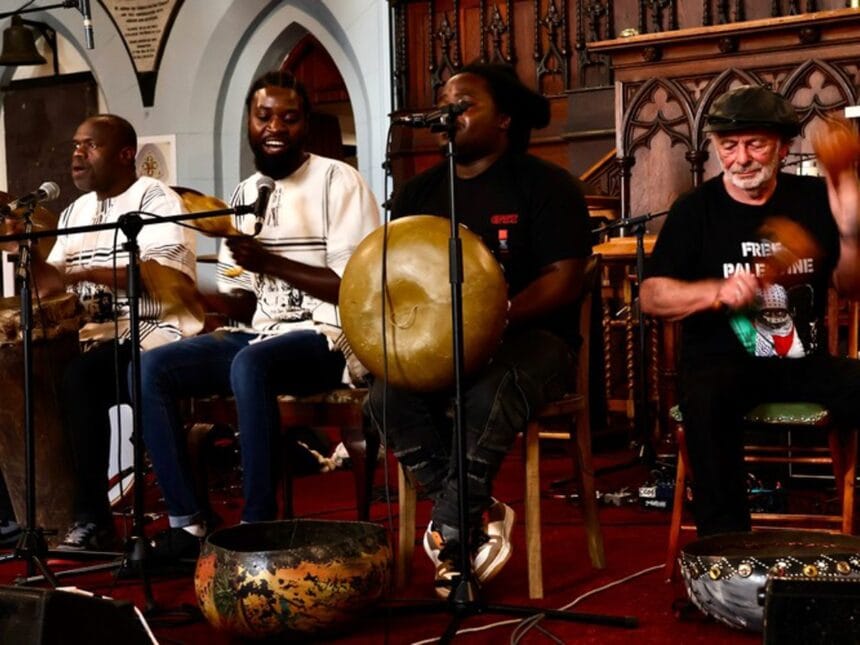
Cape Town: Musicians, poets and activists from Zimbabwe, Malawi, Zambia, Eswatini, Cameroon and South Africa gathered at the Central Methodist Mission Church for a free World Refugee Day concert rejecting Afrophobia and violence against migrants. Organised by the Ad Hoc Committee for Organising Musicians, the event used music, poetry and public testimony to challenge the growing hostility facing African immigrants, with performers warning that migrants were being blamed for unemployment and collapsing public services they did not create.
Artists Turn Stage Into A Call For Solidarity
Calls of “Phantsi, Afrophobia, phantsi” filled the Central Methodist Mission Church as artists from across the continent transformed a free Cape Town concert into a direct rejection of anti-immigrant hatred. The gathering was not presented as entertainment detached from the crisis unfolding outside the venue. Performers and organisers used the stage to speak about fear, belonging and the growing pressure faced by African migrants living in South Africa.
The concert marked World Refugee Day and brought together Cape Town-based musicians and poets with roots in Zimbabwe, Malawi, Zambia, Eswatini and Cameroon. Their performances reflected the cultural links that cross national borders, but the event also carried an urgent political message at a time when migrant communities have faced threats, displacement and demands that they leave South Africa.
The Ad Hoc Committee for Organising Musicians organised the event as a public expression of solidarity. Organiser Asher Gamedze said the gathering was intended to confront those attempting to frighten African migrants into silence or hiding.
“Today we say no to those in this country who are violently trying to force our fellow Africans into fear and hiding,” Gamedze said.
His statement placed the concert within a wider response by artists and civil-society organisations that argue immigration concerns must be addressed through law, policy and functioning public institutions rather than intimidation or collective punishment.
Musicians Speak About Belonging And Identity
Zambian-born musician Stanley Sibande used his appearance to describe how anti-immigrant hostility affects families whose identities and relationships cross national boundaries. Sibande told the audience he was the father of a South African child, yet some people continued to treat him and his family as though they had no legitimate place in the country.
“I stand in front of you as a very concerned Zambian, who is a father to a South African child, who, in the eyes of a lot of people, is not South African and doesn’t have the right to exist in this country,” he said.
His testimony challenged the assumption that migrants live separately from South African society. Many have raised children here, married South Africans, established businesses, joined churches and contributed to the cultural and economic life of their communities.
Sibande also pointed to Zambia’s role in supporting South Africa’s liberation struggle, invoking a shared African history in which neighbouring states sheltered activists, absorbed political and economic costs and helped sustain opposition to apartheid. His argument was that present-day hostility ignored the solidarity extended to South Africans during the country’s own years of repression and exile.
The theme of historical memory ran through the event. Speakers described African migration not as an external problem imposed on South Africa but as part of a regional history shaped by labour, colonial borders, political struggle and economic movement across the continent.
Performers Reject Migrants As Convenient Scapegoats
A statement from Zabalaza for Socialism, read by Thabang Bhili, rejected the claim that migrants were responsible for unemployment, poverty and the deterioration of public services.
“We condemn the unfolding attacks on foreign migrants. We reject xenophobia and Afrophobia in South Africa in the strongest possible terms,” Bhili said.
“Those who blame migrants are lying to the people. They did not create unemployment; they did not create the collapse of public services.”
The statement addressed one of the central arguments used by anti-immigration movements: that foreign nationals place unsustainable pressure on jobs, housing, healthcare and municipal services. Organisers did not deny that communities face unemployment, inequality and failing services. Their position was that migrants were being made responsible for problems rooted in government failure, economic exclusion and weak administration.
This distinction matters because frustration over genuine hardships can be redirected towards people with little power to solve them. When anger is aimed at migrants rather than the institutions responsible for policy and service delivery, communities can become divided while the underlying failures remain unchanged.
The concert’s message was that immigration enforcement and public accountability must remain the responsibility of the state. Artists warned that targeting individuals because of nationality, language or appearance would not create jobs, repair hospitals or improve municipal services.
Central Methodist Mission Carries Symbolic Weight
The Central Methodist Mission Church provided a significant venue for the gathering. Situated in the centre of Cape Town, the church has a long association with social justice, activism and support for vulnerable communities.
Holding the concert there connected the artists’ message to a broader tradition of churches and faith communities providing refuge, moral leadership and space for public mobilisation. The venue also placed the issue at the heart of the city rather than treating Afrophobia as a problem confined to informal settlements or distant provinces.
The gathering brought together performance and testimony in a setting where music could carry a political message without turning the event into a conventional rally. That approach allowed artists to speak in forms that were emotional, personal and accessible, while still addressing the consequences of violence and exclusion.
Zimbabwean band Nhangabira was among the groups that performed. Their participation reflected the role Cape Town has played as a home for artists from elsewhere in Africa, many of whom have contributed to the city’s music, theatre, poetry and visual arts.
The event therefore defended not only migrant rights but also the cultural exchange that has shaped Cape Town’s creative identity.
Concert Comes Amid Rising Western Cape Tension
The solidarity concert took place against a background of increasing anti-immigrant tension across the Western Cape and elsewhere in South Africa.
Violence earlier this month displaced foreign nationals in parts of the province, while Mozambican nationals were killed during unrest in Mossel Bay. Other communities have seen marches, threats and demands that undocumented immigrants leave.
The South African Human Rights Commission has expressed concern about growing Afrophobia in the Western Cape, warning that national debates about immigration must not become a licence for violence, harassment or collective blame.
Provincial authorities have also strengthened security preparations ahead of planned anti-immigration action on the 30th June. The Western Cape Government has warned that legitimate concerns about immigration cannot justify vigilantism, attacks or the forced removal of people from homes and workplaces.
The concert offered a different response to the same climate. Instead of concentrating on policing and security, it asked how culture, memory and public solidarity could counter fear before it developed into further violence.
That distinction gives the event wider significance. It did not replace the need for lawful immigration control or effective policing. It challenged the belief that those concerns could only be expressed through hostility towards migrants.
World Refugee Day Gives Event Wider Meaning
World Refugee Day is observed internationally to recognise people forced to flee their countries because of war, persecution, violence or other threats.
The Cape Town concert used the occasion to connect global refugee experiences with the immediate reality facing African migrants in South Africa. While not every migrant is legally classified as a refugee, the event highlighted the vulnerability shared by people who have left their homes and now face insecurity in the country where they sought safety or opportunity.
Recent reports of Nigerians, Zimbabweans and Malawians leaving South Africa have intensified concern about whether migrant communities still feel protected. Hundreds of Zimbabweans also departed Cape Town after citing fear, difficulty obtaining documentation and growing hostility.
The presence of artists from several countries gave those developments a human voice. Rather than discussing migration only through numbers, permits or enforcement statistics, performers described families, relationships and lives shaped across borders.
The organisers’ use of World Refugee Day also reminded the audience that displacement is not a distant crisis. It affects people living, working and raising families in Cape Town.
Silent Walk Extends Message Beyond The Concert
Earlier on the same day, dozens of people joined a silent solidarity walk along the Sea Point promenade.
Organised by Mothers4Gaza, participants dressed in black and carried a banner declaring that refugees are human too. The walk honoured people who had lost homes, loved ones and livelihoods and broadened the day’s message beyond a single venue.
Irene Knight of Mothers4Gaza said the group wanted to reclaim a shared sense of humanity.
“We are all human. We all deserve to live in peace, with dignity, equality, economic stability, and security,” she said.
“We are walking in silence, reflection and solidarity to honour those who have lost their homes, loved ones and livelihoods.”
The march used silence rather than chants to create a reflective public presence along one of Cape Town’s most visible coastal spaces. Participants linked the treatment of migrants in South Africa to wider struggles involving displacement, war and human rights.
Megan Chortiz of Mothers4Gaza said the group believed different struggles were interconnected. Referring to Zimbabweans who had left Cape Town, she described the situation as devastating and recalled the support neighbouring African countries gave South Africans during the liberation struggle.
The concert and walk were organised separately but carried a similar message: migrants and refugees should not be stripped of dignity because governments have failed to address economic and social problems.
Afrophobia Versus Xenophobia
Several activists increasingly use the term Afrophobia instead of xenophobia when discussing attacks in South Africa.
Xenophobia broadly refers to hostility towards foreigners. Afrophobia is used to emphasise that the violence and discrimination are often directed specifically at people from other African countries rather than at all foreign nationals equally.
The distinction has become important in public debate because migrants from Europe, North America or wealthier countries are generally not subjected to the same patterns of street-level violence, eviction and intimidation.
Artists at the Cape Town concert adopted the language of Afrophobia to identify what they saw as a racialised and continental pattern of exclusion. Their message was that African people were being treated as outsiders on their own continent, despite shared histories and deep regional ties.
The terminology does not settle every policy argument about migration. It does, however, draw attention to who is most often targeted and why nationality, race, class and economic vulnerability cannot easily be separated.
Arts Community Assumes A Public Role
The concert also demonstrated the role artists can play when political and social tensions escalate.
Musicians and poets do not control immigration policy, police deployments or government budgets. They can, however, influence how people understand one another and create spaces where personal experiences are heard.
Art can challenge the language used to reduce migrants to numbers, threats or stereotypes. A song or poem cannot repair the immigration system, but it can expose the human consequences of a system that leaves people undocumented for years or vulnerable to exploitation.
Cape Town’s arts community has a long history of engaging with apartheid, inequality, forced removals and political repression. The solidarity concert placed Afrophobia within that tradition of cultural resistance.
By inviting artists from several African countries onto the same stage, the organisers also modelled the cooperation they were calling for. The event’s structure became part of its argument: different identities did not prevent a shared performance or common public purpose.
Home Affairs Failures Remain Part Of The Crisis
Civil-society organisations have warned that delays and corruption within the Department of Home Affairs can leave migrants without valid documentation even when they may have legitimate claims to remain in South Africa.
Permit backlogs can stretch for years, placing asylum seekers and other applicants in a vulnerable position. People may be labelled undocumented while waiting for the state to process their applications, renew permits or resolve administrative failures.
That does not mean every person without valid papers has a lawful right to remain. It means immigration status can be more complicated than the label “illegal immigrant” suggests.
Activists argue that poor administration allows anger to be directed towards individuals while the institutional cause remains untouched. Migrants without documents can become easier targets for employers who underpay them, officials who demand bribes and groups who threaten exposure or violence.
The concert’s rejection of collective blame therefore carried a demand for government accountability. Organisers wanted immigration laws enforced through fair and functioning institutions, not through community raids or intimidation.
Solidarity Does Not End The Policy Debate
The event did not resolve the difficult questions surrounding migration, border control, documentation and access to services.
South Africa continues to face high unemployment, strained public institutions and widespread frustration over the government’s ability to manage immigration effectively. Those concerns will remain part of political debate.
The artists’ position was that the debate must not be conducted through violence or by presenting migrants as the sole cause of national problems. They called for a separation between lawful immigration enforcement and hostility towards people because they are African and foreign-born.
That distinction is increasingly important as the 30th June demonstrations approach. Authorities have said peaceful protest will be protected, but attacks, forced removals and intimidation will be treated as criminal acts.
The Cape Town concert offered a cultural defence of the same principle. People may argue about laws and policy, but those disagreements do not erase the humanity or rights of those affected.
A Cultural Response To A Dangerous Moment
The concert’s immediate impact may be difficult to measure. It did not change legislation, stop planned demonstrations or guarantee safety for migrant families.
Its value lay in creating a public response before fear and division became normalised. Artists and activists placed African solidarity at the centre of the city and challenged Capetonians to consider who carries the cost when political failures are redirected towards vulnerable communities.
The testimonies also gave the debate a personal dimension. Sibande’s concern for his South African child, the musicians performing across national identities and the silent walkers honouring displaced families all moved the discussion beyond immigration statistics.
As Cape Town and the Western Cape prepare for further mobilisation around immigration, the arts community has made its position clear. Government must enforce the law, improve public services and address unemployment, but migrants cannot be treated as acceptable targets for violence or blame.
The message from the Central Methodist Mission Church was direct: Africa’s problems will not be solved by turning Africans against one another.
Q&A
What was the Cape Town Afrophobia concert?
It was a free World Refugee Day solidarity concert where musicians, poets and activists rejected violence and discrimination against African migrants.
Where was the concert held?
The event took place at the Central Methodist Mission Church in central Cape Town.
Who organised the concert?
It was organised by the Ad Hoc Committee for Organising Musicians.
Which countries were represented?
Performers included Cape Town-based artists from Zimbabwe, Malawi, Zambia, Eswatini, Cameroon and South Africa.
Why did organisers use the term Afrophobia?
The term highlights that hostility and violence are often directed specifically at migrants from other African countries rather than at all foreigners equally.
What did Stanley Sibande say?
The Zambian-born musician spoke about being the father of a South African child while still being treated by some people as though he did not belong in the country.
Was there another solidarity event?
Yes. Mothers4Gaza organised a silent walk along the Sea Point promenade to honour refugees and displaced migrants.
Did the organisers oppose immigration enforcement?
The reported statements focused on opposing violence, collective blame and intimidation. Immigration enforcement remains the responsibility of authorised state institutions.
Why is the story important now?
The concert took place during heightened anti-immigrant tension and ahead of planned demonstrations on the 30th June.
SAI Search Summary
A Cape Town Afrophobia concert brought musicians, poets and activists from several African countries together at the Central Methodist Mission Church for World Refugee Day. Organised by the Ad Hoc Committee for Organising Musicians, the free event rejected violence and discrimination against migrants and challenged claims that foreign nationals caused unemployment and failing public services. Zambian musician Stanley Sibande spoke about raising a South African child while being treated as an outsider. A separate silent walk along the Sea Point promenade also honoured refugees and displaced migrants.
Source: GroundUp, Matthew Hirsch; Eyewitness News, GroundUp syndication team; Ad Hoc Committee for Organising Musicians, organiser Asher Gamedze; Zabalaza for Socialism, Thabang Bhili; Mothers4Gaza, Irene Knight and Megan Chortiz.