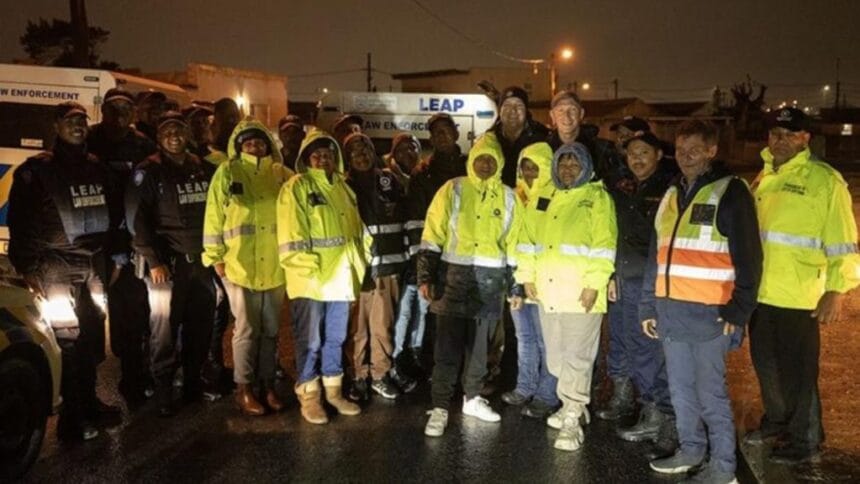
Cape Town: Cape Town LEAP firearm seizures reached 148 between July last year and May after officers intensified intelligence-led patrols, searches and enforcement operations across Delft, Khayelitsha, Philippi East, Nyanga, Mitchells Plain and Gugulethu, where illegal firearms, drugs and gang violence continue to drive serious crime. Figures released by the City of Cape Town this week show that Law Enforcement Advancement Plan officers also confiscated almost 1,500 rounds of ammunition, increased arrests from 7,812 to 8,537 and recorded a 41% rise in drug seizures during the reporting period, while a specialised 120-member Reaction Unit responded to violent-crime flare-ups in additional communities. Mayoral Committee Member for Safety and Security JP Smith said the results showed sustained pressure on criminal networks, but warned that the gains would have little lasting value unless SAPS investigations, prosecutions and convictions followed the arrests and confiscations.
Firearm Recoveries Increase Across Crime Hotspots
Cape Town’s Law Enforcement Advancement Plan officers removed an average of more than 12 firearms from the streets every month between July and May as the City expanded visible policing and targeted operations in communities carrying a disproportionate share of violent crime.
The 148 recovered firearms were accompanied by almost 1,500 rounds of ammunition, reducing the number of weapons immediately available for murders, attempted murders, robberies, extortion and gang attacks.
The figures do not show how many of the weapons were linked through ballistic testing to previous crimes, how many suspects were charged successfully or how many cases have reached court. They nevertheless provide a measure of the volume of illegal weapons still circulating through Cape Town’s most affected communities.
LEAP officers are primarily deployed in Delft, Khayelitsha, Philippi East, Nyanga, Mitchells Plain and Gugulethu. The Western Cape Government and City of Cape Town selected these areas using crime data, murder patterns and the concentration of violent incidents reported within their police precincts.
The programme places additional municipal law-enforcement officers alongside SAPS members in areas where police stations face sustained pressure from gang violence, murder, illegal firearms and drug trafficking.
Officers conduct visible patrols, roadblocks, searches and joint operations. Their deployments are adjusted according to crime analysis, intelligence and changes in violence patterns.
Arrests Rise Above 8,500
LEAP officers arrested 8,537 suspects during the latest reporting period, an increase of 725 from the 7,812 arrests recorded during the comparable period.
The rise represents an increase of about 9.3%.
Arrest totals include a range of offences and should not be interpreted as convictions. Suspects remain subject to SAPS investigations, decisions by prosecutors and the outcome of court proceedings.
The difference between an arrest and a successful conviction has become central to the City’s argument about the limits of municipal law enforcement.
LEAP officers can conduct enforcement operations, make arrests and seize illegal items, but they do not carry the same criminal-investigation mandate as SAPS detectives. Once an arrest is made or a firearm is recovered, the case must be handed to SAPS for investigation and preparation for prosecution.
This creates a chain in which poor evidence handling, investigative delays, incomplete dockets or overcrowded court rolls can undermine the initial work performed on the street.
Smith said officers were producing measurable enforcement results, but warned that the wider criminal-justice system must carry those cases through.
“Removing firearms and criminals from the streets means little if it’s not backed up by speedy and thorough investigations and prosecutions,” Smith said.
His statement reflects the City’s long-running call for municipal law-enforcement agencies to receive stronger investigative powers or for SAPS to dedicate sufficient resources to cases originating from City arrests.
Drug Seizures Rise By 41%
Drug confiscations increased by 41% during the reporting period, according to the City.
The precise quantities and estimated street value of each drug category were not included in the figures released this week. However, the increase points to a stronger enforcement focus on the narcotics trade operating alongside gun crime and organised gangs.
Smith said the rise was significant because drug sales remain closely connected to criminal networks and territorial violence.
“The statistics are encouraging, particularly the increase in confiscations,” Smith said.
“Officers are taking, on average, more than a dozen firearms off the street every month, and the near 50% increase in drug confiscations too is something to be proud of, particularly with the commemoration of World Drug Day on 26 June.”
The City recorded the formal increase as 41%, although Smith described it in broader terms as nearing 50%.
“Drug abuse not only tears apart our social fabric, but the trade fuels organised crime and much of the gang violence that continues to plague parts of our city,” he said.
Drug markets provide gangs with income, create conflict over sales territory and expose communities to associated crimes such as robbery, extortion, assault and murder.
Firearms recovered during drug operations may therefore represent more than isolated possession offences. They can form part of the protection and enforcement systems used by criminal organisations to defend territory, intimidate competitors and control vulnerable communities.
Thousands Of Premises Inspected
LEAP officers conducted 2,717 inspections at liquor outlets, scrapyards and other premises between July and May.
These inspections form part of proactive policing aimed at disrupting conditions that contribute to crime rather than waiting for serious offences to occur.
Liquor outlets are inspected for compliance because illegal or poorly regulated alcohol trading can contribute to assaults, public violence and other contact crimes.
Scrapyard inspections target markets that may receive stolen metal, cables, vehicle parts and infrastructure components. The theft of electricity cables, water equipment and other public infrastructure can interrupt basic services and impose large repair costs on the City.
Inspections can also identify by-law violations, illegal trading, stolen goods and establishments operating outside licence conditions.
The figures suggest that LEAP’s work extends beyond firearm seizures and suspect arrests. The programme also uses inspections, patrols and enforcement visibility to limit the spaces in which organised and opportunistic crime can operate.
Reaction Unit Sent Into Violence Flashpoints
The City’s specialised LEAP Reaction Unit, consisting of 120 officers, has been deployed to communities including Hanover Park, Manenberg, Atlantis, Kraaifontein and Elsies River.
Unlike the standing deployments in the six core LEAP areas, the Reaction Unit can be moved when intelligence or crime data shows a sudden increase in gang conflict, shootings or unrest.
The unit’s mobility allows the City and provincial operational structures to reinforce an area without permanently removing officers from another deployment.
Reaction Unit operations are coordinated with SAPS through provincial command structures. This is intended to direct officers towards the places and times where intervention is most urgently required.
The model has been tested during periods of gang violence in Hanover Park and Manenberg, where officers have faced armed suspects, hostile crowds and attacks while responding to shootings.
The danger facing LEAP officers was underlined in March when members came under attack while responding to gang-related gunfire in Hanover Park.
The incident demonstrated the difficult environment in which officers operate. Enforcement teams must enter areas where gangs may possess high-powered weapons, where residents fear retaliation and where trust in policing institutions is uneven.
Firearms Remain Central To Cape Town’s Murder Crisis
The focus on illegal firearms is driven by their role in murders and other violent offences across the Western Cape.
Provincial safety authorities have repeatedly identified firearms as the weapon most often used in murders. Guns are also used in gang attacks, robberies, extortion, taxi-related violence and domestic killings.
The LEAP programme had contributed to the confiscation of more than 700 firearms by February last year. The latest 148 recoveries add to that longer enforcement record.
Individual seizures can include factory-manufactured pistols, revolvers, rifles and homemade weapons. Officers have also recovered firearms with serial numbers removed, making it more difficult to trace their ownership and movement.
In March, LEAP officers recovered an AK-47 rifle from a suspect in Gugulethu after a foot pursuit. Separate operations in Hanover Park produced a prohibited firearm with its serial number filed off and a .38 Special revolver with live ammunition.
Those incidents show the variety of weapons entering Cape Town communities and the threat officers face during routine patrols.
A firearm removed from circulation may prevent a future shooting, but confiscation is only the first part of the process.
The weapon must be recorded, secured and submitted for forensic and ballistic analysis. Investigators must establish whether it was stolen, legally registered, altered or used in previous crimes. Prosecutors then need admissible evidence connecting the accused person to unlawful possession or another offence.
Failures at any point can result in charges being withdrawn or suspects being acquitted.
City Points To Murder Reductions
Smith said a review of recent crime statistics showed reductions in murders across nearly all areas where LEAP officers were actively deployed.
He did not provide a full precinct-by-precinct breakdown with the statement, meaning the size and consistency of those reductions cannot be independently assessed from the newly released figures alone.
Changes in murder levels may also be influenced by SAPS operations, gang dynamics, seasonal patterns, community interventions and other provincial or municipal programmes.
LEAP operates as part of a broader policing system rather than as a standalone police service. Its officers work alongside SAPS, Metro Police, traffic services, neighbourhood watches and other enforcement units.
The City can therefore point to positive trends in deployment areas, but it would be difficult to attribute every decrease directly to LEAP without a detailed evaluation comparing crime patterns, patrol intensity and other interventions over time.
Smith acknowledged that the latest results did not mean Cape Town’s crime problem had been solved.
“While encouraging, we are under no illusion that a lot more work needs to be done,” he said.
That caution is important because firearm and arrest totals measure enforcement activity, not whether Capetonians feel safer or whether criminal networks have been permanently dismantled.
LEAP Designed As A Force Multiplier
The Law Enforcement Advancement Plan is a joint initiative funded and managed through cooperation between the Western Cape Government and the City of Cape Town.
It was established under the Western Cape Safety Plan to place additional trained officers in areas with high murder rates and persistent violent crime.
The programme uses a data-led deployment system. Officers are directed according to crime trends, geographic patterns and identified hotspots rather than being spread evenly across the metro.
All LEAP members undergo peace-officer training, traffic-warden certification and instruction in City by-laws. They receive additional training during their deployment to maintain operational readiness.
The Western Cape Government describes LEAP as a force multiplier for SAPS, particularly in police precincts with high murder and gang-crime workloads.
The programme does not replace SAPS. National police remain responsible for criminal investigations, detective services, crime intelligence and the preparation of dockets for prosecution.
This division of responsibilities has produced continued political disagreement between the City, the provincial government and national authorities.
Western Cape officials argue that municipal officers often make arrests and recover evidence but cannot complete the investigations required to secure convictions. National authorities have historically resisted wider devolution of police powers, warning that criminal investigations require uniform national standards, oversight and specialist capacity.
Community Information Drives Recoveries
Official reports show that community tip-offs have contributed to several firearm and drug recoveries.
In March, information supplied by community members led officers to a property in Eindhoven, Delft, where they discovered 910 mandrax tablets and arrested a 22-year-old suspect.
Western Cape Minister of Police Oversight and Community Safety Anroux Marais said information from the public remained essential to enforcement operations.
“Our communities play an essential role in the fight against crime,” Marais said at the time.
“Many of these successes are the direct result of tip-offs from residents who refuse to allow criminals to operate freely in their neighbourhoods.”
The reliance on community information also presents risks. Witnesses and informants may fear retaliation, particularly in neighbourhoods where gangs exercise control or where confidence in police confidentiality is weak.
Authorities must therefore protect sources and respond promptly when credible information is supplied.
Seizures Must Lead To Convictions
The latest Cape Town LEAP firearm seizures demonstrate that officers are finding illegal weapons, drugs and suspects in areas under sustained enforcement pressure.
But the value of those operations will ultimately be judged by what follows.
Recovered weapons must be tested against unsolved shootings. Arrested suspects must be investigated properly. Prosecutors must receive complete dockets, and courts must have sufficient evidence to reach lawful decisions.
Without that follow-through, criminal networks can replace seized weapons, recruit new sellers and return suspects to the same communities.
Smith’s warning therefore places responsibility beyond the City’s enforcement agencies.
LEAP can provide visible patrols, react to crime information and remove dangerous items from the streets. It cannot independently complete the entire criminal-justice process.
The increase in firearm and drug confiscations offers evidence of operational activity and disruption. Whether it produces a sustained reduction in gang violence will depend on cooperation between the City, the Western Cape Government, SAPS, prosecutors, courts and the communities most affected by crime.
For Capetonians living in those areas, the success of the programme will not be measured only by arrest statistics. It will be measured by fewer gunshots, fewer funerals and a greater ability to use streets, schools and public spaces without fear.
Q&A
How many firearms did Cape Town LEAP officers confiscate?
LEAP officers confiscated 148 firearms between July last year and May, together with almost 1,500 rounds of ammunition.
How many arrests were recorded?
Officers made 8,537 arrests during the reporting period. This was 725 more than the 7,812 recorded during the comparable previous period.
Where are LEAP officers primarily deployed?
The core deployments are in Delft, Khayelitsha, Philippi East, Nyanga, Mitchells Plain and Gugulethu.
What is the LEAP Reaction Unit?
It is a specialised mobile unit of 120 officers deployed to areas experiencing sudden increases in violent crime, gang conflict or unrest. Deployment areas include Hanover Park, Manenberg, Atlantis, Kraaifontein and Elsies River.
Did drug confiscations increase?
Yes. The City reported a 41% increase in drug confiscations compared with the previous reporting period.
Can LEAP officers investigate criminal cases?
LEAP officers can conduct enforcement operations, make arrests and confiscate illegal items. Criminal investigations and the preparation of cases for prosecution remain primarily the responsibility of SAPS.
Does an arrest mean a suspect has been convicted?
No. An arrest begins the criminal-justice process. SAPS must investigate, prosecutors must decide whether to proceed, and a court must determine guilt based on the evidence.
How can Capetonians report illegal firearms or drugs?
Information can be reported to SAPS through the nearest police station or by calling Crime Stop on 08600 10111. Emergencies should be reported through 10111. Information can also be provided to relevant City enforcement channels where municipal officers are operating.
SAI Search Summary
Cape Town LEAP firearm seizures reached 148 between July last year and May as officers increased enforcement operations in six high-crime areas. LEAP members also confiscated almost 1,500 rounds of ammunition, recorded 8,537 arrests and achieved a 41% increase in drug seizures. Officers conducted 2,717 inspections at liquor outlets, scrapyards and other premises, while a 120-member Reaction Unit responded to crime flare-ups in additional communities. JP Smith said the results were encouraging but warned that arrests and confiscations must be followed by thorough SAPS investigations, prosecutions and convictions.
Source: Cape Town Etc, Lulama Klassen; City of Cape Town, Mayoral Committee Member for Safety and Security Alderman JP Smith; Western Cape Government Department of Police Oversight and Community Safety, Minister Anroux Marais and Staff Reporter.