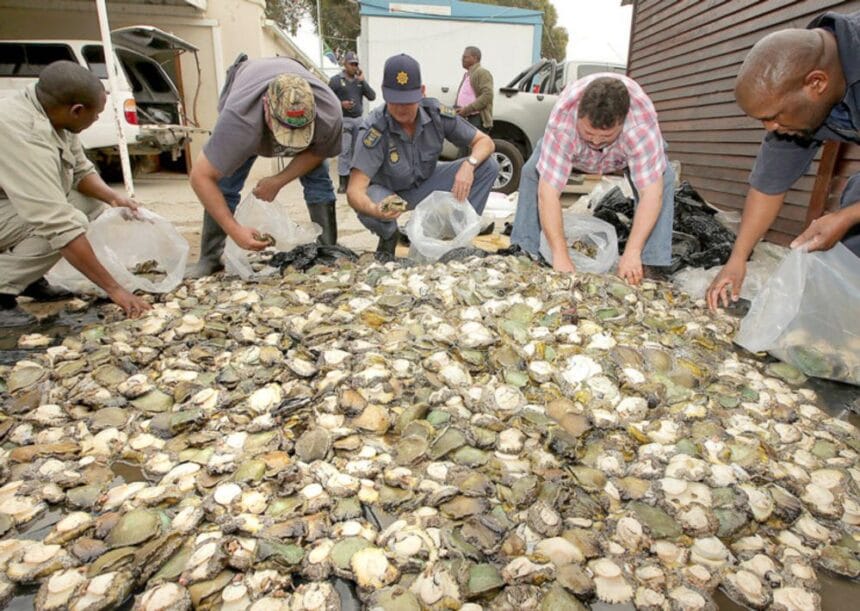
Gordon’s Bay: Two suspects were arrested after officers intercepted a vehicle carrying 743 abalone on Clarence Drive near Gordon’s Bay, where information received by the City of Cape Town’s Marine and Environmental Unit led to a joint operation involving Gordon’s Bay SAPS and GBSEC Armed Response. The man and woman were arrested under the Marine Living Resources Act, while the abalone was seized as evidence in a case that comes amid official warnings that South Africa’s wild abalone stocks remain critically depleted by sustained illegal harvesting and trafficking.
Information Leads Officers To Vehicle
The operation began after the City’s Marine and Environmental Unit received information about a vehicle allegedly being used to transport abalone illegally. Officers worked with Gordon’s Bay SAPS and GBSEC Armed Response to locate the vehicle and intercept it on Clarence Drive, one of the main coastal routes passing through the Gordon’s Bay area.
A search of the vehicle uncovered 743 abalone, according to information supplied by the City and reported by IOL. The abalone was seized, while a male and female occupant were arrested for alleged offences under the Marine Living Resources Act.
The initial report did not identify the suspects or provide their ages, nationalities or expected court date. Authorities also did not disclose where the abalone had allegedly been harvested, where it was being transported or what value had been assigned to the seizure.
Those details remain unconfirmed and should form part of the continuing investigation rather than speculation about the suspects’ intended destination or possible links to other individuals.
Joint Operation Brings Two Arrests
The interception brought together municipal law-enforcement officers, the South African Police Service and a private security company. The City credited the cooperation between its Marine and Environmental Unit, Gordon’s Bay police and GBSEC Armed Response for the arrests and recovery.
The Marine and Environmental Unit is tasked with enforcing municipal and national laws affecting Cape Town’s coastline, protected marine resources and associated environmental offences. SAPS is responsible for the criminal investigation and processing of the arrested suspects, while fisheries officials have a formal role in handling seized marine resources.
The suspects are accused but have not been convicted. The prosecution will need to prove unlawful possession or transportation under the Marine Living Resources Act through evidence presented in court.
The source report did not confirm whether the vehicle was impounded, whether further searches were conducted or whether investigators expect additional arrests. It also did not provide information about permits or documents allegedly found or requested during the stop.
Seized Abalone Must Follow Strict Procedures
SAPS has an established procedure for handling confiscated abalone because it is both evidence and a perishable marine product.
According to the police, seized abalone and crayfish must be entered into the SAPS 13 property register at the relevant police station. The exhibits must then be handed to a representative of the fisheries department for secure storage because police stations are not permitted to store them.
After a criminal case has been finalised, the exhibits must be destroyed in the presence of a commissioned police officer. The officer is required to compare the items with the property register before destruction takes place.
This process is intended to preserve the integrity of the evidence and maintain an accountable record from the moment of seizure until the conclusion of the case. It also reduces the risk of confiscated marine products being lost, tampered with or returned to unlawful trade.
Wild Abalone Stocks Remain Critically Low
The Gordon’s Bay seizure comes against an increasingly serious conservation background. The Department of Forestry, Fisheries and the Environment has warned that South Africa’s wild abalone resource remains critically depleted.
For the current fishing season, the department set the legal Total Allowable Catch at 12.01 tonnes. That decision followed scientific assessments by the Abalone Scientific Working Group, which examined catch rates, independent survey data and updated estimates of illegal harvesting.
Government assessments found severe declines across several fishing zones. Catch-per-unit-effort indicators fell by between 71% and 77% in Zones E to G, while densities in Zones A to D were measured at only 0.02 to 0.07 abalone per square metre.
The department kept the legal catch at zero in Zones A to D and reduced allocations in the remaining areas to protect the resource from further decline.
The figures show why a seizure involving hundreds of abalone cannot be treated only as a routine possession case. Each unlawful removal adds pressure to a wild resource that official scientists say is approaching collapse in parts of the coastline.
Illegal Catch Dwarfs The Legal Fishery
The scale of illegal harvesting is significantly larger than the amount available through the regulated commercial fishery.
The fisheries department reported that estimated illegal catches during 2023 exceeded 13.85 million individual abalone. Government said this level of unlawful removal directly undermined the legal fishing industry and efforts to rebuild depleted stocks.
Illegal harvesting damages the prospects of licensed commercial and small-scale fishers who depend on a sustainable resource. When stocks decline, the government must reduce legal allocations even though lawful operators may not be responsible for the bulk of the losses.
This creates a damaging cycle. Poaching reduces the resource, scientific advice forces tighter legal limits, and legitimate fishers face smaller allocations while illegal networks continue removing abalone outside the regulated system.
The impact therefore extends beyond environmental loss. It affects livelihoods, legal fishing businesses and coastal communities whose economic opportunities depend on the long-term survival of the species.
Financial Intelligence Report Describes Organised Trade
A Financial Intelligence Centre report identifies abalone as one of the South African marine species targeted by organised wildlife-trafficking networks supplying demand in Southeast Asian markets.
The report says syndicates involved in the trade operate through parts of the Western Cape, from the West Coast to the Overberg, before moving abalone through wider transport, processing and export networks. It also records the use of financial intelligence and cooperation between banks and law-enforcement agencies to investigate the money moving through illegal wildlife trade.
This national context does not prove that the two people arrested near Gordon’s Bay belonged to a syndicate. No such connection was confirmed in the available report.
It does, however, explain why authorities treat the transport stage seriously. Illegal abalone does not reach processing facilities or foreign markets without vehicles, storage sites, financial transactions and people willing to move it between locations.
Stopping a shipment can therefore prevent illegally harvested stock from progressing further through the supply chain, while evidence recovered during an interception may help investigators identify other participants.
Separate Lobster Case Shows Wider Enforcement Pressure
The City also reported a separate marine-resource operation in Sherwood Park, Manenberg, where officers recovered 720 West Coast rock lobster tails.
Officers reportedly searched a property after receiving information about the alleged illegal sale of lobster. One occupant was arrested after allegedly failing to produce documentation authorising possession of the tails.
The Sherwood Park incident is separate from the Gordon’s Bay case. There is no confirmed connection between the suspects, the seized products or the investigations.
It nevertheless shows that marine-resource enforcement does not take place only along beaches and harbours. Illegally obtained seafood may also be transported, stored or traded from vehicles and residential properties elsewhere in Cape Town.
Public Information Supports Enforcement
The City has encouraged members of the public to report suspected poaching, transport, storage or sale of protected marine resources.
Reports can be made by calling 021 480 7700 from a cellphone or 107 from a landline. The municipality says rewards of up to R5,000 may be offered when information leads to a successful operational result.
Members of the public should provide details to the authorities rather than confronting suspected offenders. Useful information may include vehicle descriptions, registration numbers, locations, times and observations of suspicious handling or storage.
The Clarence Drive interception demonstrates how information supplied to enforcement officers can lead to a coordinated operation. The City has not disclosed the source of the information or whether a reward will be paid in this case.
Key Questions Remain Unanswered
Several important details remain outstanding after the arrests. Authorities have not confirmed the weight or estimated value of the 743 abalone, the place where they were allegedly harvested or the destination of the intercepted vehicle.
The initial report also did not state whether the abalone was fresh, dried or processed, whether permits were presented, or when the two suspects would appear in court.
These details may emerge through a police update, a court appearance or a further statement from the City or fisheries department. Until then, the verified case remains limited to the interception, the seizure of 743 abalone and the arrest of two people.
Cape Town News will follow the matter for confirmation of the charges, court proceedings and any further enforcement action linked to the investigation.
Q&A
How many abalone were seized near Gordon’s Bay?
Officers recovered 743 abalone from a vehicle intercepted on Clarence Drive.
How many suspects were arrested?
A man and woman were arrested under the Marine Living Resources Act.
Which agencies took part in the operation?
The operation involved the City of Cape Town’s Marine and Environmental Unit, Gordon’s Bay SAPS and GBSEC Armed Response.
What happens to seized abalone?
SAPS says seized abalone must be entered into the police property register and transferred to fisheries officials for secure storage. It is destroyed under supervision after the criminal case is finalised.
Why is abalone poaching a serious concern?
Government scientists say South Africa’s wild abalone stocks remain critically depleted. Estimated illegal catches exceeded 13.85 million individual abalone during 2023, undermining legal fisheries and recovery efforts.
Has the value of this seizure been confirmed?
No. The available report did not provide a verified weight or monetary value for the 743 abalone.
SAI Search Summary
A man and woman were arrested after officers intercepted a vehicle carrying 743 abalone on Clarence Drive near Gordon’s Bay. The operation involved the City of Cape Town’s Marine and Environmental Unit, Gordon’s Bay SAPS and GBSEC Armed Response. The seizure comes as government assessments show that South Africa’s wild abalone stocks remain critically depleted, with estimated illegal catches exceeding 13.85 million abalone in 2023. Authorities have not yet confirmed the value, origin or intended destination of the seized abalone.
Source: IOL News, Wendy Dondolo; City of Cape Town, Staff Spokesperson; Department of Forestry, Fisheries and the Environment, Ministerial Statement; Financial Intelligence Centre, South African Anti-Money Laundering Integrated Task Force; South African Police Service, Staff Reporter