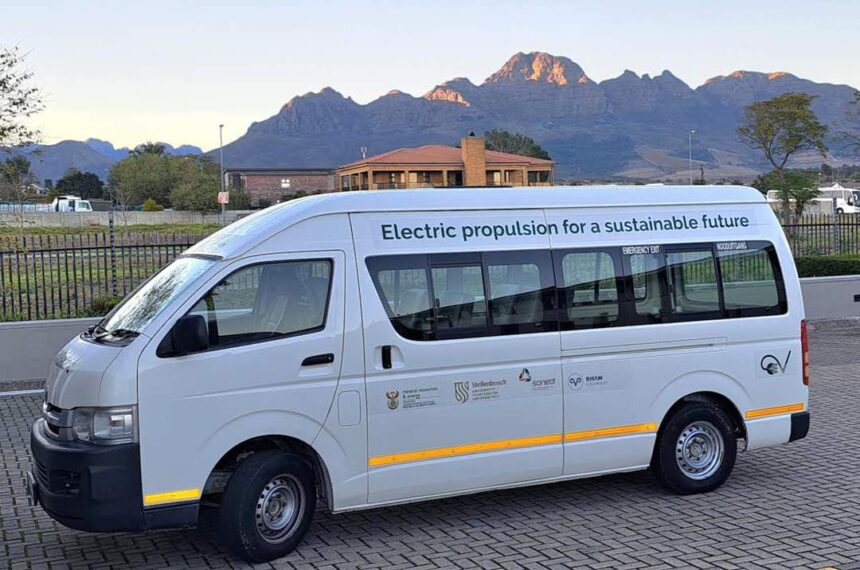
For decades, the minibus taxi has been the engine room of South Africa’s commuter economy, moving millions of people between townships, suburbs, industrial zones, and city centres every single day. In Cape Town, where thousands rely on taxi routes stretching from Khayelitsha (Kai-lee-cha), Mitchells Plain, Bellville, Paarl, and beyond, a new transport shift is beginning to take shape. Industry researchers, engineers, and public transport specialists now believe the Western Cape could become one of the first regions in South Africa to seriously test whether electric minibus taxis can work on real commuter routes.
The conversation around electric mobility in South Africa has often focused on private passenger vehicles, luxury imports, or future charging networks for wealthy consumers. But a new study highlighted by Moneyweb is turning that conversation toward one of the country’s most important economic sectors, the minibus taxi industry.
Researchers linked to Stellenbosch University and transport innovation programmes are now actively studying how electric taxis could perform under some of the toughest operating conditions found anywhere in urban transport.
Unlike private vehicles, taxis operate for long hours, often before sunrise and well after dark. They stop constantly, carry heavy passenger loads, climb steep urban roads, and navigate heavy traffic through areas such as Cape Town’s CBD, the N2 corridor, and the northern transport routes linking Bellville and Durbanville.
These demanding operating conditions make South Africa an important real-world test environment for electric public transport.
According to the research, one of the biggest attractions for operators is the potential reduction in day-to-day running costs. Fuel remains one of the largest expenses for taxi owners, particularly after repeated diesel price increases over recent years. Maintenance costs on internal combustion engines also continue to rise as vehicles age and spare parts become more expensive.
Electric drivetrains could significantly reduce many of those costs.
With fewer moving parts, lower servicing requirements, and reduced dependence on volatile fuel prices, electric fleets could potentially improve long-term profitability for operators while helping stabilise commuter pricing.
But the transition is far from simple.
Battery technology remains expensive, and replacement costs continue to present one of the biggest financial risks for fleet owners. Access to affordable vehicle finance also remains limited, particularly for smaller operators working outside formal banking structures.
Charging infrastructure presents another major obstacle.
Unlike private motorists who may charge overnight at home, taxis operate almost continuously throughout the day. This means rapid charging stations would need to be installed near high-volume transport hubs, taxi ranks, and strategic commuter corridors if electric fleets are to become commercially viable.
Industry analysts say Cape Town’s relatively strong municipal infrastructure, growing renewable energy sector, and established transport planning systems could make the metro one of South Africa’s best candidates for early adoption.
If pilot programmes prove successful, the economic impact could extend far beyond transport.
Electric taxi adoption could create new demand for vehicle assembly, battery servicing, charging infrastructure installation, technical training, and specialised maintenance services, opening the door for entirely new sectors of green economic activity in the Western Cape.
For now, the taxis may still run on diesel, but the next chapter of Cape Town’s commuter economy may already be quietly charging.
Source: Moneyweb – MJ Booysen, Joshua Sello.