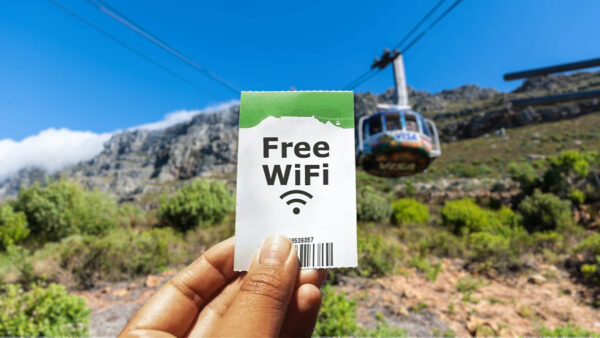
In today’s economy, internet access is no longer viewed as a luxury. It has become as essential as electricity, water, and public transport, shaping how people work, study, trade, bank, communicate, and access government services. In Cape Town, where digital access can often determine whether a job application gets submitted, a student completes an assignment, or a small business reaches new customers, the expansion of public WiFi is becoming more than just a technology project. It is rapidly evolving into one of the city’s most important social and economic infrastructure investments.
The City of Cape Town is continuing to expand one of South Africa’s largest municipal public connectivity programmes, with new WiFi access points being rolled out across libraries, transport interchanges, clinics, administrative centres, and public facilities throughout the metro.
The programme forms part of Cape Town’s long-term smart city strategy, which aims to improve digital access for residents while supporting economic participation, education, entrepreneurship, and access to public services.
According to recent city infrastructure updates, thousands of residents connect to municipal WiFi services every day, using the network for everything from online learning and job applications to banking, communication, and small business operations.
As South Africa’s digital economy continues to grow, affordable internet access is increasingly being viewed as a critical development tool rather than simply a communications service.
The Western Cape has consistently positioned itself as one of the country’s leading technology and innovation hubs, attracting software developers, digital startups, financial technology companies, creative agencies, and international remote workers. But while parts of Cape Town’s private sector enjoy world-class fibre connectivity, digital inequality remains a daily reality in many communities.
For families living in lower-income areas, mobile data costs can still consume a significant portion of monthly household income. For students, entrepreneurs, and job seekers, limited access to affordable internet often creates an invisible barrier to opportunity.
That is where municipal connectivity programmes are becoming increasingly important.
The City says public WiFi sites are strategically placed in high-demand public locations where digital access can have the greatest community impact. Libraries remain some of the busiest access points, particularly among school learners, university students, and job seekers. Public transport interchanges are also seeing growing usage as commuters increasingly rely on mobile connectivity during daily travel.
Health facilities, civic centres, and community halls are being incorporated into the rollout, allowing residents to access digital government services, healthcare information, and online administrative systems without relying solely on costly mobile data.
Technology analysts say Cape Town’s investment in public connectivity places it ahead of many other metropolitan areas in South Africa.
Digital access is increasingly linked to economic participation. Small businesses use online platforms for payments, marketing, supplier management, and customer communication. Informal traders are beginning to adopt digital payment systems, while community entrepreneurs are increasingly using social media marketplaces and messaging platforms to build local customer networks.
Education is also playing a major role.
Since the rapid digital shift in learning over recent years, students have become increasingly dependent on stable internet access for assignments, online research, applications, and educational content.
Officials say the expansion of public WiFi is not simply about faster internet.
It is about building a city where economic opportunity is not determined by whether a resident can afford a monthly data bundle.
As Cape Town continues investing in digital infrastructure, the city is quietly building something that may prove just as valuable as roads, ports, or power grids in the decades ahead, a connected economy where access to information becomes access to opportunity.
Source: City of Cape Town Digital Infrastructure Reports, SmartCape Programme.