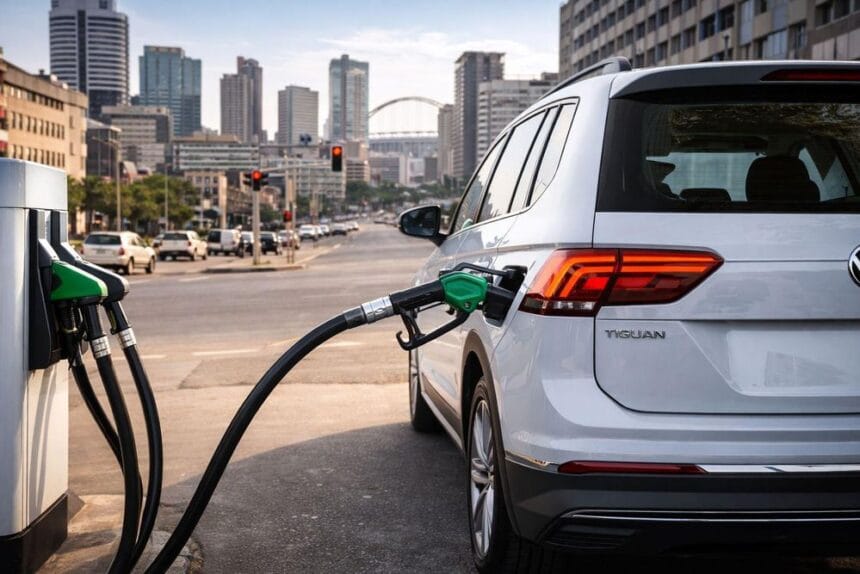
Cape Town: July fuel price cuts could bring relief to Cape Town road users, businesses and public transport operators after early Central Energy Fund data pointed to reductions of more than R1 per litre for petrol and close to R4 per litre for diesel. The provisional forecast reflects lower international fuel-product prices and a stronger rand, but the final adjustment will depend on market movements during the rest of the review period. The government must also restore the remaining portion of the temporary General Fuel Levy relief in July.
Early Data Points To Lower Fuel Prices
South African motorists could receive meaningful fuel-price relief in July if the favourable market conditions recorded during the opening days of the review period continue.
Early Central Energy Fund data indicated over-recoveries of between R2.68 and R2.71 per litre for petrol and between R5.73 and R5.84 per litre for diesel. An over-recovery means the current regulated price is higher than the calculated cost suggested by international product prices and the rand-dollar exchange rate.
Those headline recoveries do not represent the likely final reductions at the pumps because the remaining portion of the General Fuel Levy relief is scheduled to end in July. Once that levy is included, the initial projection suggests that petrol could decrease by between R1.18 and R1.21 per litre.
The projected diesel reductions remain substantially larger. Early estimates indicate possible wholesale-price cuts of about R3.77 per litre for 0.05% sulphur diesel and R3.88 per litre for 0.005% sulphur diesel after the remaining levy is restored.
These figures are not final prices. They are an early indication based on a small portion of the monthly review period and can change daily as oil prices, international product values and the rand move.
Projected July Adjustments
The first-week estimate points to the following possible changes once the remaining fuel-tax relief is included:
| Fuel Type | Early Market Recovery | Returning Levy | Projected July Change |
| Petrol 93 | R2.68 decrease | R1.50 increase | R1.18 decrease |
| Petrol 95 | R2.71 decrease | R1.50 increase | R1.21 decrease |
| Diesel 0.05% | R5.73 decrease | R1.96 increase | R3.77 decrease |
| Diesel 0.005% | R5.84 decrease | R1.96 increase | R3.88 decrease |
The amounts should be treated as estimates rather than confirmed adjustments. The Department of Mineral and Petroleum Resources normally announces the official fuel-price changes near the end of the monthly review period.
Why The Outlook Has Improved
South Africa imports crude oil and refined petroleum products at prices influenced by international markets. The domestic Basic Fuel Price therefore responds strongly to changes in global oil prices and the exchange rate between the rand and the United States dollar.
The July outlook improved after international product prices eased and the rand recovered from weaker levels recorded during heightened Middle East tensions. Brent crude remained below the peaks reached earlier in the year, while the rand traded within a firmer range against the dollar.
A stronger rand lowers the local cost of imported fuel because fewer rand are required to buy the same dollar-denominated product. Falling international petroleum prices create a similar benefit by reducing the cost used in the Basic Fuel Price calculation.
These gains have so far been large enough to absorb the return of the remaining General Fuel Levy relief while still leaving petrol and diesel in line for possible reductions.
Government Relief Ends In July
The government temporarily reduced the General Fuel Levy earlier this year after international conflict caused sharp increases in oil and fuel-product prices.
The measure cut the levy by R3 per litre for petrol and about R3.93 per litre for diesel. It was introduced as short-term support for households and businesses facing sudden fuel-price pressure.
Half of the suspended levy was restored in June. Petrol received an additional R1.50 per litre, while approximately R1.93 per litre was added back to diesel.
The remaining amount is due to return in July. That means early market recoveries must first cover the restored levy before motorists receive a net reduction.
The present forecast suggests that the market improvement is large enough to achieve that. However, a sudden rise in oil prices or weakening of the rand could reduce the projected savings before the final announcement.
June Brought Mixed Results
The possible July reductions follow a difficult June adjustment for petrol users.
Both grades of petrol increased by R1.43 per litre after the partial restoration of the General Fuel Levy outweighed a small improvement in the underlying fuel price. Coastal motorists are currently paying about R27.16 per litre for petrol 93 and R27.19 per litre for petrol 95.
Diesel users received some relief in June because stronger market recoveries were large enough to overcome the returning levy. Wholesale diesel prices decreased by between R2.62 and R3.25 per litre, depending on the grade and location.
The different outcomes show why early recovery figures cannot be read in isolation. Taxes, levies, the slate mechanism and other regulated components can all change the amount finally passed on to fuel users.
What The Cuts Could Mean At The Pump
A reduction of R1.21 per litre would save a petrol user about R60.50 when filling a 50-litre tank from empty. A 70-litre tank would cost approximately R84.70 less under the same projected adjustment.
The possible diesel reductions would be more significant. A wholesale cut of R3.77 per litre would reduce the underlying cost of 50 litres by about R188.50, while an 80-litre refill would reflect a difference of about R301.60 before retailer margins and local pricing considerations.
Diesel is regulated at wholesale level rather than through one national pump price, which means the amount charged at individual filling stations can differ. Petrol prices are regulated by zone, with coastal prices generally lower than inland prices because of transport costs.
The projected savings would not reverse all the increases experienced earlier this year, but they could ease pressure on motorists, transport companies and businesses dependent on road freight.
Cape Town Businesses Could Benefit
Fuel prices affect more than private motoring. Cape Town’s food suppliers, couriers, construction companies, tourism operators and small businesses all carry transport costs that influence their operating expenses.
Lower diesel prices could reduce pressure on freight and delivery operations, although businesses may not immediately pass the full saving to customers. Companies often use reductions to recover losses accumulated during periods of high fuel prices.
Minibus taxis, buses and other public transport services also rely heavily on diesel. A substantial reduction could help contain operating pressure, but it would not automatically result in lower passenger fares.
Public transport pricing is influenced by several costs, including wages, vehicle finance, maintenance, insurance and regulatory fees. Fuel remains one of the largest variable expenses, making a sharp diesel cut important even when fares do not change immediately.
Forecast Remains Vulnerable To Market Changes
The Central Energy Fund updates its fuel-price data throughout the review period. Each update reflects changes in international product prices and the rand-dollar exchange rate.
The first-week calculation offers an early indication, but it cannot predict political events, production decisions, shipping disruption or currency movements later in the month.
Oil prices can rise quickly when conflict threatens supply routes or major producing countries alter output. The rand can also weaken in response to domestic or international financial uncertainty.
A shift in either factor could reduce the projected July cuts. An improvement could produce even larger reductions.
Motorists should therefore wait for the official government announcement before making firm budget decisions based on the early estimate.
Sea Point Protest Traffic Advisory
Road users travelling through Sea Point should also prepare for temporary delays while the March and March anti-immigration protest moves through the area.
The procession is scheduled between 9am and 3pm and is expected to use Beach Road near Fort Road, St John’s Road, Main Road and Glengariff Road.
Police may introduce temporary traffic restrictions according to the movement of the crowd and operational requirements. A complete closure timetable had not been issued before the protest began.
Capetonians should avoid the immediate route where practical and allow additional travelling time. High Level Road may provide an alternative for some journeys, although diverted vehicles could create secondary congestion.
No confirmed MyCiTi suspension had been announced before publication. Passengers should check official service channels or contact the Transport Information Centre on 0800 65 64 63 before travelling.
For full details of the route, safety arrangements and business impact, readers should follow Cape Town News’ City News report on the Sea Point protest.
When The Final Fuel Price Will Be Known
The official July fuel-price adjustment will only be confirmed after the Department of Mineral and Petroleum Resources completes the monthly review.
The final announcement will include changes for petrol, diesel and illuminating paraffin, together with the market and levy factors used in the calculation.
Cape Town News will update the report when later Central Energy Fund data becomes available and again when the department publishes the official adjustment.
Until then, the projected reduction should be described as encouraging but provisional.
Q&A
How much could petrol decrease in July?
Early data suggests petrol 93 could decrease by about R1.18 per litre and petrol 95 by about R1.21 per litre after the remaining levy is included.
How much could diesel decrease?
The initial projection points to wholesale reductions of about R3.77 to R3.88 per litre, depending on the grade.
Are the July fuel price cuts confirmed?
No. The figures are early estimates and can change before the government announces the final adjustment.
Why is the General Fuel Levy returning?
The government introduced a temporary reduction to cushion fuel users against sharp international price increases. The relief is being phased out.
What determines South Africa’s fuel prices?
The main market factors are international petroleum-product prices and the rand-dollar exchange rate. Taxes, levies and regulated costs are then added.
What are Cape Town motorists paying in June?
Coastal petrol prices are approximately R27.16 per litre for petrol 93 and R27.19 per litre for petrol 95.
Could the Sea Point march affect traffic?
Yes. Temporary delays or restrictions are possible on Beach Road, St John’s Road, Main Road and Glengariff Road.
Where can MyCiTi passengers check for changes?
Passengers can consult official MyCiTi service channels or call the Transport Information Centre on 0800 65 64 63.
SAI Search Summary
July fuel price cuts could bring relief to Cape Town motorists and businesses after early Central Energy Fund data pointed to lower petrol and diesel prices. Once the remaining General Fuel Levy is restored, petrol could decrease by about R1.18 to R1.21 per litre, while diesel could fall by approximately R3.77 to R3.88 per litre. The forecast remains provisional because oil prices and the rand-dollar exchange rate can change before the official announcement. Sea Point road users should also expect possible delays during Tuesday’s protest.
Source: TopAuto, Michael Taylor; Central Energy Fund daily Basic Fuel Price data; Department of Mineral and Petroleum Resources; City News traffic information.