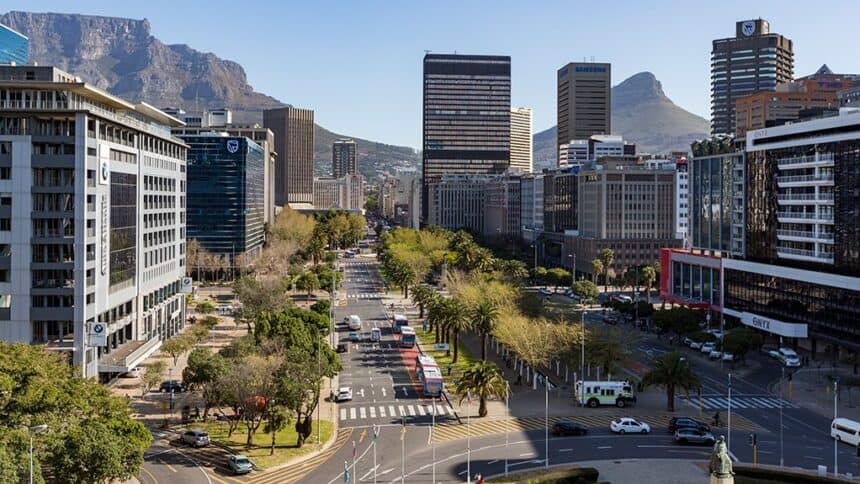
Cape Town’s central business district is undergoing a steady transformation, with residential demand and mixed-use developments driving a property boom that continues to outperform other major South African cities. The shift is not only reshaping the skyline, but also redefining how the inner city functions, moving towards a more active, seven-day urban economy.
The Cape Town CBD has become one of the country’s most resilient property markets, supported by strong investor confidence, limited supply, and a growing preference for inner-city living. According to industry data, residential property prices in Cape Town increased by approximately 9.1% year-on-year, maintaining its position as South Africa’s top-performing metro in the sector.
Grant Elliott, deputy chairperson of the Central City Improvement District and chief operating officer of Thibault Investments, said the continued growth reflects sustained demand across the residential market.
“This points to sustained demand and price momentum as we head into 2026,” Elliott said.
The number of residential units in the CBD has now exceeded 7 000, a figure that continues to rise as developers respond to demand from both local buyers and investors. The increase is also reflected in property values, with the median price of sectional-title units rising from R1.27 million in 2020 to approximately R1.95 million in 2025. This represents a 53% increase over five years, highlighting the strength of the market.
One of the most significant trends driving this growth is the expansion of mixed-use developments. These projects combine residential, commercial, and retail spaces into integrated environments, allowing residents to live, work, and access services within the same area. This model is increasingly seen as key to creating a more sustainable and active urban core.
Developers are also converting older office buildings into residential units, a move that is reducing office vacancies while increasing foot traffic in the city centre. According to the South African Property Owners Association, Cape Town’s office vacancy rate has dropped to 6.1%, compared to 15.8% in Johannesburg and 12.1% in Durban.
Quintin Rossi, chief executive officer of Spear REIT, said the limited supply of new office space is expected to support rental growth in the sector.
“This bodes well for gross rental growth of existing CBD office properties, which could be as high as between 10% and 12%, helping to offset the pain of rising operating costs and local authority charges,” Rossi said.
Major projects such as the redevelopment of Golden Acre on Adderley Street and the construction of One on Bree Tower on the Foreshore are further transforming the CBD landscape. These developments are designed to extend economic activity beyond traditional office hours, encouraging a more vibrant and continuous flow of movement in the area.
Industry leaders say the shift towards a “live, work, and play” model is critical for the long-term sustainability of the CBD. By increasing residential density and reducing reliance on commuting, the model supports retail activity, improves safety through increased presence, and enhances the overall appeal of the inner city.
However, the growth also brings challenges. Rising property prices and demand could place pressure on affordability, particularly for lower- and middle-income buyers. At the same time, infrastructure and service delivery must keep pace with increased density to avoid future strain.
Cape Town’s CBD is now at a turning point, where continued growth will depend on balancing investment with accessibility and long-term planning. The current trajectory suggests strong momentum, but the ability to sustain it will rely on how effectively the city manages both opportunity and pressure in the years ahead.
Source: IOL – Given Majola.