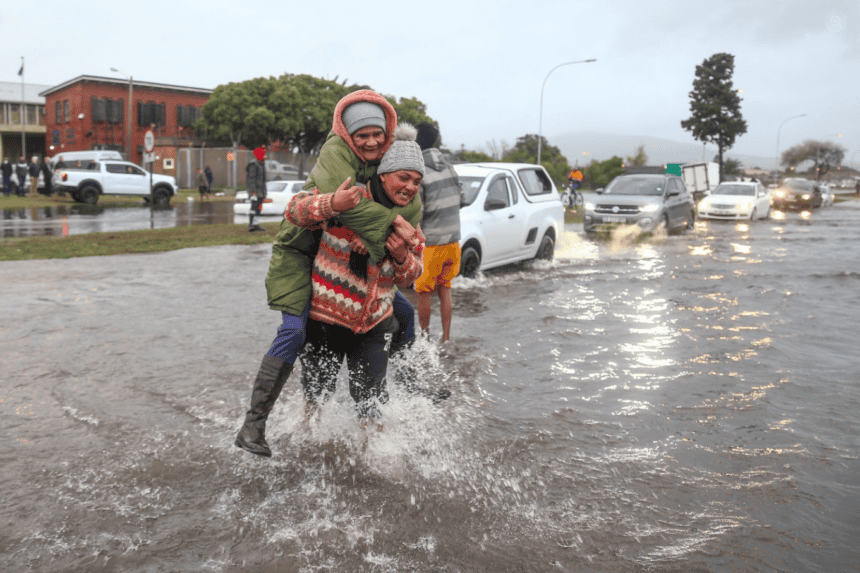
A powerful cold front that swept across Cape Town over the past weekend has left a visible mark across the metro, flooding informal settlements, disrupting major transport routes, and forcing emergency response teams into action as the city begins assessing the full scale of the damage.
After three days of persistent rainfall, the impact of the storm has been felt most sharply in low-lying and vulnerable communities. In Nyanga and Brown’s Farm, rising water levels pushed into homes and informal structures, leaving residents exposed to the elements and uncertain about the extent of the damage.
Disaster Risk Management teams were deployed to affected areas, including the Mkhonto Square informal settlement, where on-the-ground assessments are now underway. Officials say it will take time to fully understand the scale of structural damage as inspections continue.
“Disaster Risk Management officials will be conducting assessments in the Mkhonto Square Informal Settlement in Nyanga, as well as Brown’s Farm,” said spokesperson Sonica Lategan, adding that initial reports confirmed that structures had been impacted by the heavy downpours.
“Our Disaster Operations Centre received reports that structures in these areas have been affected by the heavy downpours, although the extent can only be confirmed once assessments are completed,” she said.
Beyond residential areas, the storm placed significant strain on Cape Town’s road network. Localised flooding spread across the metro, affecting both suburban streets and major transport routes. Several key roads were partially submerged, including sections of Simon’s Town Main Road, Kalk Bay Main Road, and the N1 outbound near the Wingfield interchange, where lanes were obstructed by standing water.
Traffic congestion quickly built up as motorists navigated reduced visibility, slippery conditions, and debris washed onto roadways. In some areas, fallen trees and blocked drainage systems further worsened conditions, highlighting ongoing challenges around stormwater management in parts of the city.
One of the most visible impacts of the storm was the closure of Chapman’s Peak Drive, a key coastal route that remains vulnerable during severe weather events. Authorities closed the route as a precaution due to the risk of rockfalls and unsafe driving conditions, placing additional pressure on alternative routes.
The South African Weather Service confirmed that the system brought widespread showers to the south-western parts of the Western Cape, with rainfall totals ranging between 30mm and 60mm. The heaviest precipitation was recorded over mountainous areas, where conditions were cold enough for snow to fall on the highest peaks near Worcester.
“The snow has arrived. It is cold and stormy. Snow only right at the peaks, nothing low down,” Matroosberg Nature Reserve noted, underscoring the intensity of the cold front as it moved across the region.
While conditions are expected to gradually improve, officials have warned that the impact of the storm will not disappear overnight. Floodwaters in some areas are slow to recede, particularly where drainage systems are under pressure or blocked, raising concerns about lingering disruptions in the days ahead.
Residents have been urged to remain vigilant, avoid flooded roads, and report emergencies to the city’s Public Emergency Communications Centre as clean-up operations continue across affected areas.
The weekend’s cold front has once again exposed the vulnerability of parts of Cape Town to extreme weather, particularly in informal settlements and low-lying areas where infrastructure struggles to cope with sustained rainfall. While the city’s emergency response teams have moved quickly to assess and manage the situation, the event highlights the ongoing challenge of balancing rapid urban growth with resilient infrastructure. As Cape Town moves deeper into the winter season, attention now shifts to recovery efforts, preparedness, and whether the metro can withstand further systems of similar intensity.
Source: IOL/ Cape {town} Etc – W.Dondolo/A. Bredeveldt