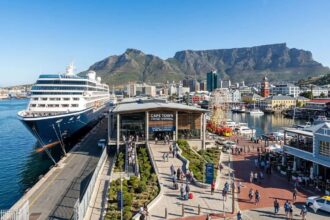
Cape Town’s growth story is no longer only about more people moving to the city. It is about more households needing water, sanitation, electricity, roads, housing, schools, safety services, and social support at the same time. With around 100 000 families relocating from Gauteng over the past three years, the City is now under pressure to plan faster, spend faster, and work more closely with the private sector to avoid the infrastructure strain seen in other major South African metros.
Cape Town is facing one of the biggest urban pressure tests in its recent history as sustained semigration from Gauteng adds to existing demand for housing, transport, water, sanitation, and public services.
Speaking at the Civic Centre during an address to members of the Cape Chamber of Commerce and Industry, Mayor Geordin Hill-Lewis said the City is now planning around the reality that household growth is rising faster than overall population growth. That distinction matters because infrastructure demand is not only measured by how many people live in a city, but by how many separate homes need services every day.
According to Hill-Lewis, household growth in Cape Town is sitting at about 3.8%, and this figure is now one of the key indicators shaping infrastructure planning.
“What is very interesting is that we have a 3.8% household growth, it’s the number that determines our infrastructure need,” Hill-Lewis said, according to the report.
The pressure is being driven by several overlapping trends. Families continue to move from Gauteng and other provinces in search of better service delivery, economic opportunity, and a more stable urban environment. At the same time, household patterns are changing, with smaller family units, more separate homes, and greater demand for individual service connections. Tourism growth and broader economic activity are also adding further pressure to the city’s systems.
This means Cape Town’s challenge is not limited to finding space for more people. The City must expand the systems that allow daily life to function, from water pipes and sewage networks to roads, public transport, electricity infrastructure, safety programmes, and planning approvals.
Hill-Lewis warned that Cape Town had already been investing in infrastructure in previous years, but not at the level needed to match the city’s growth trajectory.
“Four or five years ago this City was already investing in infrastructure, but not at the adequate level to keep up with the pressure we face as a City,” he said.
The mayor said the City recognised early warning signs and responded by increasing infrastructure spending before the situation reached crisis point. He compared the earlier trajectory to a warning light on a vehicle dashboard.
“If we continued down the path we were on, infrastructure would have been OK for a long time, it’s not like it was close to collapse like we are seeing in other places. But the trajectory was concerning. The dashboard oil light was on. So we have accelerated significantly infrastructure spend to make sure the City can continue being a success for many decades to come,” Hill-Lewis said.
Water security remains one of the biggest long-term concerns. Cape Town’s recent history with drought and water restrictions has made future supply planning a central political and infrastructure issue. The City is now considering new water supply options, including another desalination plant and a major water recycling project. These projects could be structured through public-private partnerships, allowing private sector expertise and funding to support long-term resilience.
Transport is another pressure point. As more families relocate to Cape Town, congestion is likely to intensify on key routes unless public transport and road capacity improve. The proposed Cape Skytrain was raised during the session, but Hill-Lewis made clear that a project of that scale cannot be funded by the City alone.
“I’m aware of the Cape Skytrain, but there’s no prospect of that project proceeding without significant government funding. I would love that project to proceed, but it is above our pay grade to fund a project like that,” he said.
The mayor’s comments also point to a wider political reality: Cape Town’s growth is both an opportunity and a risk. On one hand, the city is attracting families, businesses, investors, and skilled workers. On the other, unmanaged growth can push up housing costs, increase traffic, place pressure on basic services, and widen inequality if poorer communities are left behind.
Business leaders at the session also raised concerns about property rates, planning delays, electricity pricing, and housing. These issues show that Cape Town’s growth debate is not only about infrastructure, but also about affordability, regulation, and whether development can keep pace with demand.
The City’s strategy is now focused on staying ahead of decline rather than reacting after systems fail. That approach will require large capital investment, better planning turnaround times, partnerships with developers, and long-term coordination between local, provincial, and national government.
For Capetonians, the issue is practical. More households mean more pressure on roads during peak traffic, more demand for housing near jobs, more load on water and sanitation networks, and greater expectation that public services must keep improving.
Cape Town’s challenge is now to prove that growth can be managed without losing the reliability that made the city attractive in the first place. The arrival of 100 000 families from Gauteng has sharpened that test, and the City’s infrastructure decisions over the next few years will shape how well it responds.
Source: Cape {town} Etc – Aiden Daries.