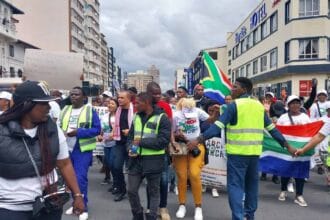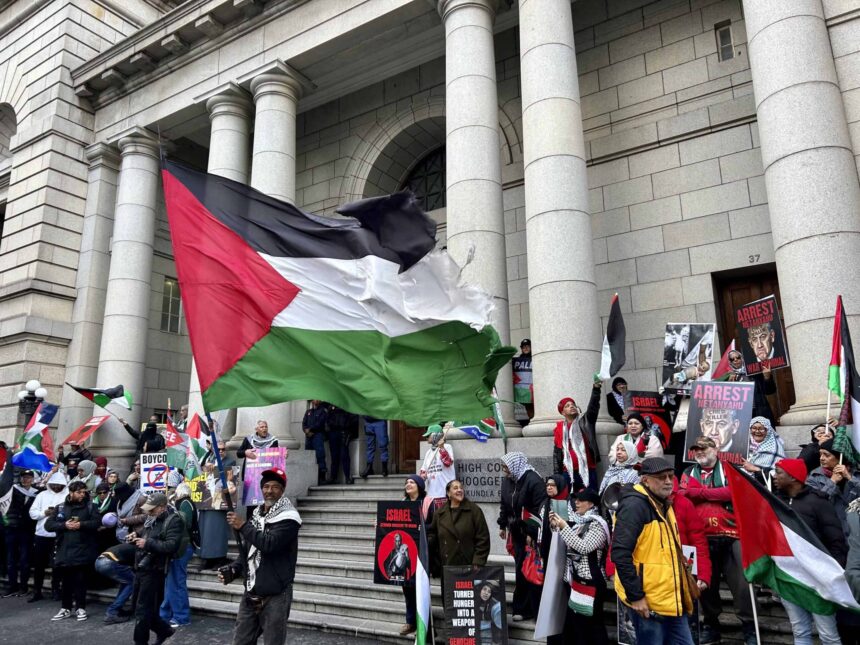
A protest outside the Western Cape Provincial Parliament has brought renewed focus to the province’s political positioning on international issues, with activists accusing the DA-led government of contradicting South Africa’s stance at the International Court of Justice and failing to demonstrate solidarity on a matter of growing global and domestic importance.
The demonstration, led by the Palestine Solidarity Campaign, unfolded outside the provincial legislature as activists called for the Western Cape Government to reassess its position on international relations, particularly in relation to Israel and Palestine.
At the centre of the protest is a dispute over symbolism and political alignment. Activists argue that the provincial government and the City of Cape Town have demonstrated solidarity with Ukraine in the past by illuminating public buildings in its national colours, yet have not extended similar recognition to Palestine. This, they say, reflects a selective approach to international solidarity that is inconsistent with South Africa’s historical and diplomatic stance.
Coordinator Usuf Chikta framed the issue as one of national integrity and alignment, warning that provincial actions risk undermining the country’s broader position on the global stage. The concern is closely tied to South Africa’s case at the International Court of Justice, where the national government has taken a firm position that has drawn international attention and debate.
The protest also forms part of a wider push for the implementation of a boycott, divestment and sanctions programme. Activists are calling on the Western Cape Government to halt all forms of political and economic engagement with Israel, arguing that provincial policy should reflect national commitments and historical values.
This pressure is expected to intensify in the coming weeks, with organisers confirming that further demonstrations are planned in the lead-up to Nakba Day, a significant date in the Palestinian calendar that often sees heightened activism globally.
Inside the legislature, the issue has taken on a formal political dimension. African National Congress leader Khalid Sayed indicated that the concerns raised by protesters would be pursued within official parliamentary processes, framing the matter as one of constitutional and political alignment between provincial and national government.
The Democratic Alliance has rejected claims that it is undermining national policy. Provincial spokesperson Matthew Sims reiterated that the party’s focus remains on governance and service delivery, positioning the DA as an administration committed to practical outcomes for residents rather than symbolic political gestures.
However, the dispute highlights a broader tension within South Africa’s governance structure, where provincial autonomy intersects with national foreign policy. While foreign relations remain the mandate of national government, provincial actions, particularly those with symbolic or economic implications, can carry political weight and influence public perception.
The Western Cape Government has not indicated any shift in its position, leaving the issue unresolved as both activist groups and political opponents continue to apply pressure.
As South Africa’s role on the international stage continues to evolve, the debate unfolding in Cape Town reflects deeper questions about political alignment, governance priorities, and the role of symbolism in shaping public and diplomatic narratives.
Source: IOL – Ntsikelelo Qoyo.