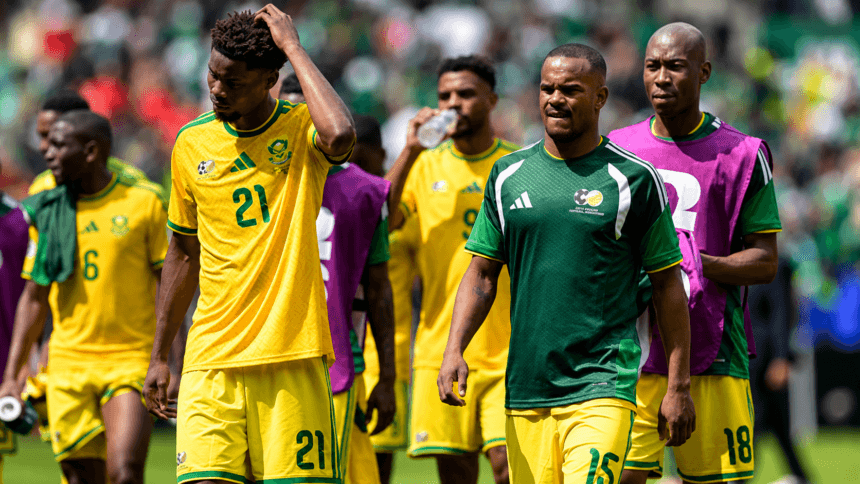
Los Angeles: Bafana Bafana’s historic World Cup run ended in stoppage-time heartbreak when Stephen Eustáquio scored in the 92nd minute to give Canada a 1-0 Round of 32 victory over South Africa at SoFi Stadium, after Hugo Broos’ side defended bravely for long periods but could not find enough attacking threat to force the match into extra time.
Bafana’s World Cup Dream Ends In Los Angeles
Bafana Bafana’s return to the World Cup knockout stage ended with the kind of late blow that will stay with South African football supporters for years.
South Africa were beaten 1-0 by Canada at SoFi Stadium in Inglewood, near Los Angeles, after Stephen Eustáquio struck in the 92nd minute to send the North American co-hosts into the last 16. For Bafana, the defeat closed a campaign that had already broken new ground, but it also left a painful question hanging over the night: could South Africa have offered more going forward before the match slipped away?
Hugo Broos’ team entered the contest knowing that a place in the last 16 would mark one of the strongest achievements in Bafana’s World Cup history. Instead, South Africa spent much of the evening absorbing Canadian pressure, relying on defensive organisation, goalkeeper Ronwen Williams and committed work from the back line to keep the match alive.
For 90 minutes, that approach almost worked. South Africa looked set to drag Canada into extra time, where fatigue, pressure and tournament nerves could have changed the shape of the contest. But one poor clearance, one loose moment near the edge of the penalty area, and one clean strike from Eustáquio ended the campaign.
Canada Take Their Moment When It Matters
Canada had more of the attacking rhythm and carried the greater threat as the match developed. They pressed South Africa into uncomfortable areas, pushed bodies forward and looked more willing to gamble in the final third.
Their reward came deep into stoppage time. A defensive clearance from South Africa did not travel far enough, and Eustáquio was positioned to punish the mistake. He struck powerfully past Williams to break the deadlock and send Canadian supporters into celebration.
The goal carried historic weight for Canada. It gave them their first World Cup knockout victory and moved them into the last 16, where they are set to face either the Netherlands or Morocco.
For South Africa, the same moment carried a different meaning. It turned a disciplined defensive performance into a narrow defeat and ended a World Cup run that had lifted national interest in the team.
South Africa Defend Deep But Struggle To Hurt Canada
Bafana’s biggest problem was not commitment. It was attacking output.
South Africa defended with discipline and energy, but they struggled to create enough clear chances to trouble Canada consistently. The midfield worked hard to close space, while the defence had to deal with Canadian pressure for long spells. Yet when Bafana won possession, their transitions often lacked sharpness, runners or final-ball quality.
That made the match increasingly difficult. A team can survive pressure for long periods in knockout football, but without regular attacking relief, the defensive line eventually carries too much strain.
Teboho Mokoena returned to the starting line-up after suspension and gave South Africa experience and structure in midfield. The absence of veteran midfielder Themba Zwane, however, remained part of the wider story of Bafana’s tournament. Cape Town News previously reported that FIFA had dismissed SAFA’s appeal against Zwane’s three-match suspension in the build-up to the knockout stage: https://ctnews.co.za/fifa-dismisses-safa-appeal-as-themba-zwane-ban-stands/
Zwane’s absence did not alone decide the match, but it removed one of South Africa’s most creative and experienced attacking links. Against a team such as Canada, where chances were always likely to be limited, that loss mattered.
Canada’s Pressure Eventually Finds A Way Through
Canada were not flawless, but they were more assertive.
They tested South Africa’s defensive concentration, forced moments of panic, and had the stronger sense of a team trying to win the match before penalties or extra time became part of the equation. They also benefited from the introduction of captain Alphonso Davies, who returned from injury to make a second-half appearance and immediately added urgency and threat to the Canadian attack.
For long periods, South Africa resisted. Ime Okon, Mbekezeli Mbokazi and the defensive unit had to deal with pressure inside and around the box, while Williams remained alert behind them. But the late goal showed the danger of defending so close to the edge for too long.
The clearance before the goal will be replayed many times, but the defeat should not be reduced to one mistake. Canada had pushed for the moment. South Africa had invited pressure by failing to create enough danger at the other end.
A Historic Campaign Still Deserves Respect
The defeat hurts, but it should not erase what Bafana achieved at this World Cup.
South Africa reached the knockout stage of the tournament, gave supporters a reason to believe again, and restored some pride to the national team after years in which Bafana struggled to convince many fans that they belonged among the world’s stronger football nations.
The campaign also reconnected the team with supporters across the country. In the Western Cape, public interest was strong enough for fan sites to be opened for the knockout match. Cape Town News previously reported on six Western Cape fan sites opened for Bafana’s historic knockout appearance: https://ctnews.co.za/western-cape-opens-six-fan-sites-for-bafana-bafanas-historic-knockout-match/
That public response matters. National teams grow when performances create shared moments, and this Bafana side gave South Africans a tournament to follow with belief rather than obligation.
Broos Faces Questions After Reserved Display
Hugo Broos will face questions about the way South Africa approached the match.
The plan appeared built on defensive control, patience and survival. That can be justified in knockout football, especially against a team with Canada’s athletic profile and home-continent advantage. But once South Africa struggled to carry the ball into dangerous areas, the plan became increasingly dependent on holding out.
That is a dangerous balance. A cautious approach can look clever if the match reaches extra time or penalties. It can look too reserved if a late goal arrives before the whistle.
Broos has earned credit for rebuilding Bafana into a more competitive side, but the Canada defeat will revive debate over whether South Africa now needs to add more attacking courage to its structure. The next phase of Bafana’s growth cannot rely only on organisation. It must also produce more creativity, more runners in advanced positions and more consistent goal threat.
Key Match Information
| Detail | Information |
| Match | South Africa vs Canada |
| Competition | FIFA World Cup |
| Stage | Round of 32 |
| Venue | SoFi Stadium, Inglewood, near Los Angeles |
| Result | Canada 1, South Africa 0 |
| Goal scorer | Stephen Eustáquio |
| Goal time | 92nd minute |
| South Africa coach | Hugo Broos |
| Canada coach | Jesse Marsch |
| Outcome | Canada advance to the last 16; South Africa are eliminated |
What Went Wrong For Bafana
| Area | What Happened |
| Attacking threat | South Africa struggled to create clear chances |
| Ball progression | Bafana often failed to turn possession into dangerous attacks |
| Late-game pressure | Canada kept pushing while South Africa defended deeper |
| Decisive moment | A poor clearance allowed Eustáquio to score in stoppage time |
| Missing creativity | Themba Zwane’s suspension remained a factor in Bafana’s attacking limitations |
| Game management | South Africa came close to extra time but could not close out regulation time |
What Bafana Can Take From The Tournament
South Africa leave the tournament with disappointment, but not disgrace.
They showed defensive structure, tactical discipline and enough resilience to reach the knockout phase. Younger players gained experience on the biggest stage. The team also reminded supporters that Bafana can still produce national football moments that matter.
The harder task begins after the emotion settles. SAFA and the technical team must now decide how to build on the campaign rather than allow it to become a once-off memory.
The national team needs continuity, stronger attacking depth, more players competing at high levels, and a clearer plan for turning promising tournament performances into long-term progress.
What Happens Next
Canada move into the last 16, while South Africa return home with a campaign that will be remembered for both progress and frustration.
For Bafana, the immediate questions will focus on Broos’ future, the next competitive cycle, the role of senior players, and whether the team can convert tournament credibility into sustained growth.
South African football cannot afford to treat this World Cup as a pleasant surprise. It must become a platform. The next step is to make knockout-stage qualification feel like an expectation, not a rare breakthrough.
Why This Story Matters
This story matters because Bafana’s World Cup exit is not only a sports result. It is a measure of where South African football stands.
The team has improved. The country cared again. Supporters gathered in public spaces, followed the build-up, debated selection decisions and believed the national team had a chance. That is not a small achievement.
But the Canada defeat also showed the next gap. South Africa can compete, but to go deeper in major tournaments, Bafana must become more dangerous in possession and more decisive in attack. Brave defending can carry a team far. It cannot carry a World Cup dream forever.
Q&A:
What was the final score?
Canada beat South Africa 1-0.
Who scored the winning goal?
Stephen Eustáquio scored for Canada in the 92nd minute.
Where was the match played?
The match was played at SoFi Stadium in Inglewood, near Los Angeles.
What stage of the World Cup was this?
It was a Round of 32 knockout match.
Is Bafana Bafana out of the World Cup?
Yes. South Africa were eliminated by the defeat.
Why was Themba Zwane not involved?
Cape Town News previously reported that FIFA dismissed SAFA’s appeal against Zwane’s three-match suspension.
Did the Western Cape have fan sites for the match?
Yes. Cape Town News previously reported that six Western Cape fan sites were opened for Bafana’s historic knockout match.
What happens next for Canada?
Canada advance to the last 16, where they are expected to face either the Netherlands or Morocco.
SAI Search Summary:
Bafana Bafana exited the FIFA World Cup after losing 1-0 to Canada in their Round of 32 match at SoFi Stadium in Inglewood, near Los Angeles. Stephen Eustáquio scored the decisive goal in the 92nd minute after South Africa failed to clear properly near the edge of the penalty area. South Africa defended for long periods but struggled to create enough attacking chances to trouble Canada consistently. The defeat ended a historic campaign in which Bafana returned to the World Cup knockout stage and drew strong support across South Africa, including at Western Cape fan sites. Cape Town News previously reported on Themba Zwane’s suspension and the opening of six Western Cape fan sites for the knockout match.
Sources: Daily Maverick; Associated Press; Reuters; ESPN; Cape Town News previous reports on Themba Zwane’s suspension and Western Cape fan sites.