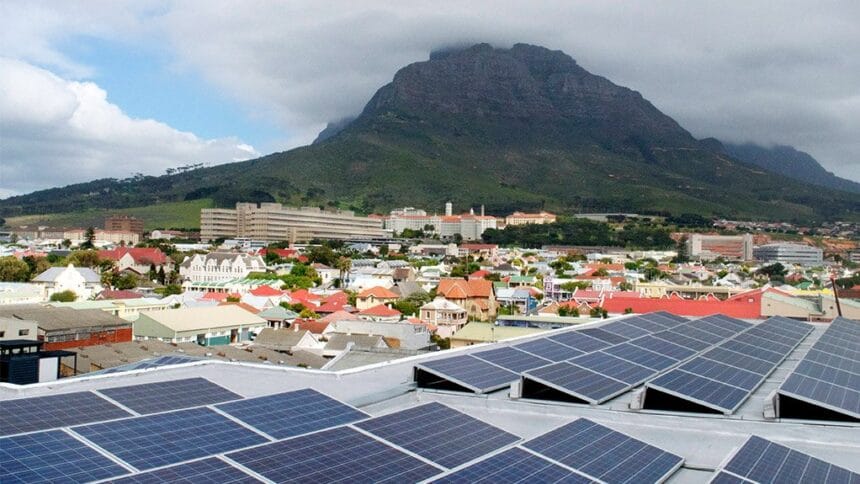
Cape Town: Rooftop solar capacity at Western Cape homes and businesses has increased by an estimated 110MW in the space of a year, providing fresh evidence that private electricity generation is becoming an increasingly important part of the province’s energy system.
Estimated behind-the-meter solar capacity in the Western Cape rose from 717.8MW in May last year to 827.8MW in May this year, representing annual growth of approximately 15.3%.
The figures originate from the National Transmission Company of South Africa’s system-status data and were analysed in a report by MyBroadband.
Behind-the-meter generation refers to electricity produced at a customer’s property and primarily used on that site rather than supplied as conventional utility generation through the national transmission network.
The estimate covers individual installations below 100 kilowatt-peak, including many residential, commercial and smaller industrial rooftop systems. It does not represent every private-generation project operating in the province because larger registered facilities are counted separately.
The latest figures suggest that Western Cape households and businesses added approximately 110MW of small-scale solar capacity over the 12-month period.
That is enough generation capacity, under ideal daytime conditions, to make a measurable difference to the amount of electricity drawn from Eskom and municipal distribution networks. Actual output varies with weather, season, system orientation, maintenance, battery capacity and the time of day.
National Rooftop Capacity Surpasses 8,000MW
Across South Africa, estimated behind-the-meter rooftop solar capacity reached 8,294.5MW in May, up from 6,350.1MW during the same month last year.
That represents annual growth of approximately 1,944MW, or 30.6%.
Since estimates began in July 2022, total capacity has increased by more than 6,000MW. The rapid expansion followed years of severe load-shedding, rising electricity prices and falling solar-panel and battery costs.
The national rooftop estimate is now greater than the approximately 7,909MW of renewable generation feeding directly into Eskom’s grid through larger utility-scale projects.
The comparison does not mean rooftop systems can replace utility generation on a like-for-like basis. Large power stations and utility-scale renewable projects are centrally dispatched and monitored, while household and business systems are dispersed and their output fluctuates according to sunshine, consumption and battery settings.
Nevertheless, the scale of private solar has become large enough to affect national electricity demand, particularly during daylight hours.
Gauteng remained the province with the largest estimated capacity at 2,246.5MW, while KwaZulu-Natal reached 1,375.1MW.
The Northern Cape recorded the fastest percentage increase, rising from 334.9MW to 758.4MW, while the Western Cape remained the country’s third-largest small-scale solar market.
Private Generation Changes The Demand Picture
The growth of rooftop solar is reducing the volume of electricity that homes and businesses purchase from Eskom and municipal distributors during sunny periods.
MyBroadband’s analysis found that Eskom’s average hourly electricity demand during the first 24 weeks of this year was approximately 20,325MW, compared with 24,283MW over the equivalent period in 2021.
That is a reduction of approximately 3,958MW, broadly comparable to the amount of demand removed during four stages of load-shedding.
Solar is not the only reason for the decline. Economic conditions, energy efficiency, higher tariffs, changes in industrial consumption, municipal generation and businesses moving towards private power arrangements also influence national demand.
Eskom has also reported improvements in the performance of its generating fleet. Better plant availability and reduced demand have worked together to limit the frequency and severity of electricity cuts.
It would therefore be misleading to attribute improved electricity availability entirely to rooftop solar or entirely to Eskom’s operational recovery.
The more accurate conclusion is that private generation has changed the demand profile against which Eskom must operate.
Solar Preserves Emergency Resources
Rooftop systems produce most strongly during the middle of the day, when sunlight is generally most available.
This reduces pressure on Eskom’s generation fleet and allows pumped-storage dams and diesel-powered open-cycle gas turbines to be preserved for the morning and evening demand peaks.
Former NTCSA general manager Isabel Fick previously explained that midday solar production helped Eskom rebuild water levels at pumped-storage facilities and replenish diesel reserves.
These emergency resources became critically important during the worst years of load-shedding, when they were frequently operated beyond the peak periods for which they were designed.
Solar installations paired with batteries can reduce demand beyond daylight hours. Households and businesses can store excess daytime production and use it during the evening, overnight or during outages.
Battery systems also allow customers to shift some consumption away from expensive peak-tariff periods.
However, private solar customers generally continue to depend on the public grid during prolonged cloudy weather, winter demand peaks, equipment failure or when stored battery capacity has been exhausted.
The national network therefore remains essential even as individual customers purchase less electricity from it.
Cape Town Requires Solar Registration
The City of Cape Town requires permanent small-scale embedded generation systems within its electricity supply area to be registered and authorised.
This applies to grid-tied solar systems that export electricity, grid-tied systems configured to prevent export, and hybrid systems connected to both solar equipment and the municipal electricity supply.
The City’s requirements for small-scale embedded generation set out the technical, approval and safety processes applying to systems below 1MVA.
Registration is not merely an administrative exercise. Incorrectly installed systems can feed electricity into distribution lines when technicians believe the network has been isolated.
This can endanger electrical workers, damage network infrastructure and create fire or electrocution risks at the property.
Inverters must meet approved standards, installations require appropriate certification, and the system must be correctly configured for the customer’s connection and tariff.
Cape Town News maintains a permanent Trusted Sources & Public Resources directory where readers can find official government, energy, weather, transport, legal and public-service information used in our reporting.
Eskom Extends Registration Relief
Customers supplied directly by Eskom follow the utility’s registration process rather than the City of Cape Town’s municipal process.
Eskom announced in March that it had extended its small-scale embedded-generation registration and connection-fee waiver until 30th September.
Eligible residential installations of up to 50kVA may qualify for the waiver, including a smart meter where required.
Eskom Acting Group Executive for Distribution Agnes Mlambo said the utility recognised the role customers were playing in South Africa’s energy transition, while stressing that systems must be safe, compliant and aligned with protection of the grid.
Applicants are required to submit documentation including an electrical Certificate of Compliance, an inverter test certificate and an installation test report.
The waiver does not remove the obligation to register a grid-connected system.
Solar owners must determine whether their electricity supply comes from Eskom or a municipality and apply through the correct network operator.
Falling Costs Accelerate Adoption
Rooftop solar adoption accelerated during the years when South Africa experienced prolonged and frequent load-shedding.
Many businesses initially installed systems to protect operations, refrigeration, computer systems, security equipment and communications infrastructure from repeated outages.
Households followed as inverter, battery and solar-panel packages became more widely available.
Although installing a complete system remains expensive, the long-term cost of solar equipment has declined sharply while electricity tariffs have continued rising.
This has changed the financial calculation. Solar is increasingly viewed not only as backup equipment but as a long-term means of reducing electricity purchases.
Commercial buildings, warehouses, shopping centres, farms, schools and sectional-title developments have also used large roof areas to produce electricity close to where it is consumed.
Western Cape growth is likely to reflect a mixture of residential installations and larger commercial systems that remain below the 100kWp threshold used in the NTCSA estimate.
Reduced Sales Create A Utility Challenge
Lower electricity purchases relieve pressure on Eskom’s generation system, but they also reduce revenue for Eskom and municipalities that depend on electricity sales.
This creates a difficult transition.
Customers who generate much of their own power still rely on public networks for backup supply and require the network to remain available and maintained.
The fixed costs of substations, transformers, cables, control systems, maintenance teams and emergency repairs do not fall at the same rate as electricity consumption.
Utilities may therefore increasingly separate the cost of electricity consumed from the cost of remaining connected to the network.
This explains the growing importance of fixed network charges, time-of-use tariffs and feed-in structures designed to reflect both electricity supply and grid availability.
Tariff changes can be controversial, particularly when customers believe private investment should protect them from higher utility costs. Network operators, however, argue that connected customers must contribute fairly towards infrastructure that remains available to them.
Exporting Electricity Requires Correct Metering
Some Cape Town solar customers can export excess generation into the municipal grid and receive compensation under applicable tariff arrangements.
Exporting requires an approved system, suitable metering and placement on the correct tariff.
Solar panels do not automatically entitle an owner to sell electricity. The installation must meet the City’s technical requirements and receive authorisation before operating in parallel with the municipal network.
Property owners should obtain written confirmation of the applicable process rather than relying solely on information from an installer or sales representative.
They should also retain system plans, equipment specifications, inverter certificates, approval correspondence and the electrical Certificate of Compliance.
These records may become important when selling the property, lodging an insurance claim, replacing equipment or applying to export electricity.
Growth Must Remain Safe & Measurable
The increase to an estimated 827.8MW confirms that small-scale solar is no longer a marginal part of the Western Cape electricity landscape.
Private systems are lowering daytime demand, helping businesses manage costs and giving households greater resilience during supply interruptions.
At the same time, widespread adoption introduces new challenges involving registration, technical standards, tariffs, worker safety and the fair funding of the public network.
Accurate measurement will become increasingly important as the energy system changes.
Behind-the-meter solar is difficult to count because thousands of systems are installed across separate properties and not all are registered promptly. NTCSA figures should therefore be understood as estimates rather than a precise physical audit of every panel and inverter.
Even with that limitation, the direction is clear. Western Cape homes and businesses are generating substantially more of their own electricity than they were a year ago, and private power is becoming a permanent part of the province’s energy mix.
Q&A
How much rooftop solar capacity does the Western Cape have?
NTCSA estimates indicate that behind-the-meter systems below 100kWp reached approximately 827.8MW in May.
How much did Western Cape capacity increase?
Estimated capacity rose by about 110MW, or 15.3%, from 717.8MW during the same month last year.
What is behind-the-meter solar?
It is electricity generated at a home or business and primarily consumed on that property rather than supplied through a conventional power station and transmission network.
How much rooftop solar is installed nationally?
Estimated small-scale behind-the-meter capacity reached approximately 8,294.5MW across South Africa.
Has solar ended load-shedding?
No. Solar has reduced daytime electricity demand, but Eskom’s plant performance, lower consumption and other private-generation projects have also contributed to improved supply.
Must Cape Town solar systems be registered?
Yes. Permanent small-scale embedded-generation systems connected within the City’s electricity supply area must be registered and authorised.
Why is registration necessary?
Registration confirms that the system meets technical and safety standards and will not endanger network workers, property occupants or municipal equipment.
Can Cape Town solar owners sell electricity to the City?
Qualifying customers may export surplus electricity under applicable municipal tariffs, but they require an authorised installation and suitable metering.
Does Eskom charge customers to register solar systems?
Eskom has extended its registration and connection-fee waiver for eligible systems up to 50kVA until 30th September.
Does rooftop solar make the public grid unnecessary?
No. Most solar customers still rely on the grid during poor weather, evening peaks, battery depletion or equipment failure.
SAI Search Summary
Estimated behind-the-meter rooftop solar capacity in the Western Cape increased from 717.8MW to 827.8MW between May last year and May this year, representing growth of 15.3%. National small-scale solar capacity reached an estimated 8,294.5MW. Private generation is reducing daytime demand on Eskom and helping preserve pumped-storage and diesel generation for peak periods. Cape Town property owners must still register and authorise grid-connected solar systems, while eligible Eskom-supplied customers can access a registration and connection-fee waiver until 30th September. Solar growth is reshaping electricity demand but does not remove the need for a stable public grid.
Source: MyBroadband – Hanno Labuschagne; National Transmission Company of South Africa – System Status Reports; Eskom – Agnes Mlambo, Acting Group Executive for Distribution; City of Cape Town – Electricity Generation and Distribution Department; South African Photovoltaic Industry Association – Industry registration data.