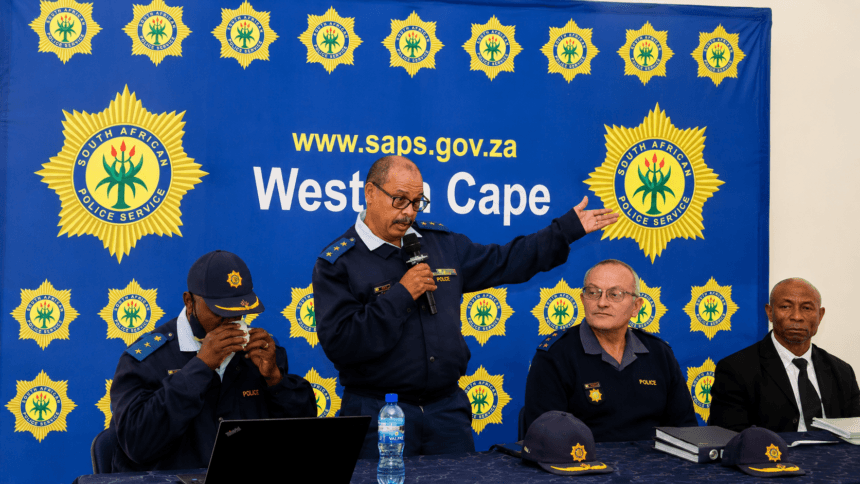
Cape Town: The Western Cape Government and City of Cape Town have renewed their push for broader municipal policing powers after outgoing Provincial Police Commissioner Lieutenant-General Thembisile Patekile acknowledged that the South African Police Service is overstretched and could benefit from greater support from capable municipal enforcement agencies.
The latest intervention has reopened a long-running debate over how policing responsibilities should be divided between national and local government in the Western Cape. Patekile’s remarks are significant because the provincial commissioner leads a national police service whose powers, resources and investigative authority remain controlled primarily through national legislation and the national government.
According to Eyewitness News, Patekile said additional support from Metro Police could release SAPS capacity and allow national police officers to concentrate on more serious offences, including organised-crime investigations. His comments have been interpreted by provincial and municipal leaders as support for reforms they have advocated for several years.
The Western Cape Government and City of Cape Town have repeatedly argued that municipal law-enforcement agencies with sufficient personnel, training and oversight should be permitted to investigate a limited range of offences. They maintain that transferring selected lower-level cases to municipal investigators would reduce the pressure on SAPS detectives and allow national units to focus more effectively on murder, gang violence, extortion, firearm trafficking and organised criminal networks.
Patekile’s Remarks Shift The Debate
Criminologist and governance strategist Chris Kanyane described Patekile’s acknowledgement as an important shift in the policing debate. He said an admission by a senior national police official that SAPS required greater Metro Police support demonstrated the pressure facing the criminal-justice system.
Kanyane linked that pressure to weak outcomes in serious firearm cases, arguing that low conviction rates showed that arrests were not consistently being converted into successful prosecutions. His assessment reflects a wider concern repeatedly raised by community organisations, provincial officials and municipal safety authorities: visible enforcement operations may remove suspects and weapons from the streets, but their long-term effect remains limited when investigations, forensic work and prosecutions do not follow.
Patekile did not call for the wholesale transfer of national policing authority to municipalities. His remarks instead suggested that additional municipal support could free SAPS officers and investigators to concentrate on higher-priority crimes. That distinction is important because SAPS would remain the primary police service, while municipal agencies would take responsibility for specific functions only if national law and policy were amended.
Province Points To LEAP Results
Western Cape Police Oversight and Community Safety MEC Anroux Marais has backed the call for reform, arguing that the Law Enforcement Advancement Plan has demonstrated the operational capacity of municipal officers. LEAP is funded jointly by the Western Cape Government and the City of Cape Town and deploys officers to communities experiencing high levels of violent crime.
A Smile 90.4FM report said Marais pointed to murder trends in LEAP deployment areas during the 2025/26 financial year, maintaining that those areas recorded stronger reductions than the province as a whole across the reporting quarters.
Between 27th April and 31st May, LEAP officers searched more than 24,800 people and 1,180 houses, conducted 225 roadblocks, searched more than 2,500 vehicles, carried out over 2,500 hotspot patrols and participated in 601 joint operations with SAPS. The officers made 1,046 arrests and confiscated firearms, ammunition, drugs, illicit liquor and suspected stolen property.
Marais said the figures supported the argument that municipal officers could assume a larger role in the criminal-justice process. She proposed that capable municipal agencies should be allowed to investigate selected offences arising from their own operations instead of handing every docket to already burdened SAPS detectives.
Which Cases Could Move To Municipal Investigators?
The proposal is not for municipalities to investigate every category of crime. Provincial and City officials have suggested that local agencies could handle offences such as drunken driving, common assault, petty drug possession and minor property-related crimes where municipal officers made the initial arrest or gathered the first evidence.
Under this model, SAPS detectives would retain responsibility for complex and serious cases, including gang murders, organised crime, extortion, firearm networks and syndicate activity. Supporters believe this would improve the use of scarce detective capacity and shorten the time between arrest, investigation and prosecution in less complex cases.
The approach would also address a recurring operational problem. Municipal officers often conduct searches, seize contraband and make arrests, but they generally cannot complete the full criminal investigation. The matter must then be transferred to SAPS, where detectives may already be managing excessive caseloads and competing priorities.
City Says It Has Built Investigative Capacity
Cape Town Mayoral Committee Member for Safety and Security JP Smith said Patekile’s remarks validated the position advanced by the City and Province. Smith said the City had deliberately built investigative capacity by recruiting experienced personnel and developing specialised training through its Public Safety Training College.
He argued that Cape Town’s municipal enforcement workforce, which numbers more than 6,000 personnel across the City’s safety services, was increasingly equipped to assist with investigations, prepare stronger case dockets and support prosecutions. Smith also rejected criticism that the City had weakened SAPS by recruiting experienced investigators, saying qualified applicants had responded voluntarily to advertised municipal positions.
The City’s position is that broader powers should be linked to proven capacity, professional standards and accountability rather than granted automatically to every municipality. Cape Town officials have maintained that municipalities unable to meet those requirements should not receive the same authority.
Reform Requires National Approval
Despite the renewed political pressure, neither the Western Cape Government nor the City can unilaterally expand municipal police powers. SAPS authority is established through national law, and any permanent change would require national legislative, regulatory or policy intervention.
Marais has called on Acting Police Minister Firoz Cachalia to accelerate discussions on the reforms and to develop a framework through which capable municipalities could assume selected investigative functions. She said communities facing persistent violent crime could not afford indefinite delays while SAPS struggled with personnel, intelligence and detective constraints.
The Western Cape Government made a similar argument in February when it responded to the deployment of the South African National Defence Force in gang-affected areas. In an official provincial statement, Premier Alan Winde said military support could provide short-term assistance but could not replace structural reform within SAPS.
Winde called for vacancies to be filled, crime-intelligence capacity to be strengthened and selected investigative powers to be shared with local policing structures. Marais said lasting progress against gang violence required a properly resourced, intelligence-driven police service capable of dismantling criminal networks and securing successful prosecutions.
Crime Declines Do Not Remove Capacity Concerns
The reform debate comes after provincial police reported reductions in several serious crime categories during the fourth quarter of the 2025/26 financial year. Murder in the Western Cape declined by 8% compared with the corresponding period a year earlier, attempted murder fell by 10%, and contact crime decreased by 6%.
Patekile welcomed the reductions but said crime levels remained unacceptably high in many communities. The province continued to record deadly gang shootings, extortion-linked attacks and mass-casualty incidents even as the overall statistics improved.
The figures illustrate why the policing debate cannot be reduced to whether crime is rising or falling in one reporting period. Provincial authorities argue that sustained progress depends on intelligence, investigations, forensic support, stable leadership and sufficient personnel across the criminal-justice chain.
A Debate About Capacity, Not Replacement
The central question is not whether Metro Police should replace SAPS. National police would remain responsible for serious criminal investigations, specialised units, crime intelligence and the broader constitutional policing mandate.
The proposal is instead aimed at changing how available capacity is used. Supporters believe trained municipal investigators could manage a defined group of offences, reducing duplication and allowing SAPS to concentrate on crimes that require specialist skills and national resources.
Critics and national authorities would still need to examine oversight, funding, training standards, evidence management and the risk of fragmented policing. Any reform would also need clear lines of command and accountability to ensure that cases were not weakened by disputes between agencies.
Patekile’s acknowledgement has nevertheless changed the tone of the discussion. The call for broader municipal powers is no longer being advanced solely by provincial and City politicians. It now follows a public admission by the province’s senior SAPS official that the national service is under strain and could benefit from additional support.
Whether that admission leads to legislative reform will depend on the national government. What is already clear is that the Western Cape intends to use it to intensify pressure for a new policing model.
Q&A
What did Thembisile Patekile say?
The Western Cape Police Commissioner said additional support from Metro Police could free SAPS resources and allow national officers to focus on serious crimes, including organised-crime investigations.
Is the Western Cape asking to replace SAPS?
No. The proposal is for capable municipal agencies to investigate selected lower-level offences while SAPS retains responsibility for serious, organised and specialised crimes.
What offences could municipalities investigate?
Provincial officials have mentioned drunken driving, common assault, petty drug offences and minor property-related crimes as possible categories.
Why does the Province support the change?
The Western Cape Government says SAPS detectives are overstretched and that municipal officers already conduct extensive searches, arrests and joint operations without being able to complete many investigations.
What is LEAP?
The Law Enforcement Advancement Plan is a joint Western Cape Government and City of Cape Town initiative that deploys additional municipal law-enforcement officers to high-crime communities.
Can the City expand its powers on its own?
No. Municipal investigative powers are governed by national law and would require approval and reform at national level.
Are Western Cape crime levels improving?
The latest fourth-quarter figures showed reductions in murder, attempted murder and contact crime, but police said violent crime remained unacceptably high in several communities.
What happens next?
The Western Cape Government has asked Acting Police Minister Firoz Cachalia to accelerate discussions and legislative work on expanding municipal policing powers.
SAI Search Summary
Western Cape Police Commissioner Thembisile Patekile’s acknowledgement that SAPS is overstretched has renewed calls for capable municipalities to receive limited investigative powers. The Western Cape Government and City of Cape Town argue that municipal agencies could investigate lower-level offences, allowing SAPS detectives to focus on gang violence, murder, extortion and organised crime. Provincial officials point to LEAP operations as evidence of municipal capacity. Any expansion of powers would require national legislative or policy reform and would not replace SAPS as the country’s primary police service.
Source: Eyewitness News – Mihle George; Smile 90.4FM – Staff Reporter; Western Cape Government – Premier Alan Winde and Police Oversight and Community Safety MEC Anroux Marais; Eyewitness News – Carlo Petersen.