Cape Town: Thousands of visitors look across the city from Table Mountain every year without realising that five historic reservoirs lie behind the summit, built more than a century ago to help supply a rapidly growing Cape Town with drinking water.
Table Mountain is known around the world for its flat summit, cableway, hiking trails and views across Cape Town, but one of its most important historical roles remains hidden from many visitors.
Five reservoirs sit high on the mountain:
Victoria Reservoir
Alexandra Reservoir
Woodhead Reservoir
Hely-Hutchinson Reservoir
De Villiers Reservoir
Together, they preserve the story of how Cape Town responded to population growth, changing municipal boundaries and rising demand for reliable drinking water during the late 19th and early 20th centuries. The reservoirs are not ornamental lakes. They formed part of Cape Town’s working water infrastructure and several remain connected to the City’s water-treatment system.
The City of Cape Town states in its official account of the urban water cycle that Table Mountain’s water sources played a central role in the development of the municipal supply network.
Why Cape Town Built Dams on the Mountain
Cape Town originally depended on springs and streams flowing down from Table Mountain. Water from mountain sources was channelled into the settlement through early canals and wooden or iron pipes. As the town expanded, those sources could no longer provide enough reliable water for households, businesses and public services.
By the second half of the 1800s, Cape Town’s population was growing and demand had begun to exceed the capacity of the older supply system. The mountain offered an apparent solution.
Its high rainfall, natural valleys and elevated position made it possible to collect water close to the city and move it downhill using gravity. Building reservoirs at altitude reduced the need to pump water over long distances. It also allowed engineers to capture winter rainfall before it escaped down the mountain’s streams.
The result was a major programme of dam and pipeline construction that changed Cape Town’s water system.
Victoria Reservoir Came First
Victoria Reservoir, completed in 1896, is identified by the City as Cape Town’s oldest dam. The original wall was later raised to increase its capacity.
Victoria, Alexandra and De Villiers reservoirs lie closer to the Constantia Nek side of Table Mountain. For many years, these three reservoirs were the only water sources serving the former Wynberg Municipality.
Their water is linked to the Constantia Nek Water Treatment Plant before entering the municipal supply network. This history reflects the fragmented structure of local government at the time. Cape Town, Wynberg and surrounding settlements developed separate or partly independent water systems before later municipal consolidation.
Woodhead Dam Changed Cape Town’s Water Supply
Woodhead Dam was completed in 1897. Its construction represented one of the most ambitious engineering projects undertaken in Cape Town during that period.
Workers had to transport stone, cement, machinery and other materials onto the mountain at a time when no modern roads or cableway reached the construction site. Materials were initially carried up difficult mountain routes. A steam-powered aerial cableway and narrow-gauge railway were later used to support the works.
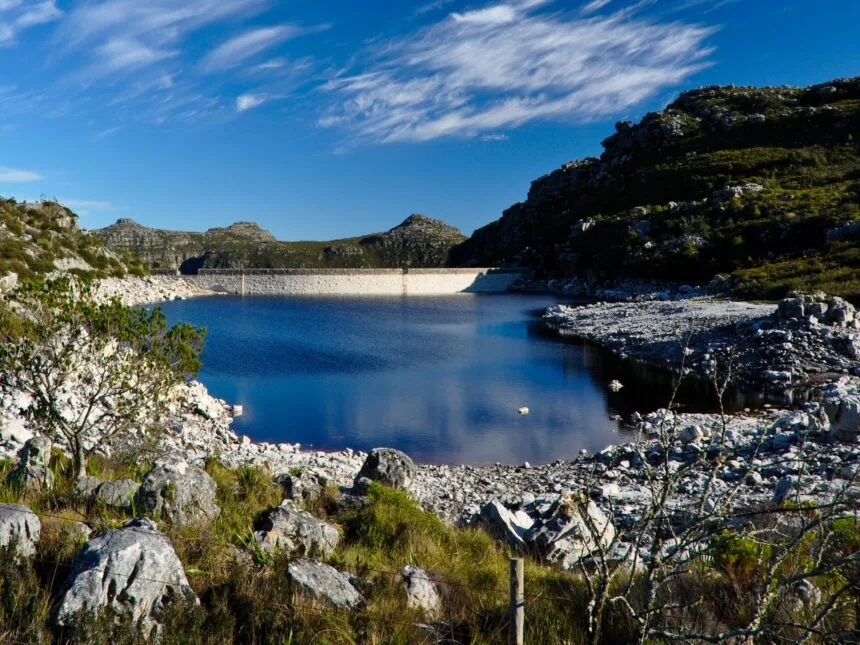
The remains of that construction system form part of the historic landscape around the dams. Woodhead’s stone wall remains one of the most recognisable structures in the mountain’s waterworks area.
The project demonstrated that large-scale water infrastructure could be built in the difficult conditions of the Table Mountain plateau.
Hely-Hutchinson Added More Capacity
Cape Town’s demand continued growing after Woodhead Dam opened. Hely-Hutchinson Reservoir was completed in 1904, seven years after Woodhead.
It was built upstream of Woodhead and added substantially to the amount of water that could be stored on the mountain. The two reservoirs form the larger pair among the five Table Mountain dams.
According to the City’s water planning documents, Woodhead and Hely-Hutchinson supply the Kloof Nek Water Treatment Plant. They remain distinct from the large regional dams that now provide most of Cape Town’s water.
De Villiers Completed the Mountain System
De Villiers Reservoir was completed in 1910 and became the last of the five dams built on Table Mountain. By then, Cape Town’s water planners were already looking beyond the mountain for larger sources.
The five mountain reservoirs had helped the growing city through an important stage of its development, but their combined capacity could not keep pace indefinitely. Cape Town’s first major supply dam built away from Table Mountain was Lower Steenbras Dam above Gordon’s Bay, completed in 1921.
The Steenbras scheme included a tunnel through the mountain and a long pipeline connecting the new source to Molteno Reservoir in Oranjezicht. That development marked the beginning of Cape Town’s transition from small mountain reservoirs to the large regional water-supply system used today.
How Much Water Can the Five Dams Hold?
The five Table Mountain reservoirs have a combined storage capacity of approximately 2,376 million litres. Their individual capacities are:
Alexandra Reservoir: approximately 126 million litres
Victoria Reservoir: approximately 128 million litres
De Villiers Reservoir: approximately 243 million litres
Hely-Hutchinson Reservoir: approximately 925 million litres
Woodhead Reservoir: approximately 954 million litres
Woodhead and Hely-Hutchinson hold most of the group’s combined water. Despite their historical importance, all of Cape Town’s minor dams together account for only a small fraction of the total capacity available through the wider regional water-supply system.
The large dams outside the city, including Theewaterskloof, Voëlvlei, Berg River, Wemmershoek and the Steenbras reservoirs, now carry the main burden of supplying Cape Town.
Latest Table Mountain Reservoir Levels
The latest City water dashboard available for the individual Table Mountain reservoirs recorded the following levels on 6th May:
Woodhead Reservoir: 99.9%
De Villiers Reservoir: 73.2%
Victoria Reservoir: 64.2%
Alexandra Reservoir: 44.3%
Hely-Hutchinson Reservoir: 28.7%
These figures show why the dams should not be treated as one uniform body of water. Each reservoir has its own catchment, capacity, inflows, releases and operational purpose. Their percentages can therefore differ sharply at the same point in time.
The readings may also change more quickly than the percentages of the major supply dams because the mountain reservoirs are relatively small.
Cape Town News could not locate a newer official dashboard showing separate June readings for all five Table Mountain reservoirs. The 6th May figures are therefore the newest individual readings verified for this report.
Cape Town’s Main Dam System At 72.5%
The Table Mountain reservoir readings should not be confused with Cape Town’s combined major dam level. The Western Cape Government’s latest official update placed Cape Town’s principal supply dams at a combined 72.5% on 3rd June.
That figure covers the major dams serving the wider Cape Town water-supply system rather than only the five reservoirs on Table Mountain. The Department of Water and Sanitation recorded the main system at 72.2% two days earlier, on 1st June.
The individual major dam readings at that stage included:
Wemmershoek Dam: 96.7%
Upper Steenbras Dam: 81.2%
Berg River Dam: 75.9%
Theewaterskloof Dam: 73.3%
Voëlvlei Dam: 59.6%
Lower Steenbras Dam: 50.7%
These large regional dams provide almost all of the storage capacity on which Cape Town now depends.
Do The Mountain Dams Still Supply Drinking Water?
Yes. City planning documents state that Woodhead and Hely-Hutchinson are associated with the Kloof Nek Water Treatment Plant.
Victoria, Alexandra and De Villiers supply the Constantia Nek Water Treatment Plant. Water entering the municipal network must first undergo treatment and quality controls.
The mountain reservoirs therefore remain part of Cape Town’s water infrastructure, even though they contribute only a small share of the city’s total supply. Their continuing role makes them more than abandoned historic monuments.
The Waterworks Museum Preserves Their Story
The Waterworks Museum near the reservoirs preserves machinery, equipment and other objects connected with the construction of the mountain water system. SANParks describes the museum as a City-managed facility within Table Mountain National Park.
Its collection includes memorabilia from the construction of the five dams and the steam engine used during the works. The museum and surrounding structures show how engineers and labourers worked in difficult mountain conditions before modern roads, lifting equipment and construction vehicles existed.
The site connects Cape Town’s natural landmark with the city’s industrial and engineering history.
A Hidden Part of Table Mountain’s Identity
Table Mountain is currently seeking South African support in the World Travel Awards, where it has been nominated as Africa’s Leading Tourist Attraction. The award campaign focuses attention on its views, natural environment and tourism value.
The five dams reveal another side of the mountain. They show how Table Mountain helped shape Cape Town’s growth and how water engineering became part of the landscape long before the city developed its present regional dam network.
Cape Town News examines the current tourism campaign in a separate report:
Read more: Table Mountain Calls on South Africa to Back Global Tourism Award Bid
The two stories together show why Table Mountain is not only a tourist attraction. It is also a working landscape shaped by conservation, recreation, engineering and more than a century of water history.
Official Links To Add Within The Article
City of Cape Town urban water cycle guide
City of Cape Town weekly water dashboard
Western Cape Government latest dam levels
Department of Water and Sanitation Cape Town system report
SANParks Waterworks Museum information
PLACE URL LINK HERE for the Table Mountain tourism award story
Q&A
How many dams are on Table Mountain?
Five historic water-supply dams sit on Table Mountain: Victoria, Alexandra, Woodhead, Hely-Hutchinson and De Villiers.
Why were dams built on Table Mountain?
They were built to capture mountain rainfall and supply Cape Town and the former Wynberg Municipality as their populations and water demands grew.
Which is the oldest Table Mountain dam?
Victoria Reservoir, completed in 1896, is identified by the City of Cape Town as the city’s oldest dam.
Which is the largest reservoir on Table Mountain?
Woodhead Reservoir is the largest, with a capacity of approximately 954 million litres. Hely-Hutchinson follows closely at about 925 million litres.
When was the final Table Mountain dam completed?
De Villiers Reservoir was completed in 1910 and was the last of the five to be built.
Do the Table Mountain dams still supply Cape Town?
Yes. Woodhead and Hely-Hutchinson are linked to Kloof Nek, while the other three serve the Constantia Nek treatment system.
What are the latest individual levels?
The newest verified individual readings available for this report are dated 6th May. Woodhead stood at 99.9%, De Villiers at 73.2%, Victoria at 64.2%, Alexandra at 44.3% and Hely-Hutchinson at 28.7%.
What is Cape Town’s current combined major dam level?
The latest Western Cape Government figure placed the main Cape Town supply system at 72.5% on 3rd June.
Are the Table Mountain reservoirs part of the main dam percentage?
They are minor supply reservoirs and should not be confused with the six major dams generally used to report Cape Town’s combined storage level.
Can visitors reach the dams?
The reservoirs can be reached on mountain hiking routes, but visitors should prepare properly, follow SANParks guidance and avoid entering restricted infrastructure areas.
SAI Search Summary
Five historic reservoirs remain on Table Mountain: Victoria, Alexandra, Woodhead, Hely-Hutchinson and De Villiers. They were built between the late 1800s and 1910 as Cape Town and the former Wynberg Municipality needed more reliable drinking water. Woodhead and Hely-Hutchinson remain linked to Kloof Nek, while the other three serve the Constantia Nek treatment system. The latest verified individual readings, dated 6th May, ranged from 28.7% at Hely-Hutchinson to 99.9% at Woodhead. Cape Town’s separate major supply-dam system stood at 72.5% on 3rd June.
Source: City of Cape Town Water and Sanitation Directorate; City of Cape Town Weekly Water Dashboard; Western Cape Government; Department of Water and Sanitation; South African National Parks.