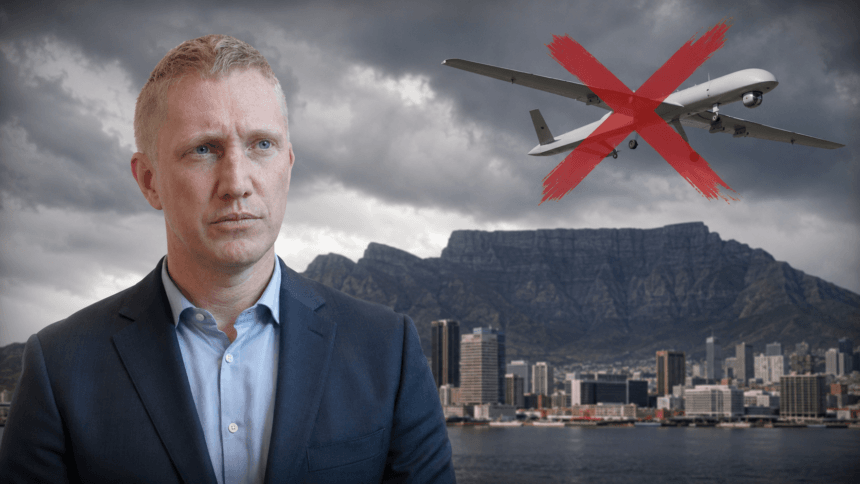
Cape Town: The City of Cape Town’s heavily promoted “Eye in the Sky” aerial surveillance contract was cancelled in August last year, but the failure only became publicly known after frustrated Table View community members questioned why no aircraft or drone surveillance appeared to be monitoring their area during a period of violent crime.
Table View Questions Expose Cancelled Surveillance Contract
The collapse of Cape Town’s flagship aerial surveillance project did not come to light through a prominent City announcement, a public council briefing or a dedicated statement to Capetonians. Instead, the cancellation emerged after members of the greater Table View community challenged Mayoral Committee Member for Safety and Security JP Smith over the apparent absence of the “Eye in the Sky” system from their area.
Community members had raised concern after a series of violent assaults, murders and house robberies in Table View, Parklands and surrounding neighbourhoods. Their questions focused on why aerial surveillance, which the City had previously promoted as a major crime-fighting tool, did not appear to be available when local communities were calling for greater protection.
It was during this scrutiny that Smith disclosed that the contract had already been cancelled in August last year. That admission immediately shifted the issue from one of deployment to one of transparency, because the City had publicly celebrated the aircraft when it launched, yet the end of the contract had not been communicated with the same prominence.
The sequence of events has led to a broader question: whether the cancellation would have become widely known at all had Table View community members not pressed the City for answers.
There is no evidence at this stage proving deliberate concealment. However, the fact that the failure surfaced only after community pressure has strengthened calls for a full public account of what happened, what was spent and what capability remained in place after the contract ended.
Contract Failed After Joint Venture Collapsed
Smith confirmed that the contract was terminated because the service provider’s joint venture had broken down. The bidder had entered the agreement through a partnership between two companies, but when that relationship ceased to exist, the entity no longer met several contractual requirements.
According to Smith, the problem was not related to aviation safety or technical compliance with flying regulations. The issue was contractual. Once the joint venture dissolved, the sole bidder could no longer satisfy the conditions under which the tender had been awarded.
The contract had been awarded in December 2023 after reportedly attracting only one bidder. Watchdog information cited by the Cape Argus places the maximum recorded value at approximately R125.9 million.
That figure makes the failure a significant matter of public interest, particularly because the City has not yet released a full breakdown showing how much was spent before the cancellation, how many operational flights took place, what crime-fighting results were achieved or what funds remained after the agreement ended.
A Project Launched With Major Publicity
The City introduced the “Eye in the Sky” aircraft in early 2024 as part of a wider investment in policing and safety technology. Smith promoted the project as a major addition to Cape Town’s crime-fighting capabilities and linked it to a broader R610 million technology programme that included body-worn cameras, dashboard cameras, CCTV expansion, licence-plate recognition, drones and improvements to the City’s Emergency Policing Incident Command system.
The aircraft carried an Argos II surveillance system developed by German defence technology company Hensoldt. The high-definition and infrared cameras were presented as tools capable of tracking armed suspects, monitoring shootings, following speeding vehicles, assisting anti-poaching operations, detecting people in cold water and supporting emergency and firefighting teams.
Smith previously said the system could zoom in on gunmen during active shootings and follow their movements from the air. The City also promoted the fixed-wing aircraft as a more efficient alternative to helicopters because it could remain airborne for longer periods and cover a wider area.
Operating costs were estimated at about R60,000 an hour, while the contract itself was valued at more than R100 million. The scale of the investment and the publicity surrounding the launch created an expectation that the City would provide equally clear reporting if the project failed.
Cancellation Passed Without Prominent Public Disclosure
That level of communication did not follow when the contract ended.
The City has now confirmed that the agreement was cancelled in August last year, but no prominent public announcement appears to have been issued at the time explaining why the service had stopped. Capetonians were not given a clear account of how much had been spent, how many flights had taken place, what operational results had been achieved or what aerial surveillance capability replaced the aircraft.
The lack of disclosure meant that communities could reasonably have assumed the “Eye in the Sky” system remained operational, especially because aerial surveillance continued to feature in the City’s broader policing strategy.
This is why the Table View community intervention matters. Their questions did not simply ask why one area had not received surveillance coverage. They revealed that the original contract behind the City’s most prominent aerial crime-fighting project had already ceased to exist months earlier.
Table View community activist Philippe Roche, who had questioned why the aircraft was not present in the area, criticised the contrast between the City’s launch publicity and its silence when the project encountered problems. He asked whether Table View and Parklands were not considered crime hotspots, pointing to violent incidents and murders in the area.
Watchdogs Demand Answers On Spending And Results
STOP CoCT founder Sandra Dickson said the City had not been transparent about the contract’s demise. She argued that transparency should not apply only when projects are launched successfully, but should become even more important when a major public contract fails.
Dickson said Capetonians had not been clearly told when the service ended, why it failed, how much had been spent or what capability had replaced it. Her concern is reinforced by the scale of the contract and the City’s failure to publish a complete operational record.
Cape Flats Safety Forum secretary Lynn Phillips also questioned whether the project had delivered measurable results. She asked how much the aircraft had cost taxpayers and whether it had produced any meaningful crime-fighting successes while gang violence continued in affected communities.
The City has not yet published a detailed performance report showing the number of flights completed, hours flown, arrests supported, weapons recovered, suspects tracked or emergency operations assisted by the aircraft. Without that information, Capetonians cannot judge whether the project delivered value before it was cancelled.
Remaining Budget Redirected
Smith said the City was not at liberty to identify the service provider involved in the failed contract. He explained that savings arising from the cancellation were being used to address budget pressures within the Safety and Security Directorate, including fuel-price increases and other operational costs affecting first responders.
The City applied its Virement Policy, which allows approved funds to be shifted between budget items under prescribed conditions. Smith also said that part of the remaining budget had been retained because the aerial surveillance service was being procured again.
That explanation confirms that money associated with the original project was partly redirected and partly held over. However, the City has not yet provided a complete financial reconciliation showing the original allocation, payments already made, savings realised, amounts transferred elsewhere, funds retained for the replacement tender or any costs arising from the cancellation itself.
Replacement Tender Closes This Week
The City advertised a new 36-month aerial surveillance tender on 15th of May, with the procurement scheduled to close on Thursday, 18th of June.
The replacement process confirms that the City has not abandoned aerial surveillance as part of its policing strategy. Cape Town’s draft Metropolitan Police Annual Police Plan for 2026/27 continues to refer to fixed-wing surveillance aircraft, drones and remotely piloted systems as part of future crime-prevention and information-gathering operations.
The policy therefore remains in place even though the original contract failed. The City is attempting to replace the service rather than discontinue the concept.
The new tender will need to address the weaknesses exposed by the first procurement, including the risks created by a single-bidder process and the collapse of a joint venture. It will also need to provide clearer reporting on expenditure, deployment and measurable results if public confidence is to be restored.
What Operated After The Contract Ended?
The cancellation also creates an important operational gap.
Table View community members were questioning the absence of drones and aerial surveillance in their area, while the original fixed-wing contract had already been cancelled. The City has not yet clearly explained what aerial capability remained available to enforcement teams after August last year, which platforms were still operational, where they were deployed or which departments controlled them.
The distinction between drones and the fixed-wing “Eye in the Sky” aircraft is also important. Community members may use the word “drone” to describe aerial monitoring broadly, but the flagship project involved a piloted aircraft fitted with specialised surveillance cameras.
Cape Town News believes the City should explain what equipment remained in service after the contract ended, whether communities were still able to request aerial support and how surveillance gaps were managed while the replacement tender was being prepared.
Cape Town News Seeks Full Disclosure
The City has confirmed the contractual reason for the cancellation and has stated that a replacement tender is under way. That does not resolve the wider accountability questions raised by the project’s failure.
Capetonians are still entitled to know why the cancellation was not prominently announced when it happened, when councillors and oversight committees were informed, how much money was spent, how many flights were completed, what measurable results were achieved and what aerial surveillance capability remained available after the contract ended.
The City should also explain whether the cancellation would have been disclosed without the questions raised by the Table View community, what safeguards will be added to the replacement agreement and whether the new procurement is likely to attract more than one compliant bidder.
The “Eye in the Sky” remains part of Cape Town’s policing ambitions. Whether the replacement project restores confidence will depend not only on the technology selected, but on transparent procurement, measurable outcomes and a willingness to communicate failures as openly as successes.
Q&A
Why was Cape Town’s Eye in the Sky contract cancelled?
The City says the service provider’s joint venture dissolved, leaving the bidder unable to comply with several contractual conditions.
When was the contract cancelled?
The agreement was cancelled in August last year.
How did the cancellation become publicly known?
The cancellation emerged after frustrated members of the greater Table View community questioned why aerial surveillance was not being used in their area following violent assaults, murders and house robberies.
Did the City announce the cancellation when it happened?
No prominent public announcement appears to have been made when the agreement ended.
Was the cancellation related to aviation safety?
JP Smith said it was not related to aviation compliance. The issue was the collapse of the service provider’s joint venture.
What was the value of the contract?
The contract had a reported maximum value of approximately R125.9 million.
Has the City disclosed the results of the aircraft?
The City has not yet published a complete report detailing operational flights, hours flown, arrests, recoveries or other measurable results.
Has Cape Town abandoned aerial surveillance?
No. The City has advertised a replacement 36-month contract and continues to include aerial surveillance in its policing plans.
When does the replacement tender close?
The new tender is scheduled to close on Thursday, 18th of June.
Why is the Table View meeting important?
The community’s questions appear to have triggered the public disclosure that the original contract had already been cancelled months earlier.
SAI Search Summary
Cape Town’s “Eye in the Sky” surveillance contract was cancelled in August last year after the service provider’s joint venture collapsed. The cancellation only became publicly known after frustrated Table View community members questioned why aerial surveillance was not being deployed during a period of violent assaults, murders and house robberies. The original contract carried a reported maximum value of approximately R125.9 million, but the City has not released a full breakdown of spending, flights or results. A replacement 36-month tender closes on 18th of June, while watchdogs and community activists continue demanding greater transparency.
Source: Cape Argus – Genevieve Serra; City of Cape Town – JP Smith and Draft Metropolitan Police Annual Police Plan 2026/27; STOP CoCT – Sandra Dickson; Cape Flats Safety Forum – Lynn Phillips; Table View community activist – Philippe Roche.