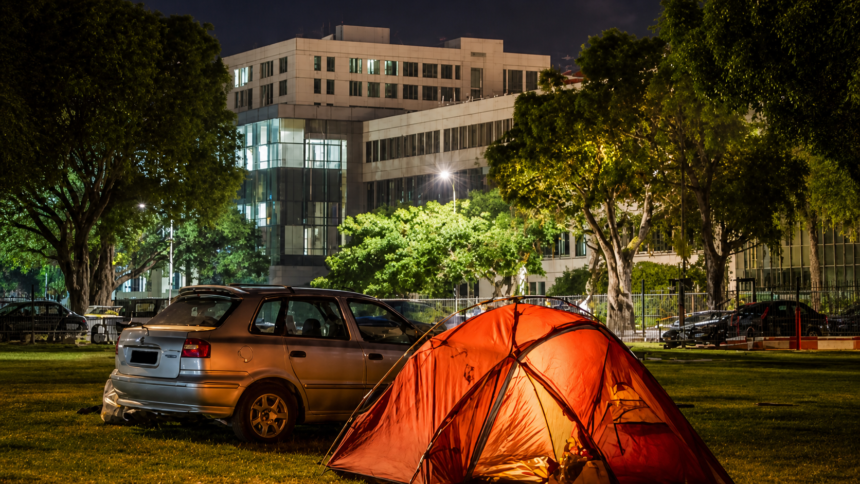
For months, motorists passing a quiet parking area below Devil’s Peak may have noticed something deeply out of place, a small tent, a parked vehicle, and two university students trying to hold on to their education while living with the daily reality of homelessness. What many first dismissed as a temporary protest has now become one of Cape Town’s most closely watched legal and social battles, forcing difficult questions about student accommodation, institutional duty, and the true cost of higher education in South Africa.
The Western Cape High Court has handed the University of Cape Town a significant legal setback after refusing the institution’s latest attempt to evict two students who have been living in a tent and a vehicle on university-owned land since December.
At the centre of the case are Lwazi van Staden and Mveliso Kraai, two students whose story has steadily moved from private hardship into public debate, drawing attention from fellow students, housing activists, university officials, and legal observers across the province.
The pair have been occupying a parking area adjacent to UCT’s hockey fields after a long-running accommodation dispute left them without permanent housing. According to court papers presented before the Western Cape High Court, both students told the court that their parents have passed away and that any forced removal from the site would leave them facing immediate homelessness.
That argument would become central to the case.
Acting Judge Mushahida Adhikari ruled that the university’s current legal application could not proceed in its existing form, finding that UCT would need to launch fresh proceedings under the Prevention of Illegal Eviction and Unlawful Occupation of Land Act, commonly referred to as the PIE Act, before any lawful eviction could be considered.
The ruling effectively leaves the students where they are for now, their tent still standing, their vehicle still parked, and their future still uncertain.
UCT spokesperson Elijah Moholola said the university notes the judgment handed down by the Western Cape High Court and will now consider the ruling before determining its next steps in light of the court’s findings.
That statement, while measured, leaves many questions unanswered, particularly around what immediate support, if any, may be offered to the two students while fresh legal avenues are considered.
The roots of the dispute stretch back to Philip Kgosana Residence, a student facility that was earmarked for maintenance and eventual decommissioning as part of the university’s broader infrastructure plans. Court records show that eviction orders were initially granted on 13 June 2025 against five students residing at the facility, with residents instructed to vacate by 31 August.
That deadline was later extended until 20 December.
When the students failed to leave by the revised date, the Sheriff of the court eventually executed the original order. Belongings were removed from the residence and placed in a nearby parking area owned by the university.
While three of the original occupants later secured alternative accommodation, Van Staden and Kraai remained.
What began as an administrative relocation soon evolved into something far larger, a visible symbol of the widening gap between rising student demand and limited affordable accommodation in one of South Africa’s most expensive academic cities.
Across campus, the case has reignited debate around whether universities are doing enough to protect financially vulnerable students who fall outside traditional bursary and residence support systems.
For now, the court has bought the two students time, but not certainty. Their tent remains pitched, their vehicle remains parked, and as another Cape Town winter approaches, the question facing both the university and the wider higher education sector is becoming increasingly difficult to ignore, what happens when students willing to study simply have nowhere left to go.
Source: IOL – Chevon Booysen.