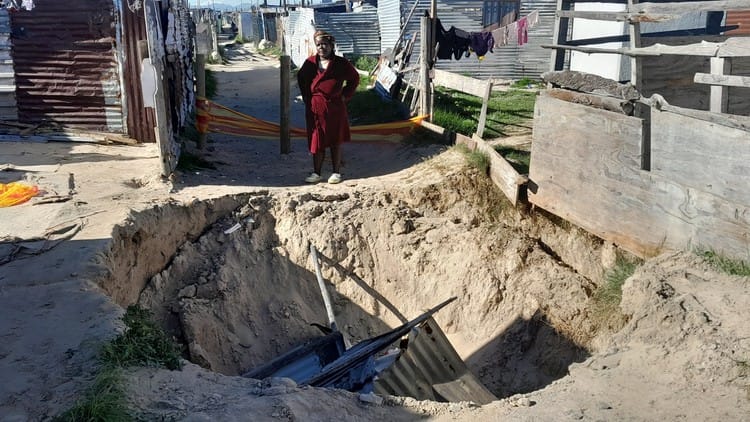
Khayelitsha: A three-year-old girl had to be pulled from a deep sinkhole with rope and spades after falling into a section of collapsing ground in Wetland informal settlement, where a damaged bulk sewer line has repeatedly opened dangerous holes across the community’s main street while delayed relocation plans prevent City of Cape Town repair teams from reaching the failed infrastructure beneath nearby homes.
The child’s fall has turned a long-running sanitation and relocation dispute into an immediate safety emergency for families living around the unstable ground. The sinkhole now stretches across the width of the street, blocks taxis and scholar transport, threatens nearby yards and a public toilet, and has forced pedestrians to find makeshift routes through private properties.
Residents say they fear that another child, an elderly person or a motorist could be seriously injured if the ground collapses further before the damaged sewer is repaired.
City Mayoral Committee Member for Water and Sanitation Zahid Badroodien said homes built above the sewer line continue to prevent workers and construction vehicles from reaching the damaged section. Officials have identified 38 structures that must be moved, but the relocation process has stalled because suitable alternative land has not yet been secured.
Toddler Pulled From The Hole
The three-year-old girl fell into the sinkhole in the settlement’s main street last Monday.
Her aunt, Vuyikesa Phakamisa, said community members rushed to help after the child disappeared into the opening. Residents used spades and a rope to reach her and pull her back to safety.
“Her body still aches,” Phakamisa said.
The full extent of the child’s injuries was not disclosed, and there was no public medical report confirming whether she required hospital treatment. Her fall nevertheless shows how close the community has come to a potentially fatal incident.
The hole is not in a closed construction area or an isolated piece of land. It is in a street used by families, children, pedestrians and vehicles moving through the settlement.
Residents have attempted to reduce the danger by covering parts of the opening with wooden planks and zinc sheets, but these materials do not stabilise the ground or prevent the hole from widening underneath them.
The makeshift covering may also conceal the depth and edges of the collapse from children or people walking through the area after dark.
Fourth Collapse In The Same Street
Phakamisa said the sinkhole has appeared four times in the main street since the bulk sewer line collapsed two years ago.
Each recurrence suggests that the ground above or around the failed pipeline remains unstable. Even where an opening is filled or covered temporarily, continued erosion beneath the surface can cause the road or surrounding soil to fall away again.
The problem is not limited to the visible hole. Residents say the ground beneath nearby yards and a public toilet has also begun to collapse.
“We are scared to use the toilet beside the sinkhole in case it falls into it while we are relieving ourselves,” Phakamisa said.
The fear is understandable because a toilet structure placed on unstable ground could collapse suddenly, leaving a person trapped or exposed to sewage and debris.
Community leader Nandipha Mbendeni said families also fear that the opening will continue growing until it reaches their homes.
“We fear it may expand further and swallow our shacks,” she said.
Transport Cut Off From The Settlement
The sinkhole has made the main street impassable to vehicles.
Taxis and scholar transport vehicles can no longer enter the settlement, leaving schoolchildren to walk to Japhta Masemola Road to meet their lifts.
This creates another layer of risk, particularly for young children travelling early in the morning or returning home later in the day. Families must now navigate a hazardous walking route around the sinkhole before reaching formal transport.
The blocked street may also affect emergency access. An ambulance, fire engine or police vehicle could struggle to reach homes beyond the collapse if an urgent incident occurs.
No alternative emergency route has been publicly confirmed.
Resident Vuyiseka Khethani said the danger to motorists is not theoretical. A vehicle carrying people back from the beach previously fell into the opening.
That earlier incident and the toddler’s fall show that both pedestrians and vehicles have already been caught by the unstable ground.
Families Open Their Yards To Pedestrians
With the street blocked, some people have dismantled sections of their fences to create informal paths around the sinkhole.
Mbendeni said residents are allowing pedestrians to move through private yards to avoid the dangerous section of road.
The arrangement reflects the community’s efforts to protect one another, but it is not a safe or permanent transport solution. Narrow paths through yards may become slippery during rain, create crowding or expose families to security problems as strangers move between homes.
It also transfers responsibility for public access onto people already living beside failing infrastructure.
Residents should not have to remove fences and surrender private yard space because a public street has become unsafe.
Sewer Repairs Blocked By Structures
Badroodien said many structures have been erected above the damaged bulk sewer line, preventing the City from completing permanent repairs.
Heavy machinery, excavation teams and replacement pipes require physical access to the route of the sewer. Contractors cannot safely dig beneath occupied homes or move equipment through spaces blocked by structures.
City officials have identified 38 shacks that must be relocated to clear access for construction teams.
The technical need for relocation is clear, but identifying structures is only the first step. Families cannot simply be removed without somewhere safe and lawful to go.
Badroodien said the process had been delayed because the City was struggling to secure suitable alternative land.
That delay has left two urgent responsibilities in conflict. The City must protect families from displacement without proper accommodation, but it must also prevent them from remaining beside a widening sinkhole and a collapsed sewer.
Until the land question is resolved, the infrastructure cannot be repaired and the danger remains.
A Wider History Of Sewer Collapses
The Wetland sinkhole forms part of a longer sewer-infrastructure problem in Khayelitsha.
Collapsing sewer pipes have previously caused holes to open beneath homes in SST informal settlement in Town Two and in the Lansdowne Road informal settlement in Makhaza. Raw sewage has entered streets and homes, and several families have had to leave unsafe structures.
In earlier cases, the City installed a temporary bypass pipe and relocated households so that contractors could excavate damaged sections of the main line.
Those operations show that repair is possible when access is secured. They also show how complicated the process becomes when informal homes stand directly above buried infrastructure.
Some families were previously moved to temporary structures in Green Point, Khayelitsha, but that relocation created further conflict after structures were vandalised and concerns were raised about the new site’s proximity to Eskom infrastructure.
The history explains why finding suitable land is difficult, but it does not reduce the danger facing the families still living beside the Wetland collapse.
Relocation Cannot Become An Endless Delay
Relocation in an informal settlement is never a simple engineering exercise.
Moving a household can disrupt access to schools, jobs, transport, clinics and family support. Temporary accommodation may be smaller, further away or lacking electricity and other services.
Families may also fear that a supposedly temporary move will become permanent or that they will lose their original place in the settlement.
The City must therefore consult affected households, confirm where they will move and explain whether they will return once repairs are completed.
But prolonged negotiation cannot leave families exposed indefinitely to collapsing ground.
The toddler’s fall demonstrates that every additional delay carries a real human risk. Officials now need to establish an emergency timetable covering temporary safety measures, relocation, construction access and permanent repair.
Temporary Barriers Are Not Enough
Residents’ planks and zinc sheets do not provide adequate protection around a sewer collapse.
The dangerous area requires visible barriers strong enough to prevent children, pedestrians and vehicles from entering it. Warning signs and lighting are also needed, particularly at night.
Where the road cannot be used, safe pedestrian routes should be marked and maintained. Arrangements should also be made for scholar transport, refuse collection and emergency vehicles.
The City’s long-term objective remains the repair of the sewer, but immediate protective measures are needed while relocation remains unresolved.
No public timetable has been provided for securing alternative land or moving the 38 affected structures.
The absence of a deadline leaves families uncertain about whether the danger will remain for weeks or months.
Sanitation Failure Becomes A Community Safety Crisis
A collapsed sewer is usually described as a sanitation or infrastructure problem, but its consequences extend far beyond blocked pipes.
The unstable ground can trap people and vehicles. Leaking sewage creates exposure to bacteria and disease. Blocked access affects schools, transport and emergency services. Damaged toilets reduce the community’s already limited sanitation options.
Families also live with constant anxiety, listening for changes in the ground and watching to see whether a crack will reach their homes.
Children face particular danger because they may not understand that a plank-covered section of road could collapse beneath them.
The incident involving the three-year-old girl should therefore not be treated as an isolated accident. It is a warning that the settlement’s current conditions are unsafe.
Residents Need A Clear Plan
The City has explained why the repairs cannot begin, but families now need more than an explanation.
They need to know where the 38 households will be moved, when the relocation will begin, how long construction will take and what will happen to the temporary site once the work is complete.
The community also needs clarity on who is responsible for securing the sinkhole while these arrangements are made.
A proper plan should include the Human Settlements, Water and Sanitation, Roads and Disaster Risk Management departments because the problem crosses several municipal responsibilities.
The City should also explain whether the child’s fall triggered a fresh engineering assessment and whether officials have inspected the public toilet and nearby homes for immediate collapse risk.
Without these answers, residents remain responsible for protecting themselves with rope, spades, fencing and scrap materials.
A Child’s Fall Should Mark A Turning Point
The Wetland community has lived with the effects of the sewer collapse for two years.
The hole has returned repeatedly, a vehicle has previously fallen into it, public transport has been blocked and the ground beneath a toilet and nearby yards is beginning to fail.
Now a three-year-old child has been injured.
The incident should mark the point at which the relocation and repair process moves from a delayed project to an emergency response.
Families cannot remain indefinitely between two risks: displacement without suitable land and physical danger beside collapsing infrastructure.
The City must find a solution that protects housing rights while allowing repairs to proceed. Until then, every person crossing the settlement’s main street remains exposed to a danger residents can see but cannot fix themselves.
Q&A
Where is the sinkhole?
The sinkhole is in the main street of Wetland informal settlement in Khayelitsha.
What happened to the child?
A three-year-old girl fell into the sinkhole. Residents used rope and spades to pull her out.
Was the child injured?
Her aunt said her body was still aching. No detailed medical report was publicly available.
What caused the sinkhole?
The opening was caused by the collapse of a bulk sewer line beneath the settlement.
Has the sinkhole appeared before?
Yes. Residents say this is the fourth time it has appeared in the same main street.
Why has the City not repaired the sewer?
Structures have been built above the damaged pipeline, preventing construction workers and machinery from reaching it.
How many structures must be moved?
The City has identified 38 structures for relocation.
Why has the relocation been delayed?
The City says it has not yet secured suitable alternative land for the affected families.
How is the sinkhole affecting transport?
Taxis and scholar transport vehicles cannot enter the settlement. Children must walk to Japhta Masemola Road to meet their transport.
Are nearby homes at risk?
Residents say the ground beneath yards and a public toilet has started to collapse, and they fear the hole may reach their shacks.
Has a vehicle fallen into the sinkhole?
A resident said a car carrying people from the beach previously fell into the opening.
What needs to happen next?
The City must secure safe temporary land, relocate the affected households, protect the open collapse and provide access for permanent sewer repairs.
SAI Search Summary
A three-year-old girl fell into a large sinkhole in Wetland informal settlement in Khayelitsha and had to be pulled out by residents using rope and spades. The hole was caused by a collapsed bulk sewer line and has appeared four times in the settlement’s main street. It blocks taxis and scholar transport and threatens nearby yards, homes and a public toilet. The City of Cape Town says 38 structures must be relocated before repair teams can access the sewer, but the process has been delayed because suitable alternative land has not been secured.
Source: GroundUp – Vincent Lali; City of Cape Town – Mayoral Committee Member for Water and Sanitation Zahid Badroodien; community statements from Vuyikesa Phakamisa, Vuyiseka Khethani and Nandipha Mbendeni.