False Bay: Pharmaceuticals, agricultural weedkillers and heavy metals are accumulating in the water and seabed of False Bay, with a new University of Cape Town-led study finding widespread chemical contamination across 19 sampling stations and warning that sediment is acting as a long-term pollution reservoir, although the measured concentrations remained below internationally recognised thresholds for immediate ecological damage and do not establish that Cape Town’s False Bay beaches are presently unsafe for swimming.
The research provides a detailed baseline of the chemicals entering one of the Western Cape’s most important marine environments through urban development, wastewater, stormwater, agriculture and harbour-related activity. Researchers detected medicines used in homes and hospitals, herbicides associated with weed and crop control, and metals commonly linked to industry, transport and vessel maintenance.
The findings do not point to an immediate collapse of marine life. Assessments found a low potential for acute harm to the organisms examined, while the benthic communities living in and around the sediment remained diverse and broadly typical of coastal sandy environments.
The concern lies in what may happen over years rather than days. Chemicals that appear in low concentrations in open water can settle into sediment, persist there and repeatedly expose organisms living or feeding on the seabed. Some can also accumulate in marine animals and move through the food web.
Researchers Sampled 19 Sites Across The Bay
The study, published in the Marine Pollution Bulletin, was led by Dr Buyani Mazeka and involved researchers from several scientific disciplines.
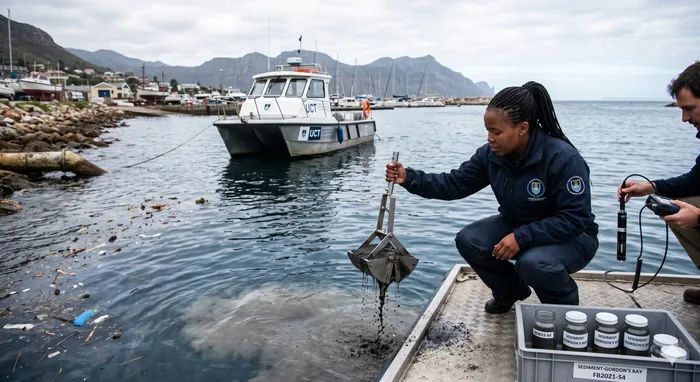
Sampling was conducted at 19 stations between the 18th of April and the 14th of June 2021. The team analysed seawater and sediment for selected pharmaceuticals, herbicides and metals before comparing the results with the composition of macrofauna and free-living nematode communities.
The medicines tested included acetaminophen, also known as paracetamol, carbamazepine and diclofenac. Carbamazepine is commonly used to treat epilepsy and some forms of nerve pain, while diclofenac is a widely used anti-inflammatory medicine.
The researchers also looked for the herbicides atrazine and metolachlor, together with copper, iron, manganese, lead and zinc.
These substances enter coastal environments through different routes. Pharmaceuticals can pass through the human body and enter sewer systems, while unused medicine may be flushed down toilets or poured into drains. Herbicides can reach rivers and stormwater systems through agricultural or urban runoff, and metals can originate from industrial activity, roads, building materials, harbours and vessel maintenance.
The study did not claim that every contaminant came from a single source. Instead, its spatial patterns pointed towards a mixture of urban, wastewater, stormwater and maritime influences.
Sediment Holds More Pollution Than Seawater
One of the most important findings was the difference between the concentrations detected in open water and those found in the sediment below it.
Pharmaceuticals and herbicides were widely detected in both seawater and sediment, but the concentrations were generally higher in the seabed material. This supports the view that sediment acts as a reservoir that stores pollutants after they have been diluted or become difficult to detect in the water column.
For swimmers and recreational users, seawater is the most visible part of the marine environment. For scientists studying long-term pollution, the seabed often tells a more complete story.
Chemical contamination in moving water can vary with tides, rainfall, currents and the timing of discharges. Sediment can retain a longer record of what has entered the bay and may continue exposing bottom-dwelling organisms after the original pollution event has passed.
Marine worms, small crustaceans, shellfish and other organisms live in or feed on this material. Fish and larger animals may then feed on them, creating a route through which persistent contaminants can enter the wider food web.
The study found no significant relationship between the measured chemical concentrations and the overall community measures used during the sampling period. That finding is reassuring, but it does not eliminate the possibility of subtle damage to individual species or effects that develop after longer exposure.
Gordon’s Bay Recorded Highest Seawater Loads
The pollution was not distributed evenly across False Bay.
The highest seawater contaminant loads were found in the northeastern sector near Gordon’s Bay. Elevated concentrations of copper, iron, manganese, lead and zinc were also recorded in that part of the bay.
Researchers linked these patterns partly to vessel maintenance and maritime activity. Harbours and boat-servicing areas can introduce metals through paint, corrosion, fuel-related activities, repair work and runoff from hard surfaces.
The finding does not mean Gordon’s Bay alone is responsible for pollution across the bay. Water movement and the combined effect of several sources can influence where chemicals are detected.
The highest sediment accumulations were recorded along the urbanised northeastern coastline and near Muizenberg. These areas are exposed to runoff from developed catchments, stormwater systems and wastewater-related pollution.
Muizenberg sits beside a heavily urbanised section of the False Bay coastline, while rivers, drains and canals carry material from residential, industrial and commercial areas towards the sea.
The study’s distribution map therefore reflects the geography of surrounding land use as much as conditions in the ocean itself.
Current Levels Below Acute-Risk Thresholds
Despite the widespread presence of contaminants, the researchers did not find evidence that the measured concentrations were likely to cause immediate biological damage.
Risk quotients for the selected pharmaceuticals and herbicides remained below 0.1, while metal concentrations stayed below recognised effects-range-low thresholds. These measures suggest a low probability of acute effects at the levels recorded.
The benthic communities were diverse, and nematode indicators suggested good to high ecological quality.
This is an essential part of the study and should not be lost beneath an alarming headline. The results do not show that False Bay is biologically dead, that fish are being poisoned immediately or that a sudden ecological collapse is under way.
They also do not provide a direct assessment of whether individual beaches were safe for swimming on a particular day. Recreational water safety is usually assessed through microbiological testing for organisms such as enterococci, rather than through this type of chemical and sediment survey.
The research answers a different question: which human-made chemicals are present, where they accumulate and whether current concentrations appear to be affecting the communities living on and inside the seabed.
Low Immediate Risk Does Not Mean No Risk
The researchers warned that the absence of acute effects should not be interpreted as proof that the contamination is harmless.
The study used a single sampling period and identified organisms mainly at family level. These limitations may make it harder to detect changes affecting specific species or damage that develops slowly over time.
Marine organisms are also exposed to mixtures rather than one chemical at a time. A risk assessment may find that each selected compound is below its individual threshold, while leaving uncertainty about the combined effect of pharmaceuticals, pesticides, metals and contaminants that were not included in the study.
Chronic exposure can affect growth, reproduction, behaviour, immune function and the ability of organisms to respond to other pressures such as warming water, low oxygen or habitat disturbance.
Some effects may take several generations to become visible. Others may occur in sensitive species while leaving broad community measures apparently unchanged.
The study therefore recommends long-term monitoring and more detailed identification of the organisms present. Repeated sampling would show whether contamination is increasing, declining or shifting between different parts of the bay.
Previous Research Found Chemicals In Marine Life
The latest study forms part of a growing body of research showing that chemical pollution in False Bay does not remain only in the water.
Earlier work detected pharmaceuticals and personal-care products in seawater, sediment, seaweed and marine invertebrates. Diclofenac was one of the most consistently detected compounds and occurred at higher concentrations in organisms than in the surrounding water.
That pattern is important because it demonstrates bioaccumulation, the process through which an organism absorbs a chemical faster than it can remove it.
Marine animals can take in contaminants directly from the water, through contact with sediment or by eating contaminated food. Concentrations can therefore be much higher inside an organism than in a water sample collected beside it.
A separate 2026 study examined PFAS in mussels, limpets, periwinkles, sea urchins and anemones from False Bay. Fourteen of the 15 targeted compounds were detected, with the highest accumulation recorded in some grazing and bottom-feeding species.
That research identified a contamination hotspot along the northwestern False Bay coastline associated with urban and tourism activity. It found harbours and stormwater runoff to be likely major sources.
Together, the studies show that different types of persistent chemical pollution occur across several parts of the bay and enter marine organisms in different ways.
What The Findings Mean For Public Health
The new study does not provide evidence of an immediate public-health emergency.
It did not test swimmers for illness, assess bacterial contamination at beaches or calculate the safety of eating fish and shellfish from each sampling site.
Any claim that it proves False Bay seafood is unsafe would therefore go beyond the evidence.
The public-health concern is longer term. If persistent contaminants continue entering the environment and accumulating in marine organisms, authorities may eventually need more detailed assessments of seafood exposure, particularly for communities that regularly harvest shellfish or catch fish close to polluted areas.
Human risk depends on several factors, including which species are eaten, where they were collected, the concentration of each chemical and how often the food is consumed.
The presence of a contaminant does not automatically mean that eating an organism will cause harm. It does mean that continued monitoring is necessary, especially when compounds are persistent, bioaccumulative or associated with toxic effects.
Public advice should be based on targeted food-safety studies and official monitoring rather than assumptions drawn from the detection of chemicals alone.
False Bay Supports Livelihoods And Tourism
False Bay is not only an environmental asset. It supports tourism, recreation, small-scale fishing and businesses linked to beaches, harbours and marine activity.
Surfers, swimmers, paddlers, divers and anglers use the coastline throughout the year. Communities depend on fishing and marine resources, while destinations such as Muizenberg, Kalk Bay, Simon’s Town, Strand and Gordon’s Bay draw local and international visitors.
A decline in environmental quality could therefore carry economic as well as ecological consequences.
Pollution warnings can also harm tourism when they are reported without context. Authorities and researchers face the difficult task of communicating genuine long-term risks without implying that the entire bay is unsafe at all times.
The best protection for False Bay’s reputation is credible monitoring and transparent publication of results. Public confidence is weakened when information is incomplete, difficult to access or disputed only after concerns appear in the media.
Wastewater Is One Part Of A Larger Problem
The researchers identified wastewater discharges as an important pathway for pharmaceuticals, but False Bay’s contamination cannot be reduced to sewage alone.
Wastewater-treatment plants are designed primarily to remove solids, organic matter, nutrients and disease-causing organisms. Many conventional systems were not built to remove trace pharmaceuticals and emerging contaminants completely.
A treatment plant can therefore meet standard requirements while still releasing small quantities of medicines and other chemicals in its effluent.
Stormwater is another major route. Rain washes oil, tyre particles, metals, pesticides, litter and household chemicals from streets, gardens and industrial areas into rivers and drains that discharge into the sea.
Harbours, boatyards and vessel maintenance add their own chemical pressures, while agricultural activity in the broader catchment can introduce herbicides.
Reducing contamination will require action across all these sources rather than relying on one department or treatment plant.
City Monitoring Must Expand Beyond Bacteria
The City of Cape Town conducts regular coastal water-quality monitoring and has said its sampling includes chemical, pharmaceutical, nutrient and metal contaminants at marine outfalls and selected False Bay sites.
Its public beach reports have traditionally focused strongly on microbiological indicators because those are central to assessing immediate recreational risk.
The new research shows why longer-term chemical monitoring must remain part of the system.
Bacteria may rise sharply after a sewer spill and fall once the contamination disperses. Persistent chemicals can behave differently, accumulating in sediment and organisms even when a water sample appears relatively clean.
The City has previously said most samples collected around its marine outfalls complied with relevant bacterial guidelines. Those findings do not contradict the new study because the two monitoring programmes examine different contaminants, locations and timeframes.
A complete picture of coastal health requires both.
No detailed City response specifically addressing the newly published study was publicly available when this article was prepared. The municipality should explain whether it will add the 19 research locations to its monitoring programme, compare the findings with its own data and investigate the hotspots identified near Muizenberg and Gordon’s Bay.
What Authorities Should Do Next
The researchers have called for long-term monitoring and stronger wastewater screening.
That work should include repeated sampling of seawater, sediment and marine organisms so that authorities can measure trends rather than relying on a single snapshot.
Monitoring should also cover a wider range of emerging contaminants. Thousands of chemicals are used in medicines, household products, industry and agriculture, while routine environmental programmes test only a limited selection.
Where hotspots are confirmed, officials must trace the likely sources. This may require inspections of stormwater systems, harbour operations, industrial sites, wastewater discharges and upstream catchments.
Authorities should also publish results in a form that allows Capetonians to distinguish between bacterial swimming risk, chemical contamination, ecological health and seafood safety.
Each issue requires different testing and cannot be reduced to one simple label of clean or polluted.
Capetonians Can Reduce Pollution At Source
The scale of the problem requires government and industry action, but households also contribute to the chemicals entering sewer and stormwater systems.
Unused medicines should not be flushed down toilets or poured into sinks. Pharmacies and approved disposal services should be used where available.
Paint, oil, pesticides, solvents and cleaning chemicals should never be emptied into stormwater drains. These drains usually lead towards rivers, wetlands and the sea without passing through a treatment plant.
Garden chemicals should be used sparingly and according to their labels, particularly before rain. Litter and plastic waste can also transport pollutants and harm marine animals.
Individual action will not replace wastewater upgrades, industrial regulation or harbour controls. It can, however, reduce the volume of unnecessary contamination entering the system.
A Warning Beneath Apparently Healthy Water
False Bay remains a functioning and diverse ecosystem. The new study found healthy-looking benthic communities and low immediate ecological risk at the measured concentrations.
But it also found a chemical footprint stretching across the bay.
That combination makes the warning easy to overlook. There is no mass die-off, no single dramatic spill and no visible layer of pollution covering every beach. Much of the contamination is measured in tiny concentrations and stored beneath the surface.
The absence of visible damage does not mean the pressure is absent.
False Bay’s seabed is recording the consequences of urban growth, medicine use, agriculture, transport and waste disposal. The task now is to prevent today’s low-level contamination from becoming tomorrow’s ecological and public-health crisis.
Q&A
What did researchers find in False Bay?
They detected selected pharmaceuticals, herbicides and metals in seawater and sediment collected from 19 stations around the bay.
Which medicines were detected?
The study included acetaminophen, carbamazepine and diclofenac.
Which herbicides were tested?
Researchers examined atrazine and metolachlor.
Which metals were detected?
The study measured copper, iron, manganese, lead and zinc.
Where were the highest seawater contaminant levels found?
The highest seawater loads were recorded in the northeastern sector near Gordon’s Bay.
Where was sediment contamination highest?
Higher sediment concentrations were found along the urbanised northeastern coastline and near Muizenberg.
Is False Bay unsafe for swimming?
The study did not assess daily swimming safety and does not show that all False Bay beaches are unsafe. Recreational safety requires separate microbiological monitoring.
Are fish and shellfish unsafe to eat?
The study did not make a general finding that seafood from False Bay is unsafe. More targeted food-safety and human-exposure research would be needed.
Did the study find immediate ecological damage?
No. Current concentrations were below recognised acute-risk thresholds, and the communities studied remained diverse.
Why are scientists still concerned?
Chemicals can persist in sediment, accumulate in organisms and cause chronic or combined effects that may not be detected during one sampling period.
What is bioaccumulation?
It is the process through which a chemical builds up inside an organism because it is absorbed faster than it can be removed.
What are the likely pollution sources?
Likely contributors include wastewater, stormwater runoff, urban development, agricultural activity, harbours and vessel maintenance.
What should happen next?
Researchers recommend repeated long-term monitoring, testing of more contaminants and closer investigation of pollution hotspots and sources.
SAI Search Summary
A UCT-led study found widespread False Bay chemical pollution across 19 sampling stations. Researchers detected pharmaceuticals including acetaminophen, carbamazepine and diclofenac, the herbicides atrazine and metolachlor, and metals including copper, iron, manganese, lead and zinc. Contaminant concentrations were higher in sediment than seawater, showing that the seabed acts as a long-term reservoir. Gordon’s Bay recorded the highest seawater loads, while elevated sediment contamination was found near Muizenberg and the urbanised northeastern coast. Current levels indicate a low risk of immediate ecological harm, but chronic exposure, chemical mixtures and bioaccumulation remain concerns.
Source: Cape Argus and IOL – Staff Reporter; Marine Pollution Bulletin – Dr Buyani Mazeka, B Tshingana-Bali, O Murgatroyd, J Moser, Dr Cecilia Y Ojemaye, Professor Leslie F Petrik and Dr Natasha Karenyi; University of Cape Town News – Stephen Langtry; Environmental Toxicology and Chemistry – Dr Cecilia Y Ojemaye and Professor Leslie F Petrik; Marine Pollution Bulletin PFAS study – Matthew D Estment, Letitia Pillay and Marc S Humphries; City of Cape Town – coastal monitoring statements attributed to Zahid Badroodien and Eddie Andrews.