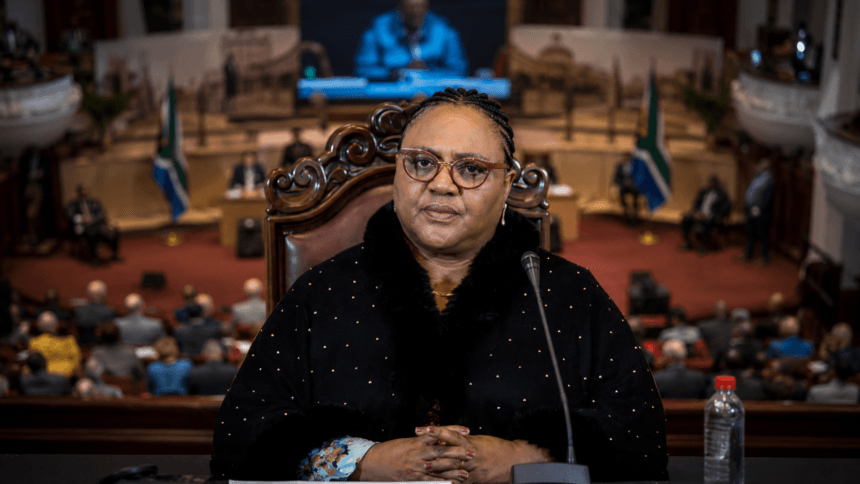
Cape Town: National Assembly Speaker Thoko Didiza faces mounting criticism over her decision not to formally oppose President Cyril Ramaphosa’s urgent attempt to stop Parliament’s Phala Phala impeachment inquiry, with opposition parties accusing her of placing ANC political loyalty ahead of Parliament’s constitutional independence.
The dispute has opened a fresh argument over the role of the Speaker, the legal standing of Parliament’s impeachment committee and the duty of the National Assembly to defend its own processes when challenged by the head of the executive.
Didiza decided that the National Assembly would file a notice to abide by the Western Cape High Court’s ruling, together with an explanatory affidavit setting out what Parliament has done following the Constitutional Court’s judgment in the Phala Phala matter. The impeachment committee, however, will separately oppose Ramaphosa’s application.
Parliament insists that the two legal approaches are complementary. Opposition parties argue that the arrangement leaves Parliament’s defence in the hands of a committee that may not have independent legal standing and allows the Speaker to avoid confronting the president of her own political party.
Parliament Defends Didiza’s Decision
Parliament spokesperson Moloto Mothapo said Didiza reached her decision after considering legal advice, the views placed before her and the different constitutional roles of the National Assembly and the impeachment committee.
Mothapo said the Speaker concluded that it would be appropriate to file a notice to abide, accompanied by an explanatory affidavit. That affidavit would explain to the court how Parliament responded to the Constitutional Court judgment and would, according to Parliament, complement the opposition papers filed by the impeachment committee.
“The Speaker, having considered all the views and processes, came to a conclusion that it will be important to file a notice to abide with an explanatory affidavit to complement the committee’s opposition papers and, most importantly, to explain to the court what Parliament has done to comply with the judgment of the Constitutional Court,” Mothapo said.
Parliament rejected claims that Didiza and the committee had adopted contradictory positions. Mothapo said the Speaker believed the two approaches reflected separate but connected constitutional responsibilities within the Section 89 process.
“While the approaches adopted by the Speaker and the impeachment committee in relation to this court application are not identical, they are neither inconsistent nor in conflict,” he said.
“Rather, they are complementary and mutually reinforcing, and reflect their distinct but interconnected constitutional responsibilities within the Section 89 process.”
A notice to abide generally means that a party does not actively oppose the application and will accept the court’s ruling. Parliament will still place information before the court through its explanatory affidavit, but it will not seek an order dismissing Ramaphosa’s application in the same manner as the opposing parties.
That distinction is now at the centre of the political dispute.
DA Questions Committee’s Legal Standing
DA parliamentary leader George Michalakis said Didiza should have acted in accordance with the impeachment committee’s decision and formally defended Parliament’s process.
He argued that the Speaker represents Parliament in court proceedings and cannot transfer that responsibility to the chairperson of an internal committee.
“We anticipated that the Speaker would act in line with the request of the impeachment committee,” Michalakis said. “She represents Parliament in all matters in court, and she has to act in line with the wishes of the impeachment committee.”
Michalakis also questioned whether the committee could independently appear before the court as the legal representative of Parliament.
“The impeachment committee itself, in my opinion, does not have locus standi to be represented in court,” he said.
“They have to go through the Speaker. We said that in the committee itself, and therefore the Speaker should have been the one actually opposing the application on behalf of Parliament, in line with the wishes of the committee.”
Locus standi refers to the legal right of a person or body to bring, oppose or participate in a court case. If Michalakis’s interpretation is correct, the court may need to consider whether the committee or its chairperson can oppose Ramaphosa’s application without the Speaker formally doing so on behalf of the National Assembly.
He said Didiza’s decision had weakened Parliament’s public image and created the impression that its leadership was unwilling to defend its constitutional role.
“She can’t outsource her responsibilities as the Speaker to the chairperson of the committee,” Michalakis said. “She has to represent us.”
He also questioned whether Didiza had acted with the impartiality expected of the head of the National Assembly.
“Her actions do raise the question of who she puts first, the ANC or Parliament, and it feels like more of the same, which is unfortunate,” he said.
The accusation that Didiza favoured the ANC remains an opposition claim. Parliament has denied that her legal approach compromises the institution or conflicts with the committee’s decision.
ATM Says Legal Advice Should Have Been Followed
ATM leader Vuyo Zungula, whose party initiated the original Section 89 process, also criticised Didiza’s position.
Zungula said the Speaker had obtained a legal opinion advising her to protect the independence and integrity of Parliament, but had then chosen not to formally oppose Ramaphosa’s application.
“It’s really disappointing because the Speaker went and got a legal opinion, and that legal opinion was very clear to say she must defend the integrity and the independence of Parliament,” Zungula said.
He argued that Didiza, as the head of the National Assembly, had a direct responsibility to resist any attempt to stop Parliament from performing its constitutional work.
“She must defend the work of Parliament from being interdicted, because she’s the head of the institution,” he said.
“She’s the one that is legally obligated to defend Parliament from any threat that seeks to restrain Parliament from doing what it is supposed to do.”
Zungula said former Speakers had defended parliamentary processes against court challenges in the past. He referred to former Public Protector Busisiwe Mkhwebane’s attempt to interdict the parliamentary process that ultimately led to her removal.
According to Zungula, the existence of separate legal opinions for the committee and the Speaker made Didiza’s decision more difficult to justify.
“Now, she can’t be going against the advice that she sought after paying and utilising Parliament’s resources for that opinion,” he said.
Zungula suggested that Didiza may have wanted to avoid being seen to challenge Ramaphosa, who leads the ANC while she serves in senior structures of the same party.
“Perhaps at a political level, she would not then go to court and challenge, or be seen to be fighting, the president of her organisation,” he said.
Parliament has previously rejected allegations that Didiza’s ANC responsibilities make her incapable of carrying out her duties impartially. It has maintained that her political membership does not remove her institutional obligations as Speaker.
What Ramaphosa Wants The Court To Stop
Ramaphosa has asked the Western Cape High Court to halt the impeachment committee’s work until his separate legal challenge to the findings of the independent Section 89 panel has been decided.
The panel, chaired by retired Chief Justice Sandile Ngcobo, found that there was sufficient prima facie evidence for Parliament to consider whether Ramaphosa may have committed serious violations connected to the burglary at his Phala Phala farm.
Prima facie evidence does not amount to a finding of guilt. It means that the available information, viewed initially, was considered sufficient to justify further examination by Parliament.
Ramaphosa is seeking to have the panel’s report reviewed and set aside. He argues that the impeachment inquiry should not proceed while the validity of the report underpinning it remains the subject of a court challenge.
In his affidavit, the President said a serious legal challenge to the report should be decided before the parliamentary inquiry begins.
“If there is a serious and substantive challenge to the validity of such a determination in the report, as there is in my case, it should be determined before the enquiry commences,” Ramaphosa said.
He argued that allowing the inquiry to continue could undermine the effectiveness of any later court ruling in his favour. By the time the review case is decided, Parliament may already have taken significant steps based on a report that the court could ultimately invalidate.
Zungula Rejects Claim Of Irreparable Harm
Zungula is opposing Ramaphosa’s urgent application and disputes the President’s claim that he will suffer unjustifiable harm if the committee begins its work.
“The fundamental basis of this application, the President’s perceived harm, is misplaced,” Zungula stated in his affidavit.
“The President has no basis to fear that his dignity and reputation will be undermined by members of the committee or the impeachment process generally.”
Zungula argued that the committee’s purpose is not to presume guilt but to test the truth, seriousness and reliability of the allegations.
“The purpose of the committee is to test whether the allegations against the President are ‘unfounded’,” he said. “The rules give it the tools to do so. That is its very function.”
He said the inquiry would give Ramaphosa an opportunity to challenge the evidence and present his own version before Parliament reaches any conclusion.
The EFF is also opposing the President’s application.
Why The Speaker’s Role Matters
The Speaker occupies a difficult position in South Africa’s constitutional system. The office bearer is elected as a Member of Parliament through a political party but must preside over the National Assembly and protect the rights, procedures and authority of the institution.
The present dispute reflects that tension. Didiza remains a senior ANC member, while Ramaphosa is the party’s president. At the same time, she serves as the constitutional head of an institution responsible for holding the executive accountable.
Opposition parties contend that her institutional obligations should take priority whenever Parliament’s authority is challenged. Parliament’s response is that Didiza is fulfilling those obligations through an explanatory affidavit while allowing the multiparty committee to place the substantive opposition before the court.
The legal question may ultimately turn on more than political perceptions. The court could be required to consider whether the committee has the necessary legal standing, whether the Speaker’s affidavit adequately represents Parliament’s institutional interests and whether the impeachment process should continue while Ramaphosa’s review remains unresolved.
Court Hearing Set For July
Ramaphosa’s urgent application is expected to be heard in the Western Cape High Court on 15th and 16th July.
The outcome could determine whether the impeachment committee begins testing the Phala Phala allegations or must wait until the President’s challenge to the Ngcobo Panel report has been decided.
It could also clarify the legal relationship between the Speaker, the National Assembly and a committee established to perform a constitutionally significant inquiry.
Until then, Didiza will face continued pressure to explain why Parliament chose not to become a direct opposing party in a case that could restrict its own proceedings.
Q&A
What did Thoko Didiza decide?
Didiza decided that the National Assembly would file a notice to abide by the court’s decision and submit an explanatory affidavit. Parliament will therefore provide the court with information but will not formally oppose Ramaphosa’s application in the same way as the impeachment committee, ATM and EFF.
What does a notice to abide mean?
It generally means that a party does not actively contest the application and agrees to accept the court’s ruling. The party may still file information that assists the court.
Why are opposition parties criticising Didiza?
They believe the Speaker has a duty to defend Parliament and its impeachment process directly. The DA and ATM also question whether the committee can legally represent Parliament without acting through the Speaker.
What is Ramaphosa asking the court to do?
Ramaphosa wants the court to stop the impeachment committee from beginning its inquiry until his application to review and set aside the Ngcobo Panel report has been decided.
Has Ramaphosa been found guilty by the Section 89 panel?
No. The panel found that there was prima facie evidence warranting further parliamentary consideration. It did not make a final finding of guilt.
When will the urgent application be heard?
The application is expected to be heard in the Western Cape High Court on 15th and 16th July.
SAI Search Summary
National Assembly Speaker Thoko Didiza is facing criticism after deciding that Parliament would abide by the Western Cape High Court’s ruling on President Cyril Ramaphosa’s urgent attempt to halt the Phala Phala impeachment inquiry. Parliament says Didiza’s explanatory affidavit will complement the impeachment committee’s opposition. The DA and ATM argue that the Speaker should formally defend Parliament and question whether the committee has independent legal standing. Ramaphosa wants the inquiry paused until his challenge to the Ngcobo Panel report is decided. The urgent application is expected to be heard on 15th and 16th July.
Source: Daily Maverick – Nonkululeko Njilo; Parliament of the Republic of South Africa – Moloto Mothapo; statements attributed to George Michalakis, Vuyo Zungula and President Cyril Ramaphosa.