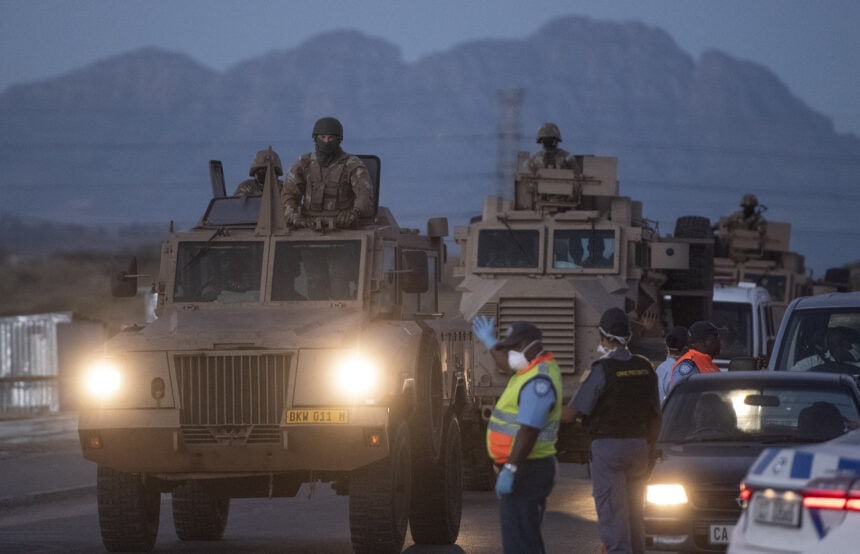
Despite the high-profile deployment of the South African National Defence Force into gang-affected areas, violence continues across parts of the Western Cape, raising serious concerns about whether Operation Prosper is delivering meaningful change or simply repeating past approaches that failed to curb crime.
The growing pressure on law enforcement was brought into sharp focus this week when Premier Alan Winde confronted South African Police Service Provincial Commissioner Lieutenant General Thembisile Patekile during a Western Cape Provincial Safety Council meeting.
Winde did not hold back, warning that visible deployments without measurable impact risk undermining public confidence in the operation.
“Too many communities are still under siege, enough is enough,” he said. “Deployments alone are inadequate. We need consistent, detailed reporting to show whether this intervention is making a real impact.”
At the centre of the concern is Operation Prosper, a coordinated intervention that includes military support to stabilise high-risk areas. While the presence of the South African National Defence Force has increased visibility on the ground, provincial leaders are now demanding proof that the strategy is producing sustained results.
Winde stressed that the operation must be intelligence-driven and adaptive. “This operation must not repeat the shortcomings of 2019. It must be focused on dismantling criminal networks, especially gangs,” he said, adding that data-driven adjustments are critical if conditions are not improving.
The Provincial Safety Council, which includes SAPS, municipalities and academic stakeholders, highlighted that gangsterism, organised crime and the proliferation of illegal firearms continue to drive the province’s murder rate.
A key concern raised during the session was the low rate of successful prosecutions in firearm-related cases. Officials pointed out that weak investigations and insufficient case preparation are limiting the impact of arrests, with fewer cases resulting in convictions.
Western Cape Minister of Police Oversight and Community Safety, Anroux Marais, reinforced this concern following a separate engagement with SAPS leadership, noting a spike in violence since the beginning of April, particularly in areas where the military has been deployed.
She stressed that enforcement must go beyond visibility. “We need actionable intelligence and coordinated operations that focus on the confiscation of illegal firearms and the dismantling of gang networks,” she said.
Marais also expressed frustration during an oversight visit to Luzuko, where she observed limited visible support from military operations on the ground, raising further questions about the scale and effectiveness of the deployment.
Lieutenant General Patekile acknowledged that Operation Prosper has experienced initial challenges, describing them as “teething problems” that are currently being addressed through operational adjustments.
However, criticism is not limited to provincial leadership. GOOD Party Secretary-General Brett Herron said the ongoing crisis reflects broader systemic failures, arguing that communities on the Cape Flats continue to bear the brunt of ineffective long-term strategies.
“It is an indictment on all of us who work as public representatives,” Herron said, calling for more decisive action as violence continues to affect daily life in vulnerable communities.
With calls now growing for a dedicated task force targeting illegal firearms and improved coordination between law enforcement agencies, the effectiveness of Operation Prosper is likely to remain under close scrutiny in the weeks ahead, as authorities face mounting pressure to demonstrate tangible and lasting improvements in safety across the province.
Source: Western Cape Government – Cape {town} Etc – Matthew Hirsch.