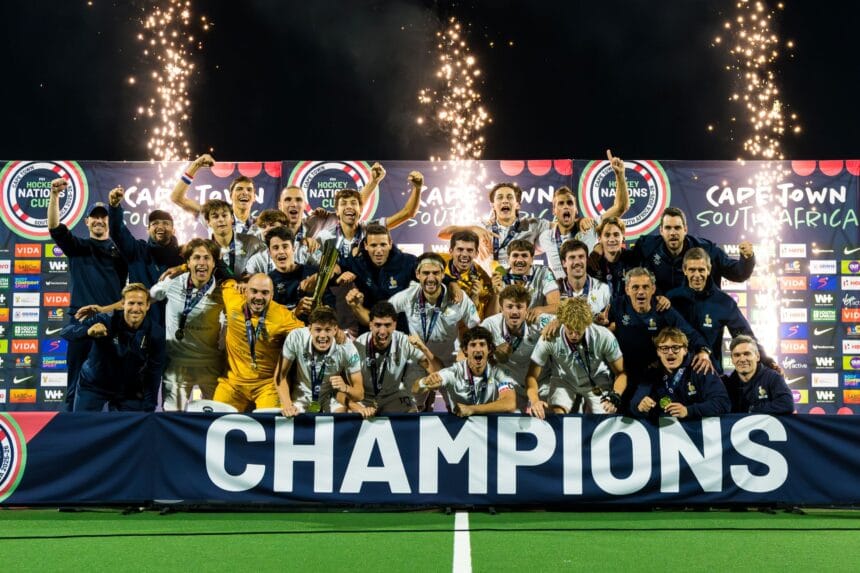
Observatory: South Africa’s men came within one goal of completing a memorable home tournament triumph before France held firm under sustained late pressure to win the FIH Hockey Men’s Nations Cup final 2-1 at a sold-out Hartleyvale Stadium. Two French goals inside the opening eight minutes left the hosts chasing the contest from the first quarter, but a second-half surge and Sam Mvimbi’s fourth-quarter finish transformed the final into a tense closing battle that kept Cape Town’s crowd on its feet until the last whistle.
France Struck Twice Before South Africa Could Settle
France entered the final with purpose and immediately imposed the tempo that had carried them through the tournament. Their midfield moved the ball quickly through South Africa’s defensive lines, while their forwards pressed high enough to prevent the hosts from building comfortable possession from the back.
South African goalkeeper Cullin de Jager was forced into important early saves as France repeatedly found space around the circle. The pressure soon produced the opening penalty corner, from which Victor Charlet delivered the breakthrough and placed the hosts behind before they had established control.
France struck again only moments later when Gaspard Tynevez added a second goal, giving the visitors a 2-0 advantage inside eight minutes. The quick double blow changed the shape of the final because South Africa could no longer rely on patience and home momentum alone. They had to chase a disciplined French side that had already created the scoreboard protection needed to defend with greater control.
The hosts steadied themselves during the latter stages of the opening quarter, with Dayaan Cassiem beginning to find pockets of space and South Africa’s forwards pressing with more urgency. France nevertheless reached half-time with their two-goal lead intact after limiting the hosts’ clear opportunities and closing passing lanes around the circle.
Final Score And Key Moments
| Match Detail | Outcome |
| Competition | FIH Hockey Men’s Nations Cup final |
| Venue | Hartleyvale Stadium, Observatory |
| Result | France 2-1 South Africa |
| France scorers | Victor Charlet and Gaspard Tynevez |
| South Africa scorer | Sam Mvimbi |
| Half-time score | France led 2-0 |
| Crowd | Sold out |
| Individual award | Cullin de Jager, Goalkeeper of the Tournament |
South Africa Changed The Contest After Half-Time

The second half produced a different match as South Africa increased their pressing intensity, committed more players forward and began forcing France to defend for longer periods. Instead of allowing the visitors to control possession through midfield, the hosts moved the ball earlier into attacking areas and created repeated entries into the French circle.
Hans Neethling, Dayaan Cassiem and Jamie Seale drove much of the pressure, while the South African forwards began winning penalty corners and forcing the French defence to deal with second-phase attacks. Each attack raised the volume inside Hartleyvale, where the home crowd had remained engaged despite the difficult opening.
France responded with disciplined defensive positioning rather than abandoning their shape. Their defenders stayed compact around the circle, protected the central channel and repeatedly forced South Africa into wider attacking routes. That structure allowed France to absorb pressure without conceding the immediate goal that could have changed the final much earlier.
South Africa’s improvement showed that the opening eight minutes had not ended the contest, but every missed opportunity increased the importance of the remaining time. The hosts needed a goal before France could slow the match and manage the closing stages on their own terms.
Mvimbi’s Goal Brought Hartleyvale To Life
The breakthrough arrived in the fourth quarter through one of South Africa’s strongest attacking combinations of the tournament.
Dayaan Cassiem created the opening with a precise delivery into the danger area, where Sam Mvimbi positioned himself ahead of the defender and produced a composed finish to reduce the deficit to 2-1.
The goal transformed the atmosphere inside Hartleyvale. South Africa no longer appeared to be chasing a distant recovery; they were one successful attack away from forcing the final level.
The hosts committed more numbers forward, generated further penalty-corner opportunities and placed France under their heaviest sustained pressure of the match. France defended with increasing desperation but retained enough composure to clear loose balls, block direct routes to goal and deny South Africa the final touch required for an equaliser.
South Africa continued attacking until the closing moments, but the early French goals ultimately proved decisive. When the final whistle sounded, France had survived the hosts’ recovery and secured a 2-1 victory in a match that became considerably tighter than its opening stages suggested.
Tournament Final At A Glance
| Stage | South Africa’s Path |
| Opening match | Lost 4-2 to France |
| Pool recovery | Defeated the United States 4-0 |
| Qualification match | Progressed after a tense contest with Ireland |
| Semi-final | Beat New Zealand after a 2-2 draw and shootout |
| Final | Lost 2-1 to France |
South Africa’s route to the final showed considerable resilience because the team recovered from an opening defeat against the same French side that eventually won the title.
The 4-0 victory over the United States restored confidence and kept the semi-final campaign alive, while the decisive pool encounter against Ireland required South Africa to manage the pressure of a match in which qualification remained uncertain until the end.
The semi-final against New Zealand then produced the tournament’s defining home moment. South Africa recovered from falling behind, moved ahead through Kenton Melville and eventually reached a shootout after New Zealand equalised at 2-2.
De Jager saved all four New Zealand shootout attempts, while Niel Raath and Hans Neethling converted for South Africa. That performance carried the hosts into their second FIH Nations Cup final and strengthened the belief that a home title was possible.
De Jager Rewarded After Outstanding Tournament
Although France lifted the trophy, South Africa’s Cullin de Jager received one of the competition’s major individual honours after being named Goalkeeper of the Tournament.
The award recognised a series of performances in which he repeatedly kept South Africa competitive during difficult periods. His work in the semi-final proved particularly decisive, with four consecutive shootout saves preventing New Zealand from scoring and sending the hosts into the final.
De Jager also made important early stops against France when the visitors threatened to take complete control of the final. Without those saves, the two-goal deficit could have grown before South Africa settled into the match.
Goalkeeping awards can sometimes be treated as secondary to tournament results, but De Jager’s recognition reflected his direct influence on South Africa’s progress. His performances gave the team time to recover in matches where opponents created strong scoring opportunities and provided confidence to defenders operating under sustained pressure.
Hartleyvale Delivered A Major Home-Sport Occasion
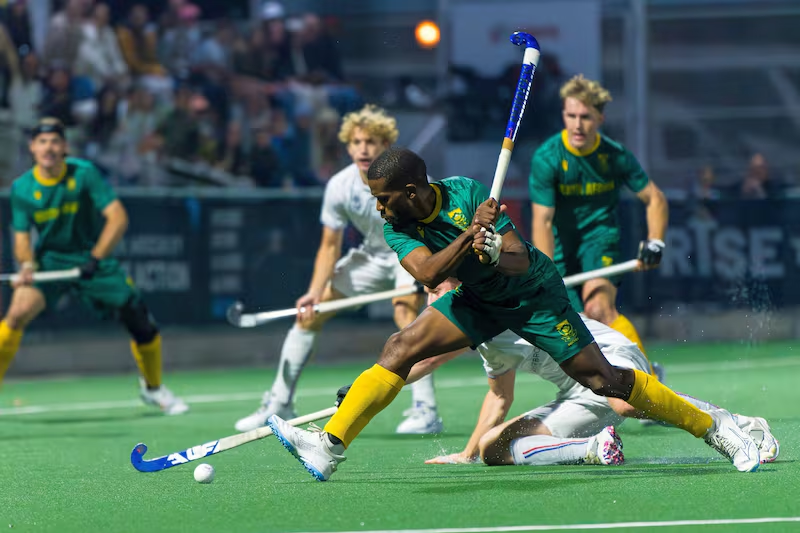
The final took place before another sold-out crowd at Hartleyvale Stadium, reinforcing Cape Town’s reputation as one of South African hockey’s strongest support centres.
Across the tournament, spectators created an atmosphere that turned ordinary pool matches into major sporting occasions. The crowd’s influence became particularly visible during the semi-final victory over New Zealand and during South Africa’s second-half comeback against France.
Hartleyvale is closely associated with Western Province and national hockey history, but staging an international tournament of this scale required the venue to support more than match play. Organisers had to manage training, broadcasting, security, ticketing, team movement and match schedules across ten days of competition.
The sustained attendance showed that international hockey can attract strong public support in Cape Town when the national team competes at an accessible local venue. That matters for a sport seeking to grow its commercial profile, build a larger supporter base and encourage younger players to see international hockey as a realistic pathway.
France Completed A Consistent Tournament
France’s final victory reflected a campaign built on technical control, attacking speed and defensive discipline.
They opened the competition by beating South Africa 4-2 and returned to the same venue for the final with a clear understanding of how the hosts wanted to play. In both matches, France used quick movement through midfield and aggressive attacking entries to place South Africa under pressure before the home team could fully establish its rhythm.
The final demanded a different quality after the opening burst. Once South Africa improved and began dominating longer stretches of possession, France had to defend their lead rather than extend it. Their ability to absorb that pressure without conceding an equaliser became as important as the two early goals.
Winning the Nations Cup also strengthened France’s position within the international structure designed to connect leading teams outside the FIH Pro League with hockey’s top annual competition. The tournament was created to provide ambitious national teams with a competitive route towards the elite level, making the Cape Town title more important than a standalone trophy.
South Africa Leave With Progress Despite Defeat
The final result will disappoint a team that had reached the title match on home soil and came close to completing the comeback. South Africa nevertheless leave the tournament with evidence of progress against international opponents ranked around or above them.
The team showed that it could recover from an opening defeat, manage high-pressure qualification matches and eliminate a strong New Zealand side through both open play and a shootout. The final also demonstrated that South Africa could place France under prolonged pressure after the difficult first quarter.
Those performances must now be converted into consistency beyond one home tournament. International hockey rewards teams that can reproduce their intensity across different venues, climates and competitive schedules.
South Africa’s next challenge will be retaining the tactical discipline, defensive resilience and attacking confidence shown at Hartleyvale while strengthening the areas exposed by France’s early pressure.
The tournament also highlighted the depth within the squad. Cassiem remained central to South Africa’s creativity, while players such as Mvimbi, Neethling, Seale, Melville and De Jager produced decisive contributions at different stages.
Cape Town Tournament Builds Momentum For Local Hockey
Hosting the Nations Cup brought nine international teams to Cape Town between 11th and 20th June and placed South African hockey before a wider local audience.
The participating field included South Africa, France, Ireland, Japan, Korea, Malaysia, New Zealand, Scotland and the United States. Pool matches and knockout rounds gave Cape Town supporters repeated opportunities to watch international hockey rather than a single isolated fixture.
That extended programme carries value for local clubs, schools and development structures because young players can see elite athletes compete at close range. It also creates opportunities for coaching exchanges, community activation and greater media exposure.
South African Hockey used the tournament period to promote participation and connect the event with Youth Day activities, reinforcing the argument that major competitions should produce benefits beyond the final scoreboard.
The long-term value will depend on whether the interest generated at Hartleyvale translates into stronger club participation, sponsorship, improved facilities and regular international matches in the city.
A Final Decided By The Opening Eight Minutes
South Africa’s second-half performance provided the clearest evidence of how close the final became, but the decisive damage occurred before the home side had settled.
France’s first two goals gave them the freedom to protect space and manage pressure, while South Africa had to spend the remainder of the match recovering from the opening deficit. Mvimbi’s goal showed that the hosts possessed the quality to break through, yet it arrived too late to leave sufficient time for the second goal.
The result should therefore be understood as both a narrow defeat and a lesson in the cost of slow starts at international level.
South Africa did not lose because they lacked effort, support or second-half quality. They lost because France converted their early dominance into a two-goal advantage and then defended that lead with enough discipline to survive the comeback.
France leave Cape Town as champions. South Africa leave without the trophy, but with a sold-out stadium, a second Nations Cup final appearance and a tournament run that restored significant belief in the men’s national programme.
Q&A
What was the final score?
France defeated South Africa 2-1 in the FIH Hockey Men’s Nations Cup final.
Where was the final played?
The match was played at Hartleyvale Stadium in Observatory, Cape Town.
Who scored for France?
Victor Charlet and Gaspard Tynevez scored during the opening eight minutes.
Who scored for South Africa?
Sam Mvimbi scored in the fourth quarter after receiving a delivery from Dayaan Cassiem.
What was the half-time score?
France led 2-0 at half-time.
Was the stadium full?
Yes. SA Hockey described Hartleyvale as sold out for the final.
Who was named Goalkeeper of the Tournament?
South Africa’s Cullin de Jager received the award.
How did South Africa reach the final?
They defeated New Zealand in a shootout after the semi-final ended 2-2.
How many teams competed?
Nine national teams competed in Cape Town from 11th to 20th June.
Did South Africa win the Nations Cup before?
Yes. South Africa won the inaugural men’s Nations Cup in 2022.
SAI Search Summary
France defeated South Africa 2-1 in the FIH Hockey Men’s Nations Cup final at a sold-out Hartleyvale Stadium in Cape Town. Victor Charlet and Gaspard Tynevez scored inside the opening eight minutes to give France a 2-0 lead. South Africa increased the pressure after half-time and reduced the deficit through Sam Mvimbi in the fourth quarter after a pass from Dayaan Cassiem, but France held on to win the title. South African goalkeeper Cullin de Jager was named Goalkeeper of the Tournament after playing a decisive role in the hosts’ run to the final.
Source: South African Hockey Association – SA Hockey Communications; International Hockey Federation – FIH Communications; Eyewitness News – Staff Reporter; SA Sports Press – Staff Reporter.