Cape Town: Cape Town plans to increase its annual safety and security drone target from 1,000 to 3,000 flights during the 2026/27 financial year as growing operational demand pushes aerial technology deeper into municipal policing and emergency response. The City’s dedicated drone unit, launched on 1st April, uses thermal cameras and live video to track suspects, guide officers, support searches and enter situations considered too dangerous for personnel, although the expansion remains subject to final budget approval and stronger safeguards around privacy, flight authorisation and the handling of surveillance footage.
City Moves To Expand Drone Operations
Cape Town is preparing for a significant expansion of its municipal drone programme as aerial surveillance becomes a routine part of law-enforcement and emergency operations across the metro. The proposed performance target of 3,000 flights for the new financial year is three times the 1,000-flight target attached to the current period, reflecting the City’s belief that drones are no longer an experimental addition but an operational tool required by several safety departments.
The increase appears in the City’s budget and corporate performance planning documents, which state that operational demand and wider adoption have driven the rapid growth of the Unmanned Aircraft Systems programme. The documents show that municipal safety operations have repeatedly exceeded earlier annual targets, with thousands of flights recorded in previous reporting periods. The new 3,000-flight target should therefore be understood as a large increase in the formal benchmark rather than proof that the actual number of flights will suddenly triple from the level already being achieved.
That distinction matters because the City completed 3,653 flights during the 2024/25 financial year, according to its own scorecard material. In other words, the lower target did not reflect the true scale of operational use. The proposed adjustment brings the official target closer to what departments have already demonstrated they can deliver, while creating a clearer measure against which future performance and spending can be assessed.
The final target remains linked to Council’s approval of the 2026/27 budget and performance plan. Until that process is completed, the 3,000-flight figure remains proposed rather than final.
Dedicated Unit Launched In April
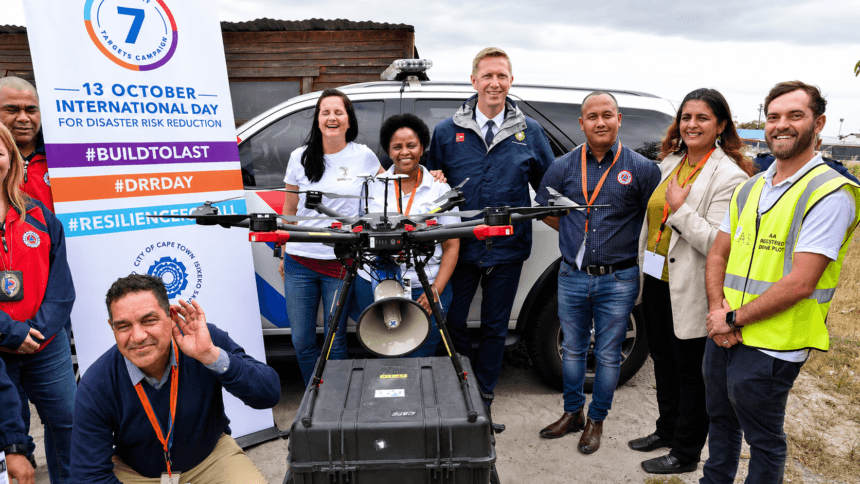
Cape Town formally launched its dedicated drone unit on 1st April after more than a decade of testing and gradually expanding the technology in municipal safety operations. The establishment of a permanent unit represents a shift from using drones mainly during selected operations towards maintaining a structured aerial capability that can be called upon by different departments.
The unit supports Metro Police, Law Enforcement, Traffic Services and emergency personnel by supplying live images from above. Officers on the ground can use that information to understand the movement of suspects, identify escape routes, locate hidden individuals and assess hazards before entering an area.
Thermal-imaging equipment allows operators to detect heat signatures in darkness or poor visibility. This can help track people moving through open land, vegetation, informal settlements or other areas where ordinary cameras and ground patrols may struggle to maintain sight.
The technology can also reduce the risk to personnel. Instead of immediately sending officers into an unknown building, dense terrain or an area where armed suspects may be hiding, commanders can first use a drone to assess the scene and direct teams more precisely.
Cape Town’s programme has therefore developed beyond simply recording events from the air. Its purpose is to create real-time intelligence that changes how officers respond while an incident is still unfolding.
Drones Track Suspects From Above
One of the strongest arguments for municipal drones is their ability to maintain visual contact with suspects attempting to escape police on foot or in vehicles. Ground officers can lose sight of a person when they enter backyards, informal pathways, vacant land or crowded areas, while an aerial camera may continue following their movement from above.
Operators can relay directions to officers through a command centre or operational radio network, reducing the need for personnel to search blindly across a large area. This can shorten pursuits, help surround suspects and reduce the risk of officers entering an ambush.
Thermal cameras are particularly valuable at night because they can detect a person’s heat signature even when ordinary lighting is poor. The technology does not identify guilt by itself, and officers still need lawful grounds to stop, search or arrest someone, but it can help maintain continuity during an active police operation.
The City has previously linked drone and CCTV assistance to arrests made during coordinated enforcement campaigns. However, public reporting does not always separate incidents in which drones directly led to an arrest from operations where they provided general support.
As the programme grows, clearer performance reporting will be necessary. Flight totals show how often the equipment is used, but they do not reveal whether the missions resulted in arrests, firearm recoveries, successful searches, faster emergency responses or reduced risks to officers.
Search And Rescue Forms Part Of The Mission
The drone fleet is not restricted to conventional crime fighting. City planning documents and public statements identify search-and-rescue operations and other emergencies as important uses of the technology.
A drone can cover open land, coastlines, waterways and mountain terrain faster than a person moving on foot. Thermal sensors may help locate a missing or injured person after dark, while live aerial images can guide rescue teams towards a safer approach.
During fires, floods or hazardous-material incidents, drones can give commanders a broader view without placing personnel directly inside the danger zone. They may help identify the direction of a fire, the movement of floodwater, blocked access routes or people stranded beyond the reach of vehicles.
The technology is particularly useful when conditions make helicopter deployment impractical or unnecessarily expensive. A drone cannot replace a crewed aircraft in every situation, but it can be launched more quickly and used for a targeted assessment at a fraction of the operating cost.
Cape Town’s expanding use of drones therefore overlaps with policing, disaster management and emergency services. That flexibility strengthens the financial case for the programme, but it also creates a need for clear rules governing which department has priority when several incidents occur at the same time.
Expansion Follows Cancellation Of Eye In The Sky
The drone programme is growing as the City moves away from its cancelled Eye in the Sky aircraft project. That separate initiative involved a piloted surveillance aircraft intended to provide high-level aerial intelligence over Cape Town, but the contract was cancelled in August last year.
The cancellation followed concerns about the project’s viability and delivery, leaving drones as a more flexible and decentralised part of the City’s aerial safety strategy. Drones cannot match the range, endurance or altitude of a crewed surveillance aircraft, but they can be deployed closer to specific operations and launched from multiple locations.
The two systems should not be confused. Eye in the Sky was designed as a large airborne surveillance platform, while the drone programme uses smaller unmanned aircraft under more limited operational and aviation conditions.
The failure of the aircraft project makes scrutiny of the drone programme especially important. Cape Town must show that procurement, maintenance, operator training and performance measurement are strong enough to prevent another ambitious safety-technology programme from falling short of its promises.
A larger number of flights alone will not prove success. The City will need to demonstrate that the technology is reliable, legally operated and producing measurable public-safety value.
Formal Target Trails Previous Performance
The official documents reveal an unusual feature of the proposed expansion: Cape Town’s recorded use of drones has already exceeded the target it now intends to increase.
The City recorded 2,835 flights during the 2023/24 financial year and 3,653 during 2024/25. Its current-year planning documents also show significant utilisation driven by demand from enforcement and emergency operations.
This means the proposed rise from 1,000 to 3,000 flights is not a simple operational jump from one level to another. It corrects a target that appears to have been set well below actual demand and delivery.
Performance targets are supposed to be realistic enough to guide budgets and hold departments accountable. A target that is routinely exceeded by several hundred percent may create an impressive appearance without providing a meaningful test of performance.
The City acknowledges that its earlier targets were overtaken by user adoption and demand. Raising the benchmark should make future reporting more credible, provided the new figure reflects available funding, equipment, operators and lawful flying conditions.
The target also needs to be interpreted alongside weather and aviation restrictions. Cape Town’s strong winds, heavy rain and controlled airspace can prevent drones from flying even when operational demand exists.
Budget Provides For Equipment Replacement
Cape Town’s draft capital budget includes provision for replacing equipment in the Safety and Security drone programme. The allocation points to a maturing operation in which aircraft, cameras, batteries, controllers and supporting technology require regular renewal.
Drone fleets carry ongoing costs beyond the initial purchase. Batteries degrade, aircraft suffer wear, sensors become outdated and software licences may need to be renewed. Operators must also remain trained and certified, while maintenance records must meet aviation requirements.
The City’s budget material lists a broader programme cost alongside annual replacement allocations, indicating that Cape Town expects drones to remain part of its safety infrastructure over several financial years.
Reliable replacement funding is essential because an aircraft grounded for maintenance cannot contribute to the flight target. At the same time, the municipality must avoid replacing equipment without demonstrating how existing assets performed and why new purchases are necessary.
Tender arrangements also influence the programme’s capacity. Earlier City documents warned that changes in service providers or stricter billing for flight hours could increase costs or reduce the number of operations available within the same budget.
That risk makes procurement planning central to the expansion. Cape Town needs enough operational flexibility to respond to emergencies without creating an open-ended cost structure that becomes difficult to control.
Comparison With SAPS Shows Scale Of Programme
MyBroadband reported that the Western Cape SAPS Air Wing completed 238 drone flights during the 2024/25 financial year, far below the thousands recorded by Cape Town’s municipal programme.
The figures are striking, but they should not be treated as a direct comparison of overall policing ability. SAPS and the City operate under different mandates, budgets, fleet structures and reporting systems. National police also use helicopters, fixed-wing aircraft and other resources that are not reflected in the drone number alone.
Nevertheless, the gap shows how rapidly Cape Town has adopted unmanned aircraft as an operational tool. A municipal safety directorate carrying out thousands of flights a year has built one of the most active public-sector drone programmes in the country.
That scale increases the importance of cooperation between City officers and SAPS. Drones may help municipal personnel locate a suspect or record an incident, but national police remain responsible for many criminal investigations and the preparation of evidence for prosecution.
Footage gathered during joint operations must therefore be handled in a way that preserves its integrity and allows it to be used lawfully if a case reaches court.
Aviation Rules Limit Where Drones Can Fly
Municipal drones cannot be launched anywhere without restrictions. South African aviation rules regulate the operation of remotely piloted aircraft, particularly when flights take place over people, near airports, beyond the operator’s visual line of sight or inside controlled airspace.
Cape Town presents a complicated aviation environment because the city contains an international airport, military facilities, heliports and busy flight paths. Table Mountain, dense development and rapidly changing weather create further operational challenges.
The City and its service providers must obtain the necessary approvals, use appropriately qualified operators and follow the conditions attached to each category of flight. Emergency demand does not automatically remove those legal obligations.
Aviation compliance affects the practical reach of the programme. A drone may be useful at an incident but unable to fly because of wind, restricted airspace or the absence of the required authorisation.
Public expectations must therefore remain realistic. Drones can strengthen safety operations, but they cannot be guaranteed at every crime scene, rescue or emergency.
Privacy Concerns Grow With Flight Numbers
Tripling the formal target also increases scrutiny of how the City protects privacy and constitutional rights.
A fixed CCTV camera watches a defined public area, while a drone can move across neighbourhoods, follow individuals and record spaces that are not normally visible from the street. Thermal sensors add another layer because they can detect heat signatures in darkness or behind limited visual obstructions.
Criminologist Kholofelo Rakubu has warned that expanding police drone surveillance without clear operational policies could violate privacy and erode public trust. She argued that public authorities must define where drones may be used, who authorises a flight and what happens to the images collected.
The issue is not whether people have an absolute right to remain unseen in public. Law-enforcement agencies may conduct lawful surveillance when investigating crime or responding to immediate threats. The concern is whether aerial monitoring becomes broad, continuous or disconnected from a specific operational purpose.
A drone following an armed suspect during a pursuit presents a different privacy question from an aircraft routinely recording homes, gardens or gatherings without a clear reason. Policy must distinguish between those situations.
Cape Town should publish enough information about its rules to reassure Capetonians that the technology is controlled, while withholding tactical details that could help criminals evade detection.
Footage Must Be Protected As Evidence
Every drone flight may create digital evidence containing faces, vehicle registrations, private property and the movements of people who are not suspected of any offence. That material must be stored securely and accessed only by authorised personnel.
The City needs clear retention periods explaining how long footage is kept and when it is deleted. Recordings connected to criminal cases may need to be retained for investigations and court proceedings, while routine footage with no evidentiary value should not remain stored indefinitely.
Access logs should record who viewed, downloaded or shared a recording. Without those controls, surveillance footage could be leaked, misused or distributed on social media.
The evidentiary chain is equally important. Prosecutors may need proof that a recording is authentic, that its time and location data are correct and that it was not altered after collection.
As flight numbers grow, the volume of digital material will increase sharply. Cape Town must ensure that storage capacity, cybersecurity and evidence-management systems expand at the same pace as the aircraft fleet.
Technology Cannot Replace Officers
The City presents drones as a force multiplier, not a substitute for trained personnel.
An aircraft can locate a suspect, but it cannot perform an arrest. It can identify a possible weapon, but officers must still approach, search and collect evidence lawfully. It can show a person in distress, but rescue teams and medics must reach that individual.
The technology is most effective when integrated with command centres, radio communications, ground units and reliable dispatch systems. A drone operator who identifies danger must be able to relay the information immediately to personnel capable of responding.
That integration also determines whether the expansion produces faster interventions or simply creates more footage. The City must avoid a situation where operators detect incidents but ground resources are too thinly spread to act.
Cape Town’s wider safety system includes CCTV cameras, licence-plate recognition, ShotSpotter gunshot detection, body-worn cameras and the Emergency Policing and Incident Command system. Drones add a mobile aerial layer to that network, allowing officials to connect information from several technologies during the same operation.
The combined system can improve situational awareness, but it also concentrates large amounts of information about people and movement in municipal databases. Oversight must therefore expand alongside technical capability.
Public Reporting Should Move Beyond Flight Totals
A target of 3,000 flights provides a simple number for the City’s scorecard, but it does not tell Capetonians whether the programme is making them safer.
The municipality should report how many missions supported arrests, searches, rescues, firearm recoveries, disaster responses and high-risk operations. It should also disclose how often flights were cancelled because of weather, technical failure or aviation restrictions.
Cost information would allow the public to compare drone support with other aerial or ground-based options. This does not require the City to reveal tactical locations or methods that could compromise operations.
Clear reporting would also separate planned patrols from emergency deployments and training flights. Without that detail, a high number may reflect activity rather than results.
The strongest public-safety technology programmes are those that can demonstrate not only that equipment was used, but that it improved response times, reduced risk and supported successful law-enforcement outcomes.
Expansion Offers Promise And Risk
Cape Town’s plan reflects a wider shift towards technology-led urban policing. Drones can reach difficult terrain, provide a view unavailable to officers on the ground and enter dangerous scenes without placing a person in immediate harm.
Those advantages are real, particularly in a city facing gang violence, large search areas, fires, floods and pressure on emergency services.
The same capability creates risks when policies are vague, oversight is weak or surveillance becomes broader than the incident requires. A public authority operating thousands of flights must be able to explain who watches, who authorises, who stores and who reviews the information gathered.
Cape Town’s drone programme has moved beyond the experimental stage. The proposed target confirms that aerial support is becoming part of ordinary municipal safety work.
The coming financial year will test whether the City can match that technological expansion with sound procurement, aviation compliance, measurable outcomes and credible privacy safeguards.
For Capetonians, the question is no longer whether drones will be used. It is whether they will be used effectively, lawfully and with enough transparency to earn public trust.
Q&A
What is Cape Town’s proposed drone-flight target?
The City proposes completing 3,000 drone flights for safety and security activities during the 2026/27 financial year.
Is that three times the current target?
Yes. The stated current annual target is 1,000 flights, although the City has previously completed substantially more flights than that benchmark.
How many flights did the City complete during 2024/25?
Cape Town’s corporate scorecard records 3,653 safety and security drone flights during the 2024/25 financial year.
When did the dedicated drone unit launch?
The City’s dedicated drone unit officially began operating on 1st April.
What are the drones used for?
They support suspect tracking, high-risk police operations, search and rescue, emergency assessments and real-time intelligence for officers on the ground.
Do the drones use thermal cameras?
Yes. Thermal-imaging technology can help operators detect people in darkness and poor visibility.
Is the 3,000-flight target final?
It remains linked to Council approval of the City’s 2026/27 budget and performance planning documents.
Can drones fly anywhere in Cape Town?
No. Flights remain subject to aviation law, airspace restrictions, weather conditions and operational authorisation.
What are the main privacy concerns?
Drones can move across neighbourhoods, follow individuals and record private spaces. Clear rules are needed for authorisation, data storage, access and deletion.
Do drones replace police officers?
No. They provide intelligence and aerial support, but trained officers must still make arrests, conduct searches and manage incidents on the ground.
SAI Search Summary
Cape Town plans to raise its formal annual safety and security drone target from 1,000 to 3,000 flights during the 2026/27 financial year. The dedicated municipal drone unit launched on 1st April and uses thermal cameras and live aerial video to track suspects, support searches and assist high-risk operations. City records show that actual flights have already exceeded earlier targets, reaching 3,653 in 2024/25, meaning the new benchmark brings formal planning closer to operational demand. The expansion remains subject to budget approval and raises questions about aviation compliance, privacy, footage storage, procurement and measurable public-safety results.
Source: MyBroadband, Hanno Labuschagne; City of Cape Town, 2026/27 Draft Budget and Corporate Scorecard; MyBroadband, Myles Illidge; criminologist Kholofelo Rakubu; City of Cape Town Mayoral Committee Member for Safety and Security Alderman JP Smith.