Cape Town: Businesses searching for warehouse space are facing fewer options, higher rentals and tougher lease conditions as demand for industrial property continues to outpace supply across the metro’s established logistics and manufacturing areas.
Cape Town’s industrial property market has shifted firmly in favour of landlords as warehouse vacancies remain exceptionally low and businesses compete for a limited supply of suitable premises.
The pressure is being felt across established industrial areas, where logistics operators, distributors, manufacturers, online retailers and technology companies are seeking space close to major transport routes. Businesses wanting to expand, reduce their footprint or relocate are finding that suitable properties are being taken quickly, often at higher rentals than they would have paid a year ago.
Cape Town’s industrial vacancy rate is estimated at approximately 3.7%, placing it below an already tight national average of 3.8%. Rode’s third-quarter 2025 survey also recorded year-on-year rental growth of 8.4% for industrial premises measuring around 500 square metres.
Industrial rentals nationally are now about 31% higher than they were in 2019, before the COVID-19 pandemic disrupted commercial property markets and supply chains.
John Jack, chief executive of Galetti Corporate Real Estate, said industrial-property performance continued to be supported by proximity to transport routes and sustained demand for distribution centres.
“Performance continues to be driven by strategic proximity to transport corridors and the ongoing demand for distribution centres, particularly in Cape Town where demand far outstrips supply,” Jack said.
“Major developers are accelerating investment as confidence strengthens across the commercial property market.”
Landlords Gain Greater Control Over Lease Terms
The shortage of available warehouse space has changed the negotiating balance between tenants and property owners.
In a market with high vacancies, businesses can compare several premises and negotiate lower rentals, shorter leases, occupation incentives or improvements funded by the landlord. Cape Town’s current shortage means landlords can be more selective about which businesses they accept and the conditions attached to a lease.
Property owners are increasingly favouring tenants prepared to enter longer agreements. Businesses may also be required to provide detailed financial records, rental-payment histories and business plans before landlords agree to terms.
This gives established companies with strong financial records an advantage over smaller or newer businesses, even when both are prepared to pay the advertised rental.
The effect is particularly difficult for businesses that need specialised properties. Cold-storage operators, food distributors, manufacturers and logistics companies cannot easily move into ordinary commercial premises because they require loading areas, secure yards, suitable electricity capacity or specialised building systems.
A company that delays its decision may therefore find that a suitable warehouse is no longer available when it is ready to sign.
Logistics And E-Commerce Reshape Industrial Demand
The shortage reflects a structural change in how goods move through Cape Town’s economy.
Online retail growth has increased demand for larger warehouses capable of receiving bulk stock, processing individual orders and dispatching goods directly to customers or collection points. These facilities need more than storage space. They require picking areas, packing stations, technology infrastructure and efficient vehicle access.
Businesses also want warehouse space closer to consumers because customers increasingly expect deliveries to arrive quickly. This is strengthening demand for industrial property within Cape Town rather than in distant areas where land may be cheaper.
Purpose-built logistics warehouses generally have lower vacancy rates because they are developed for the operational needs of specific tenants. They can also attract higher rentals because of expensive land, specialised construction and the infrastructure required to accommodate large vehicles and continuous distribution activity.
Unlike the office sector, industrial developers tend to build less speculative space without confirmed tenants. This reduces the risk of large vacant developments, but it also means the market cannot respond quickly when demand increases.
By the time developers secure land, municipal approvals, infrastructure and finance, existing warehouse supply may have tightened considerably.
Cold Storage Adds Further Pressure
Cold-chain development is placing additional pressure on Cape Town’s available industrial land.
The R1.72 billion Belcon Cold Store opened in October 2025, illustrating the scale of investment required for large refrigeration and food-distribution facilities. Projects of this type occupy substantial space and require specialised electricity, cooling and logistics infrastructure.
Cold-storage facilities are critical to agriculture, fishing, food manufacturing, retail and exports. They allow perishable goods to remain at controlled temperatures while moving between farms, factories, warehouses, shops and international markets.
Once a purpose-built cold store enters operation, the property is effectively removed from the wider pool of space available to ordinary warehouse tenants. The facility is designed for a long-term specialised use and cannot easily be converted for another business.
Cape Town’s position as an agricultural export hub and major food-processing centre supports continuing demand for these facilities. However, every large development increases competition for serviced industrial land close to transport corridors.
Data Centres Compete For Industrial Land
Technology infrastructure is also entering areas traditionally associated with warehousing and logistics.
A large international data centre has been confirmed as one of two anchor tenants at King Air Industria, a 280,000-square-metre logistics, warehousing and distribution development next to Cape Town International Airport.
Data centres require secure sites, reliable electricity, strong telecommunications connections and space for cooling and backup systems. These requirements often lead developers to industrial areas rather than office districts.
Their arrival means logistics and manufacturing companies are no longer competing only with one another for land. Technology companies and infrastructure investors are also targeting well-connected industrial sites.
King Air Industria’s position near the airport makes it attractive for logistics operators, but the site’s connectivity and infrastructure also suit data-centre investment.
This mix shows how Cape Town’s industrial-property market is being reshaped by both the physical movement of goods and the rapid expansion of digital services.
New Developments Follow The R300 And N1
Developers are bringing additional industrial supply to the market, but not quickly enough to reduce pressure in established areas.
Brackengate 2 is positioned along the R300 freeway, providing access to both the N1 and N2. The development has attracted major tenants including Amazon and Massmart, demonstrating the demand for large, modern premises with strong road connections.
Atlantic Hills Business Park is another major development responding to the shortage. The 44-hectare secure industrial estate is located at the Potsdam interchange, with access to Cape Town Harbour, Montague Gardens, Atlantis and Durbanville.
Further developments are entering the market in Brackenfell, Stikland and Kraaifontein as investors follow the N1 corridor northwards in search of available land at prices that can support new construction.
This outward movement is partly driven by the limited supply and higher cost of industrial property closer to central Cape Town, the harbour and the airport.
Businesses moving north may gain access to newer buildings and larger sites, but they must also consider how the location affects staff transport, delivery routes and travel times to customers.
The R300 remains important because it links the N1 and N2, allowing companies in the northern industrial corridor to reach both the airport and southern parts of the metro.
Epping Remains Cape Town’s Industrial Heartland
Despite new developments farther north, Epping remains one of Cape Town’s most important industrial areas.
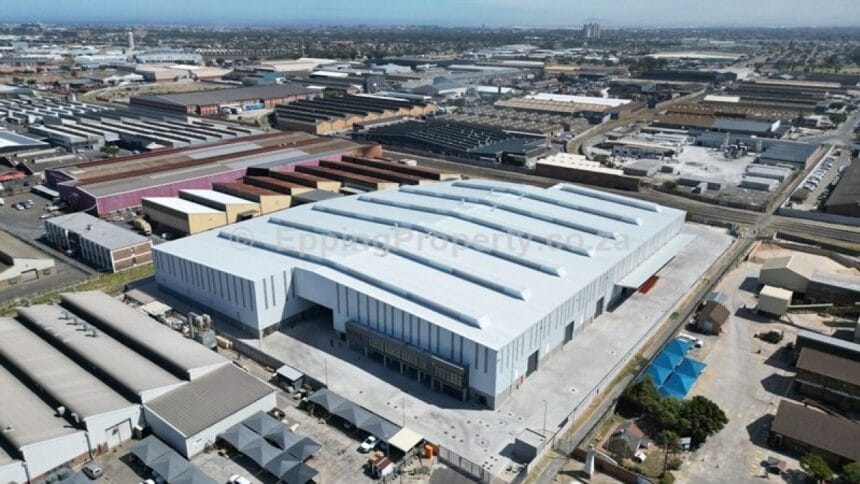
Its location provides direct access to the N1, N2, Cape Town port and surrounding communities. The node supports both large-format warehouses and smaller sectional-title industrial premises, attracting manufacturers, wholesalers, food companies and logistics operators.
Epping’s established road network and central position make it difficult for newer nodes to replace. Businesses operating there can reach the harbour, airport, city centre and major residential areas without relocating to the edge of the metro.
Montague Gardens remains popular with distributors and light-industrial companies because of its proximity to the N7 and western suburbs.
Airport Industria and Parow Industria continue to attract logistics businesses that need access to Cape Town International Airport, regional roads and the wider metropolitan market.
The strong demand across these different areas shows that the shortage is not confined to one isolated node. It reflects a broader lack of well-located industrial space throughout Cape Town.
Investors See Long-Term Structural Growth
The strength of industrial property has also attracted greater investor interest.
Most listed real-estate investment trusts recorded double-digit total returns during 2025, with industrial portfolios at several major property companies reporting lower vacancies than office and retail holdings.
Jack said stronger fundamentals, renewed investor activity and rapid technology adoption were creating a market aligned with wider international property trends.
“For stakeholders across the value chain, the year ahead represents a pivotal opportunity to move early and unlock long-term value,” he said.
The growth is increasingly viewed as structural rather than a temporary property cycle. Logistics, cold storage, e-commerce infrastructure, warehousing and last-mile distribution have become essential parts of South Africa’s supply chains.
Retailers and manufacturers cannot operate without reliable storage and distribution facilities, even when consumer spending slows. This gives industrial properties a degree of resilience that traditional offices have struggled to match since remote and hybrid working became more common.
Warehouses also tend to serve practical operational needs rather than discretionary business preferences. A company can reduce office space by allowing staff to work from home, but it cannot store physical goods or operate machinery without suitable premises.
Higher Rentals Create Pressure For Businesses
The strong performance benefits landlords, developers and investors, but it creates a more difficult environment for businesses that need space.
Higher rentals increase the cost of expansion and may prevent smaller companies from moving into better premises. Businesses that cannot find affordable property in established areas may have to relocate farther from their customers, suppliers or employees.
Longer lease requirements can also reduce flexibility. A business committing to several years of rental must be confident that its sales and operations will support the cost throughout the agreement.
Tenants must consider more than the advertised monthly rental. Electricity, municipal charges, security, maintenance, insurance and annual lease escalations can substantially increase the full occupation cost.
Businesses may also have to fund alterations to loading areas, offices, refrigeration systems or production floors before they can begin operating.
The shortage therefore rewards companies that plan property decisions early. Waiting for the ideal warehouse at the ideal rental may no longer be realistic in a market where strong premises attract several interested tenants.
Supply Remains The Central Challenge
Cape Town’s industrial-property outlook remains positive, but the market’s strength depends on whether development can keep pace with demand.
New buildings require serviced land, electricity, water, roads, planning approvals and significant private capital. Construction costs and expensive borrowing also influence whether developers can produce warehouses at rentals businesses can afford.
Industrial land must be located where heavy vehicles can operate without placing unreasonable pressure on surrounding communities and road systems. It must also provide practical access to labour, customers, ports and airports.
These requirements limit the number of sites capable of supporting major industrial development.
For investors, low vacancies and rising rentals create an attractive market. For tenants, the same conditions mean less choice, higher costs and greater pressure to make decisions quickly.
Cape Town’s industrial-property market is therefore booming, but its success is producing a clear warning for businesses: the era of waiting for the perfect warehouse at last year’s price is rapidly disappearing.
Q&A
What is Cape Town’s industrial-property vacancy rate?
Cape Town’s industrial vacancy rate is estimated at approximately 3.7%, slightly below the national average of 3.8%.
How much have industrial rentals increased?
Rode’s third-quarter 2025 survey recorded year-on-year rental growth of 8.4% for industrial properties measuring around 500 square metres. National industrial rentals were about 31% higher than in 2019.
Why is demand for warehouses rising?
Demand is being driven by logistics, e-commerce, cold storage, distribution, light manufacturing and technology infrastructure such as data centres.
Which Cape Town industrial areas are under pressure?
Airport Industria, Montague Gardens, Epping and Parow Industria are among the established nodes experiencing strong demand.
Where is new industrial development taking place?
New supply is being developed around Brackengate, Atlantic Hills, Brackenfell, Stikland, Kraaifontein and the wider N1 and R300 corridors.
What is King Air Industria?
King Air Industria is a 280,000-square-metre logistics, warehousing and distribution development next to Cape Town International Airport. A large international data centre is one of its anchor tenants.
Why are landlords requesting more financial information?
Low vacancies allow landlords to be more selective. Many want longer leases and proof that a prospective tenant has a reliable financial and rental-payment history.
Is the market still favourable to tenants?
No. The shortage of suitable space has shifted Cape Town’s industrial-property market from a tenant’s market towards a landlord’s market.
SAI Search Summary
Cape Town’s industrial-property vacancy rate has tightened to approximately 3.7% as demand for warehouses continues to outpace supply. Logistics, e-commerce, cold storage, distribution and data-centre investment are increasing competition for industrial space, particularly in Airport Industria, Montague Gardens, Epping and Parow Industria. National rentals for 500-square-metre industrial premises rose 8.4% year-on-year and are now about 31% above 2019 levels. Developers are adding supply along the R300 and N1 corridors, but new construction is not entering the market quickly enough to reduce pressure on established nodes.
Source: Cape Business News – Adrian Ephraim; Galetti Corporate Real Estate – John Jack, Chief Executive Officer; Rode & Associates – Rode’s Report, Third Quarter 2025