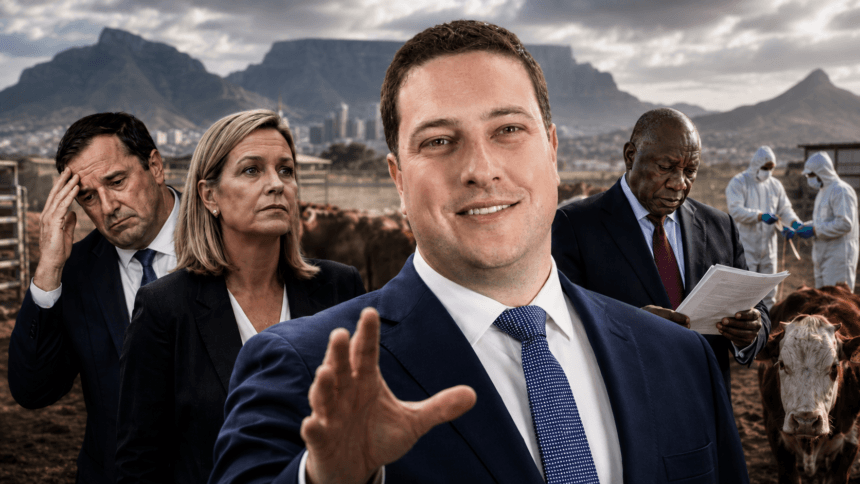
Cape Town: Geordin Hill-Lewis has asked President Cyril Ramaphosa to replace John Steenhuisen as Agriculture Minister after months of mounting farmer anger, court battles over vaccine access, accusations of administrative failure and a damaging collapse in trust between livestock producers and the minister’s office during South Africa’s foot-and-mouth disease crisis.
Geordin Hill-Lewis’s decision to remove John Steenhuisen from the Agriculture portfolio represents far more than a routine reshuffle of Democratic Alliance representatives in the Government of National Unity.
It is an intervention in a department whose handling of South Africa’s worsening foot-and-mouth disease crisis has been challenged by farmers, agricultural organisations and the courts. It follows months in which producers repeatedly warned that the national response was too slow, too centralised and too disconnected from conditions on farms.
Hill-Lewis confirmed that he had written to President Cyril Ramaphosa requesting that Willie Aucamp replace Steenhuisen as Minister of Agriculture. Steenhuisen would be moved to the position of Deputy Minister of Trade, Industry and Competition.
Although Hill-Lewis acknowledged that Steenhuisen had expanded agricultural market access and made progress in obtaining and distributing FMD vaccines, the mandate he gave Aucamp exposed the seriousness of the problems left behind.
Hill-Lewis said Aucamp’s immediate responsibility would be to resolve ongoing legal proceedings relating to FMD, work with the entire agricultural sector, overcome the crisis and “restore confidence through accelerated practical steps” to bring the disease under control.
Those words are significant.
A new minister would not need an instruction to restore confidence unless confidence had already been lost. Nor would he need an immediate mandate to resolve litigation unless the relationship between government and the farming sector had deteriorated to the point where legal action had replaced cooperation.
Hill-Lewis also placed the reshuffle within a broader standard of public accountability.
He said DA representatives in government must demonstrate higher standards of public service, responsiveness and integrity. The official party statement described the changes as the result of a “careful assessment” of the DA’s national executive team.
The party did not use the word incompetence. It did not directly accuse Steenhuisen of causing the FMD crisis. Yet the decision to remove him from the portfolio most closely associated with the crisis, while ordering his successor to repair litigation and restore trust, amounts to a serious judgement on his performance.
Farmers Had Warned The Department For Months
The breakdown did not occur suddenly.
On 27th January, the Southern African Agri Initiative, Free State Agriculture and Sakeliga sent a formal legal demand to Steenhuisen and the Department of Agriculture.
Saai said the action followed months of engagement, written submissions and warnings that the government’s approach was failing farmers, threatening food security and accelerating economic damage across the livestock and dairy industries.
The organisation described the operational response as “fragmented, slow and structurally incapable of matching the scale and pace of the outbreak”.
Saai identified several specific failures: vaccine shortages, the department’s single buyer-supplier model, uncertainty around vaccine supply, delays in permits and authorisations, contradictory messages to farmers and a widening gap between government announcements and implementation on farms.
The organisation said it had submitted practical proposals to Steenhuisen on 16th January. These included expanding private vaccine procurement, using private veterinarians and animal-health networks, accelerating permits and clarifying movement rules.
According to Saai, those measures were not implemented at the time.
The organisation warned that delays were pushing law-abiding farmers towards insolvency and increasing the risk of informal or unlawful attempts to protect livestock.
Saai chief executive Francois Rossouw said the crisis had moved beyond briefings and intentions and required decisive action.
This was not a political party attacking an opponent. It was an agricultural organisation representing family farmers warning the minister that producers were running out of time.
Steenhuisen Defended State Control
Steenhuisen and the Department of Agriculture rejected the farming organisations’ approach.
The department argued that allowing unrestricted private vaccination would undermine disease surveillance, traceability and South Africa’s ability to regain internationally recognised FMD-free status.
It accused the organisations of promoting what it called a vaccine “free-for-all” and warned that legal action would divert veterinarians, officials and financial resources away from the outbreak response.
Steenhuisen said central control was necessary because South Africa needed verifiable vaccination records, official monitoring, controlled animal movement and reliable evidence that transmission had stopped.
“Now is not the time for distraction,” he said at the time, calling instead for unity and a fast-tracked national containment strategy.
This was the minister’s core defence: the state was not blocking farmers for political reasons, but protecting the integrity of the national disease-control system.
That argument had scientific and regulatory weight. FMD is a controlled animal disease, and badly managed vaccination can obscure infections, undermine surveillance and damage export credibility.
The dispute was therefore not simply between action and inaction. It centred on whether the state had the operational capacity to insist on central control while farmers’ animals, businesses and livelihoods remained exposed.
Farmers said it did not.
The Dispute Moved To Court
The clash eventually reached the Pretoria High Court.
Saai, Sakeliga and Free State Agriculture challenged the government’s restrictions on private vaccine procurement and administration. Their case argued that farmers, veterinarians and lawful private suppliers should be allowed to assist where government capacity was insufficient.
After the court proceedings, Saai said the litigation had revealed how far the public-service response had become removed from the urgency confronting livestock farmers.
The organisation claimed that hundreds of dairies, stud breeders, commercial herds and small-scale producers were facing losses from which some might never recover.
Saai also said Steenhuisen had failed for more than a month to provide a clear legal basis for insisting that every aspect of vaccination remain under state control.
The organisation later accused the minister of misrepresenting the judgment.
It said the court had not authorised lawlessness or uncontrolled vaccination. Instead, according to Saai’s interpretation, the order allowed lawfully imported or manufactured vaccines to be used under notification, cold-chain, veterinary and reporting requirements.
Saai said the litigation had never aimed to weaken the state. Its purpose was to stop the department from preventing private capacity from helping.
The organisation asked why it had taken litigation for the state to recognise the role that private farmers, veterinarians and suppliers could play in containing the disease.
It also questioned why South Africa’s virus strains had allegedly taken nine months to reach the Pirbright reference laboratory and why a formal vaccination scheme had taken six months to publish.
Those questions go directly to administrative performance.
They ask whether the minister’s department responded with the speed, planning and legal clarity demanded by a national emergency.
Government Eventually Expanded The Rollout
The government did take substantial action.
By April, the Department of Agriculture said more than two million animals had been vaccinated and four million vaccine doses had been received from suppliers in Argentina and Türkiye.
The department reported that all recorded dairies in the Free State had been vaccinated and that major Western Cape dairies had been attended to. It also said the vaccination strategy was producing encouraging results, with no new breakthroughs detected in vaccinated herds.
Steenhuisen secured further imported doses, oversaw the return of locally produced vaccine capacity and later introduced a regulated scheme allowing greater private-sector participation.
These were not insignificant achievements.
Any fair assessment must acknowledge that Steenhuisen inherited an animal-health system weakened by limited local vaccine production, staff shortages, fragmented reporting and long-standing institutional problems.
He did not create every weakness in the department, nor was every FMD infection the result of a ministerial decision.
However, ministers are appointed to lead precisely when systems are weak and crises demand urgent coordination.
The political question was not whether Steenhuisen performed no work. It was whether his department acted quickly and effectively enough, and whether it listened when farmers warned that the official system could not meet the scale of the emergency.
The legal conflict and Hill-Lewis’s instruction to Aucamp to restore confidence suggest that the answer, at least politically, was no.
Farmer Engagement Became A Crisis Of Its Own
The breakdown deepened when conduct inside Steenhuisen’s office became part of the story.
A leaked internal email, allegedly sent by Steenhuisen’s chief of staff Jana le Roux, forwarded correspondence from FMD Response SA to senior Agriculture Department officials with the comment: “Attached just received for some amusement.”
The letter being dismissed was not an abusive complaint.
It came from farmers, veterinarians and agricultural stakeholders seeking engagement on vaccine strategy, private-sector capacity and practical methods to increase immunity across the national herd.
Dairy farmer Andrew Morphew, one of those involved, said farmers did not have time to be offended because there was a disease to defeat.
He said cooperation between government and producers was not a courtesy, but the only means through which FMD could be brought under control.
Steenhuisen publicly described the email as being in bad taste and instructed the person responsible to apologise.
But the damage went beyond a single careless sentence.
For farmers who had spent months demanding faster intervention, the email appeared to confirm their fear that legitimate warnings were being treated with contempt inside the minister’s office.
The controversy became more serious when News24 reported that Le Roux had also apologised after allegedly telling an agricultural executive at the Nampo agricultural show: “I’ll f*** you up in court.”
That alleged threat was linked directly to the same environment of conflict between the minister’s office and farming organisations.
The significance lies not merely in the profanity.
A chief of staff occupies a position of trust and authority inside a ministerial office. Threatening a stakeholder with court action during a national agricultural emergency creates the impression that the office is fighting farmers rather than working with them.
The two incidents, taken together, strengthened claims that arrogance and hostility had entered a relationship that required openness, professionalism and urgent cooperation.
The Political Consequence
Steenhuisen stepped down as DA leader earlier this year saying he intended to devote his full attention to defeating what he described as the most devastating FMD outbreak South Africa had faced.
That commitment raised expectations.
Agricultural economist Wandile Sihlobo warned at the time that many producers faced financial disaster. Farmers therefore expected decisive leadership, clear rules, sufficient vaccines and a department capable of working with private agricultural capacity.
Instead, the months that followed brought legal demands, litigation, accusations of delay, disputes over vaccine control and public controversy involving Steenhuisen’s closest office.
This is why the reshuffle cannot credibly be presented as a simple renewal of the DA’s Cabinet team.
Hill-Lewis’s language points towards accountability.
He praised the progress Steenhuisen had made, but removed him from Agriculture. He appointed a successor with instructions to resolve FMD litigation, engage the whole sector, accelerate practical action and restore confidence.
That is a corrective mandate.
It acknowledges that the department’s relationship with farmers had become unsustainable and that continued leadership by Steenhuisen risked extending the conflict.
Not A Party Feud, But A Test Of Competence
There will inevitably be speculation about rivalry between Hill-Lewis and the man he replaced as DA leader.
That political dimension exists, but it should not overshadow the evidence.
Farmers raised detailed operational complaints. Agricultural organisations submitted proposals. The department defended its approach. The conflict moved to court. The state later broadened private participation. The minister’s chief of staff became involved in two damaging controversies. Hill-Lewis then removed Steenhuisen from the portfolio and ordered his successor to restore trust.
The sequence tells its own story.
Steenhuisen’s proposed removal is not proof that he was personally responsible for every outbreak, every vaccine delay or every institutional weakness.
It is evidence that the political authority above him no longer believed he was the right person to lead the portfolio through the remainder of the crisis.
That is the central issue: competence, judgement and accountability in public office.
South Africa’s farmers were not merely an electoral constituency demanding favours. They were producers facing diseased herds, restricted animal movement, lost income, weakened exports and the possibility of financial collapse.
They needed a department that could regulate effectively without paralysing action, protect disease surveillance without excluding lawful private capacity and engage producers without hostility.
By Hill-Lewis’s own wording, Aucamp must now deliver accelerated practical action and restore confidence.
That is also the clearest explanation of why Steenhuisen is being moved.
Ramaphosa Holds The Final Authority
The reshuffle has not yet taken legal effect.
Under the Constitution, only President Cyril Ramaphosa can appoint, dismiss or reassign ministers and deputy ministers.
Hill-Lewis has submitted the DA’s requested changes, and reports indicate that the Presidency is considering them. Until Ramaphosa makes a formal announcement, Steenhuisen remains Agriculture Minister.
Should the President approve the proposal, Aucamp will inherit a department facing more than a veterinary emergency.
He will inherit litigation, mistrust, contested policy, damaged relations and farmers who believe the state failed them when the disease was at its worst.
His performance will be measured not by promises, briefings or imported vaccine totals alone, but by whether infections decline, farmers receive practical support, lawful private capacity is used and confidence returns to the sector.
For Steenhuisen, reassignment rather than dismissal would preserve a place in government.
But being moved from Minister of Agriculture to a deputy-minister position would remain an unmistakable political demotion and a public judgement on how the FMD crisis was managed.
Q&A
Why does Geordin Hill-Lewis want John Steenhuisen replaced?
Hill-Lewis says the changes follow a careful assessment of the DA’s national executive team. His mandate to Willie Aucamp specifically calls for FMD litigation to be resolved, practical action to be accelerated and confidence in the agricultural sector to be restored.
Did Hill-Lewis directly accuse Steenhuisen of incompetence?
No. Hill-Lewis acknowledged Steenhuisen’s work on market access and vaccine procurement. However, removing him from Agriculture and ordering his successor to repair the crisis constitutes a significant judgement on his performance.
What did farmers accuse the department of doing wrong?
Agricultural organisations accused the department of responding too slowly, restricting private vaccine access, creating uncertainty around permits, issuing contradictory messages and failing to translate announcements into workable action on farms.
What was Steenhuisen’s defence?
Steenhuisen argued that FMD vaccination had to remain tightly controlled to preserve surveillance, traceability and South Africa’s prospects of regaining internationally recognised disease-free status.
What happened in court?
Saai, Sakeliga and Free State Agriculture challenged restrictions on private vaccination. The farming organisations said the resulting orders recognised that lawful private capacity could assist the national response under reporting and control requirements.
What did Steenhuisen’s chief of staff allegedly say?
News24 reported that Jana le Roux apologised after allegedly telling an agricultural executive at Nampo: “I’ll f*** you up in court.” A separate leaked email appeared to describe an FMD engagement letter as material received “for some amusement”.
Has Steenhuisen already been removed?
No. President Cyril Ramaphosa must formally approve and announce any Cabinet change.
Who is expected to replace him?
Hill-Lewis has nominated Willie Aucamp, whose immediate mandate would be to resolve FMD litigation, work with the agricultural sector and restore confidence.
SAI Search Summary
Geordin Hill-Lewis has asked President Cyril Ramaphosa to replace John Steenhuisen as Agriculture Minister after months of farmer anger over South Africa’s foot-and-mouth disease response. Farming organisations accused the department of vaccine delays, restrictive central control, contradictory communication and failing to use private capacity quickly enough. The dispute led to litigation, while controversies involving Steenhuisen’s chief of staff further damaged relations with producers. Hill-Lewis has instructed proposed successor Willie Aucamp to resolve the legal conflict, accelerate practical disease-control measures and restore confidence across the agricultural sector.
Source: Democratic Alliance – Geordin Hill-Lewis; South African Government / Department of Agriculture – Minister John Steenhuisen; Business Day – Thando Maeko; Farmer’s Weekly – Hanlie du Plessis; News24 – Staff Reporter; Reuters – Siyabonga Sishi and Nelson Banya