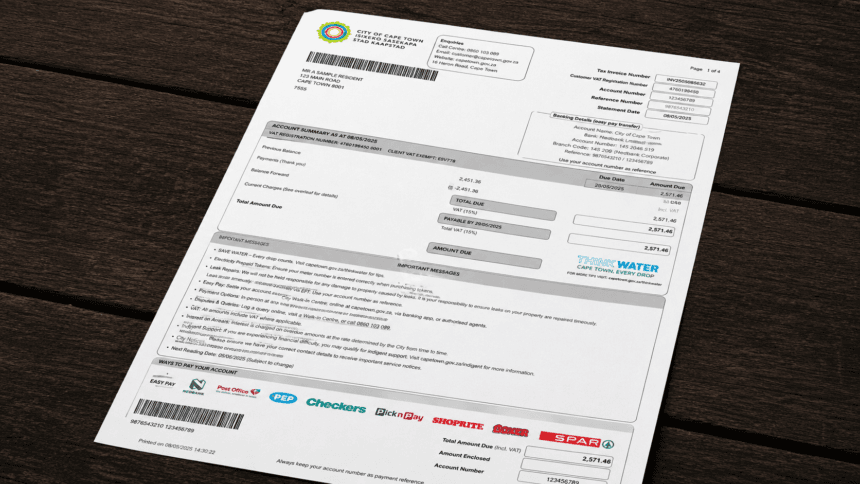
Cape Town: Cape Town municipal bill changes are expected from Wednesday, 1st July, after a Western Cape High Court ruling forced the City to remove fixed water, sanitation and citywide cleaning charges linked to property values. Under the revised budget awaiting Council approval on Monday, fixed water and sanitation charges will return to a meter-size system, cleaning costs will move back into property rates, and the rates-free portion for qualifying residential properties will rise from R450,000 to R620,000. The City says the expanded relief should offset much of the increase facing lower- and middle-value properties, although each household’s final account will depend on its municipal valuation, meter size, water consumption and eligibility for rebates.
Court Ruling Forces City To Rewrite Tariff Structure
Cape Town homeowners are preparing for important changes to their municipal accounts after the Western Cape High Court ruled that the City could no longer calculate fixed water, sanitation and citywide cleaning charges according to property-value bands. The judgment has forced officials to redesign a substantial part of the revenue structure shortly before the start of the new municipal financial year, while still finding enough income to fund the same services and infrastructure programme.
The South African Property Owners Association and AfriForum challenged the disputed tariffs, arguing that the City had effectively created additional property taxes while presenting them as service charges. The court agreed that the fixed amounts were linked too closely to municipal property valuations and ordered the City to end the structure by 30th June. The ruling applies going forward, meaning it changes how the City may collect the revenue from the new financial year but does not automatically require the municipality to refund all amounts collected under the existing system.
The City decided not to appeal the judgment. Instead, officials amended the proposed 2026/27 budget, recalculated the affected tariffs and reopened those sections for supplementary public comment. Council is expected to vote on the final revised budget on Monday, with the new tariffs scheduled to take effect from Wednesday if the package is approved.
Water And Sanitation Charges Return To Meter Size
The most significant practical change is the return to a system in which fixed water and sanitation charges are determined by the size of a property’s water connection rather than the value of the home. Cape Town used meter size as the basis for these fixed charges before moving to property-value bands during the current financial year, when the City argued that wealthier households should contribute more towards maintaining the wider water and sanitation network.
The High Court rejected that approach, forcing the municipality back to a model that links the fixed charge to the physical capacity of the connection. This means two homes fitted with similar water meters could face the same basic water and sanitation charge even if their municipal valuations differ substantially. Property value will still determine the rates portion of the account, but it will no longer set the fixed monthly charge attached to those two services.
Most ordinary residential properties use smaller water connections, commonly falling within the group of meter sizes below 22 millimetres. The City proposes grouping those common sizes into one fixed-charge category, which officials say should simplify billing and prevent unnecessary differences between standard household connections. The change does not remove consumption charges. Households will still pay for the amount of water they use, with higher tariffs applying as consumption moves through the stepped pricing bands.
Lower-Value Homes Could Face Higher Fixed Charges
The City has acknowledged that properties valued below approximately R2.8 million are generally expected to pay more in fixed water and sanitation charges under the restored meter-size system than they do under the current property-linked structure. Higher-value homes could pay less for those fixed services because their charges will no longer rise in line with the municipal valuation.
That comparison applies only to the affected service lines and should not be read as a prediction of the full municipal account. Household bills combine property rates, water use, sanitation charges, refuse services and electricity where the City is the supplier. The final result will therefore depend on several factors, including the property valuation, meter size, monthly water consumption, tariff category and any rebates attached to the account.
A lower-value property may face a higher fixed water and sanitation charge but receive a larger reduction in property rates through the expanded rates-free portion. A higher-value home may save on fixed service charges while contributing more through the revised rate-in-the-rand. Homeowners will need to compare the complete statement rather than drawing conclusions from one item in isolation.
Rates-Free Portion Rises To R620,000
To soften the effect on lower- and middle-value homes, the City proposes increasing the rates-free portion of qualifying residential properties from R450,000 to R620,000. Property rates would therefore be calculated only on the part of the municipal valuation above R620,000, provided the home qualifies for the residential benefit.
A qualifying primary residence valued at R1.5 million, for example, would not be rated on the full municipal valuation. The first R620,000 would be excluded, leaving R880,000 as the taxable value used in the rates calculation. The expanded benefit is also expected to apply to residential properties valued up to R8 million, compared with the previous R7 million ceiling.
The City says this larger exclusion should, on average, offset the increase in fixed water and sanitation charges for many properties valued below R2.8 million. However, the assurance is based on broad averages rather than an individual guarantee. Homes with larger water meters, high consumption, different tariff categories or unusual rebate circumstances could still experience a different outcome.
Indigent Threshold Moves Higher
The proposed R620,000 threshold will also become important for indigent property benefits, extending full relief to a larger number of lower-value homes. Qualifying indigent households can receive substantial assistance with property rates and basic municipal services, although those benefits depend on the City having accurate records of the household’s income, ownership and living circumstances.
Registered backyard customers and approved indigent households may also qualify for free basic water and sanitation allocations under the relevant municipal policies. In many cases, relief is not automatically applied simply because a property falls below a valuation threshold. Account holders may still need to submit documents and complete an application so the City can confirm that they meet the qualifying conditions.
The higher threshold matters because municipal valuations have increased in many Cape Town suburbs. A household previously pushed outside a relief category by a higher valuation may now fall back within the eligible property band, although income tests and other conditions will continue to apply where required.
Pensioner Rebates Remain Available
Pensioners and social-grant-dependent homeowners who meet the income rules will continue to qualify for rates relief regardless of property value. The City’s proposed rebate system applies to qualifying owners with gross household incomes of up to R27,000 a month, with the percentage of relief declining as income rises.
Households in the lowest income bands can qualify for full relief, while those closer to the R27,000 ceiling receive a smaller reduction. Applicants generally need to be at least 60 years old and must submit proof of income, ownership and other supporting documents requested by the City.
Pensioners already receiving a rebate should still examine their new account carefully to ensure that the benefit has been carried forward correctly after the tariff changes. Any owner whose circumstances have changed should update the municipality rather than assume that a previous approval will automatically remain accurate for every future financial year.
Citywide Cleaning Charge Removed As Separate Item
The standalone citywide cleaning charge introduced during the current financial year will disappear from municipal accounts. The levy funded services such as street cleaning, litter removal and the maintenance of shared public areas, but its property-linked structure formed part of the successful court challenge.
The removal of the line item does not mean the cleaning service has been cancelled or that its cost has disappeared. The City will instead return those expenses to the property-rates system, where they were funded before the separate charge was introduced. This is therefore a change in the collection method rather than a reduction in municipal expenditure.
The revised structure also changes the proposed reduction in residential property rates. The original March budget offered a 10.2% reduction in the residential rate-in-the-rand, but the amended budget lowers that relief to 2.09%. The difference allows rates revenue to absorb citywide cleaning costs that can no longer be recovered through the separate tariff. Commercial and industrial property rates are also expected to rise compared with the initial proposal.
Revised Property Rate Is Higher Than March Proposal
The City’s first draft budget proposed a residential rate-in-the-rand of 0.006428. Following the High Court judgment and the removal of the separate cleaning charge, the revised residential rate increased to 0.007010.
The rate-in-the-rand is multiplied by the taxable portion of the municipal valuation to determine the annual rates charge, which is then divided across monthly accounts. Homeowners will not automatically pay the revised rate on the full valuation because the expanded R620,000 exclusion must first be applied to qualifying residential properties.
This produces a mixed result. The rate applied to the taxable value is higher than the original March proposal, but a larger part of the home’s valuation is excluded before the calculation begins. The balance between those two changes will differ from one property to another, meaning owners should avoid relying on a single percentage when trying to estimate their next account.
Higher Water Users Will Carry More Of The Cost
The amended budget also shifts a greater share of the water and sanitation burden towards households with higher consumption. The City proposes steeper per-kilolitre charges in the bands above 10.5 kilolitres a month than those included in the March draft.
Water use between 10.5 and 35 kilolitres would cost R2.09 more per kilolitre than under the original proposal. Consumption above 35 kilolitres would attract a further R8.06 per kilolitre, excluding VAT, compared with the March tariff. Similar adjustments apply to sanitation charges in the higher usage bands.
The City says this structure maintains the principle that households can reduce their accounts by using less water, while still recovering the costs of operating and maintaining the network. Officials rejected a pure consumption-only model because it would have forced the municipality to raise prices from the first kilolitre and exposed the water service to sharp revenue losses during droughts, when households are asked to reduce consumption.
Fixed charges provide predictable income for pipes, reservoirs, pump stations, wastewater treatment works and other infrastructure that must be maintained regardless of how much water is used in a particular month. The dispute therefore centres not on whether those costs exist, but on the lawful and equitable way in which they should be recovered.
City Says Service Costs Have Not Disappeared
Mayor Geordin Hill-Lewis said the judgment changed the legal method available to the City for cross-subsidising services but did not reduce the cost of providing them. Cape Town must still fund water treatment, sewer networks, road maintenance, electricity systems, public cleaning and other municipal functions while protecting lower-income households from unaffordable increases.
“This expanded protection will, on average, offset the rise in fixed charges for most properties under R2.8m due to the court ruling’s impact,” Hill-Lewis said when announcing the amended budget.
He said the City intended engaging National Treasury and the Department of Cooperative Governance and Traditional Affairs about future options for municipal cross-subsidisation. The mayor also rejected suggestions that Cape Town should reduce its capital programme to absorb the revenue changes, arguing that cutting infrastructure investment would create larger service-delivery failures and higher costs in future.
Infrastructure Budget Remains Unchanged
The City says the court-driven amendments affect how revenue is collected but do not change the expenditure side of the proposed budget. Cape Town plans to spend R40 billion on infrastructure over three years, including R16.7 billion on water and sanitation, R6 billion on electricity-grid upgrades and maintenance, and R3.7 billion on roads, stormwater systems and pothole repairs.
A further R3.3 billion is allocated to the MyCiTi expansion across the Cape Flats, while another R3.3 billion is intended for informal-settlement upgrades and state-subsidised housing. The City argues that stable revenue from tariffs and rates is essential if these programmes are to proceed without placing the municipality under financial pressure.
Critics of municipal increases continue to question whether households can absorb repeated annual adjustments, especially while food, transport and electricity costs remain high. The City’s position is that delaying maintenance and infrastructure replacement would eventually result in more expensive breakdowns, service interruptions and emergency repairs. That affordability debate is expected to feature prominently when councillors consider the final budget.
Electricity Increase Largely Unchanged
The High Court ruling primarily affects the property-linked water, sanitation and cleaning charges. The proposed average residential electricity increase remains about 6.64% under the amended budget.
Commercial energy users are expected to receive a lower average increase than originally proposed because the City is continuing to remove the electricity surcharge contribution previously used to support cleaning costs. The precise effect on an account will depend on the customer’s tariff category, monthly consumption and whether the property qualifies for Lifeline or another form of assistance.
Prepaid and credit-meter customers should verify that they remain on the correct tariff, particularly where household income or property value may affect eligibility for support. A saving or increase in one service line may also be offset by changes elsewhere on the municipal statement.
First July Bill May Not Show Full Effect
Although the new tariffs are scheduled to begin on 1st July, homeowners may not see the complete impact on the first account issued after that date. Municipal statements follow different meter-reading and billing cycles, which means an account could include consumption from periods falling partly before and partly after the tariff change.
The clearest comparison may only appear once a statement covers a full billing cycle under the revised structure. Homeowners should keep earlier accounts so they can compare fixed charges, rates calculations and consumption over several months rather than judging the change from one isolated total.
A higher bill does not automatically mean the municipality has made an error. Seasonal electricity or water consumption may also have changed. The most reliable method is to compare each service line, the applicable tariff, the meter reading and the amount used.
What Homeowners Should Check
The first step is to confirm the municipal valuation currently attached to the property. The new rates calculation will use the City’s latest valuation information, subject to any successful objection or supplementary valuation.
Homeowners should then check the water-meter size recorded on the account because that measurement will determine the new fixed water and sanitation category. Owners of sectional-title properties should establish whether services are billed through individual meters, the body corporate or a shared connection, as this could influence how the charges appear.
Capetonians should also confirm that approved pensioner, indigent or other rebates remain correctly recorded. Water use should be compared with the physical meter reading where possible, since unexpected increases may result from leaks, estimated readings or changes in household consumption rather than the tariff revision itself.
Every Account Will Be Different
There is no single percentage increase that will apply equally to every Cape Town household. The revised structure moves different parts of the municipal account in different directions and attempts to redistribute the financial impact through rates relief, fixed charges and stepped consumption tariffs.
Lower- and middle-value properties may face higher fixed water and sanitation charges but benefit from the expanded rates-free portion. Higher-value homes may pay less for fixed water and sanitation but contribute more through the property-rates system. Households using large volumes of water will experience the higher consumption bands more strongly than careful users.
Pensioners and indigent households may receive substantial protection, but only where the City has correctly recorded and approved their circumstances. The real effect will become clear when Capetonians receive their first complete statements under the new system and examine every part of the bill.
Council Must Still Approve The Changes
The revised tariff package remains subject to Council approval on Monday. The City cannot lawfully implement the amended budget before councillors adopt it, although the governing Democratic Alliance has enough seats to secure passage.
Councillors are expected to debate the affordability of the changes, the impact of the court ruling and the scale of the infrastructure programme before the vote. Once approved, the revised tariff book and related policies will take effect from 1st July.
CTNews will update this report after Council’s decision and publish any final adjustments made during the adoption process.
Q&A
Are the Cape Town municipal bill changes final?
Not yet. The revised budget is scheduled for a Council vote on Monday. The changes are expected to take effect from 1st July if approved.
Why did the City change its tariffs?
The Western Cape High Court ruled that fixed water, sanitation and citywide cleaning charges linked to property values were unlawful.
How will fixed water and sanitation charges be calculated?
They will again be based on water-meter size rather than municipal property value.
Is the citywide cleaning charge being cancelled?
It will disappear as a separate charge, but the cost of cleaning services will move back into property rates.
What is the new rates-free portion?
The City proposes increasing the rates-free portion for qualifying residential properties from R450,000 to R620,000.
Will lower-value homeowners pay more?
Many properties valued below about R2.8 million could face higher fixed water and sanitation charges. The City says the expanded rates relief should offset much of that increase on average.
Will higher-value properties pay less?
They could pay lower fixed water and sanitation charges because those charges will no longer rise with property value. Their overall account will still depend on property rates, consumption and other services.
Do pensioner rebates continue?
Yes. Pensioners with qualifying household income of R27,000 a month or less can continue applying for rates relief regardless of property value.
When will the changes appear on municipal accounts?
The tariffs are scheduled to apply from 1st July, but the first full effect may only appear once an account covers a complete billing cycle under the new tariffs.
What should homeowners check?
They should confirm their municipal valuation, water-meter size, consumption, tariff classification and any approved rebates.
SAI Search Summary
Cape Town municipal bill changes are expected from 1st July after the Western Cape High Court ruled that fixed water, sanitation and citywide cleaning charges linked to property values were unlawful. The City’s revised budget returns fixed water and sanitation charges to a meter-size system, moves cleaning costs into property rates and increases the rates-free portion for qualifying residential properties from R450,000 to R620,000. Properties below approximately R2.8 million may face higher fixed charges, while higher-value properties could pay less for those services. The revised budget still requires Council approval on Monday.
Source: City of Cape Town, Mayor Geordin Hill-Lewis and Staff Reporter; Time Out Cape Town, Selene Brophy; Cape Business News, Staff Reporter; Western Cape High Court, Presiding Judges; South African Property Owners Association, Staff Reporter.