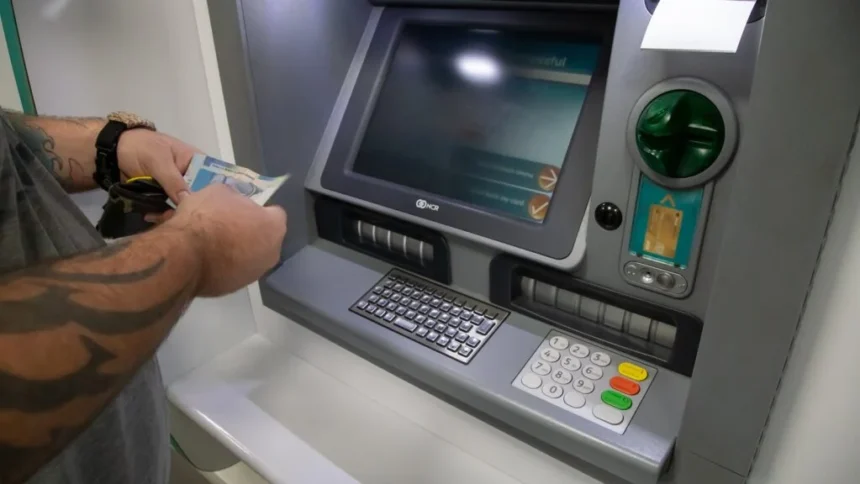
Cape Town: The South African Reserve Bank has proposed a major restructuring of the country’s cash-access network through the introduction of white-label ATMs that would not belong exclusively to one commercial bank and could serve customers across different banking institutions. The proposal forms part of the Reserve Bank’s Cash Smart Strategy, which aims to reduce the estimated R89 billion annual cost carried by consumers when accessing and using cash, protect services in rural and lower-income communities, and create a more resilient system as traditional banks close branches and reduce branded ATM networks. The plan remains at policy stage and does not mean existing ATMs will disappear immediately, with detailed regulation, licensing, funding and operating arrangements still to be developed.
Reserve Bank Proposes Shared ATM Network
South Africa’s familiar landscape of bank-branded ATMs could gradually change under a Reserve Bank proposal to create a shared national cash-access network.
The central bank wants white-label ATMs to become an important part of the country’s future cash infrastructure. Unlike a conventional machine carrying the branding of one bank, a white-label ATM is independently or jointly operated and allows customers from several banks to withdraw money and perform supported transactions.
The proposal is contained in the Reserve Bank’s position paper on cash and forms part of a wider programme aimed at ensuring that physical money remains affordable, secure and available even as digital payments continue to grow.
The policy responds to a difficult contradiction in South Africa’s financial system. Banks are encouraging customers to use apps, online transfers and card payments, while reducing some branches and ATM networks. However, millions of people still rely on cash to pay for transport, food, informal services, school expenses and other daily needs.
This means a reduction in bank-owned infrastructure does not automatically eliminate demand. Instead, it can force cash-dependent customers to travel further, pay more or rely on less secure alternatives.
The Reserve Bank’s proposed solution is to treat parts of the cash network as shared national infrastructure rather than leaving every bank to operate a separate system.
What A White-Label ATM Is
A white-label ATM performs many of the functions associated with a bank machine but does not operate solely under the identity of one financial institution.
Customers from participating banks could use the same machine, while ownership and operation could sit with a specialist ATM company, shared utility or consortium involving banks, retailers and other approved service providers.
The machines would connect to the national payment system and authenticate customers through their cards, accounts or approved digital credentials. The withdrawal would still come from the customer’s bank account, but the physical machine would form part of a shared network.
This model already operates in several international markets, although the ownership structures and fee arrangements differ from country to country.
South Africa’s proposal is closely connected to the idea of establishing a national cash utility. Such a structure could coordinate where money is needed, where ATMs should be located and how physical cash moves between banks, retailers, cash centres and communities.
The aim is not merely to remove logos from machines. It is to reduce duplication, improve interoperability and place access points where they are socially and economically needed rather than only where an individual bank finds them profitable.
Why The Reserve Bank Wants Change
The Reserve Bank’s position paper identifies three broad priorities: lowering the cost of cash, ensuring equitable access and improving the security and resilience of the physical-money system.
The central bank argues that market forces alone cannot guarantee those outcomes. Commercial banks naturally concentrate branches and ATMs in areas where transaction volumes justify the cost of installation, cash replenishment, maintenance and security.
That model works well in busy commercial centres, shopping malls and affluent suburbs. It becomes more difficult in rural towns, informal settlements and lower-income communities where transaction values may be smaller and operating risks higher.
A national shared network could spread those costs across several institutions and reduce the need for each bank to place a separate machine in the same commercial area while leaving another community with no convenient access.
The Reserve Bank also wants to reduce the cost carried by consumers. Its analysis estimates that South Africans bear about R89 billion each year in direct and indirect expenses associated with cash.
Those costs go beyond ATM withdrawal fees. They include the time spent travelling to obtain money, transport expenses, losses through crime and the opportunity cost of holding physical cash.
Consumers Carry More Than Withdrawal Fees
According to the Reserve Bank’s analysis, explicit fees account for approximately 35% of the cost borne by consumers. Travel time contributes about 31%, while the direct expense of reaching cash-access points contributes another 14%.
Losses associated with crime account for an estimated 13%, while the sourcing of money through retailers and the opportunity cost of holding cash make up the remaining portion.
This breakdown is important because a low ATM fee does not necessarily mean that cash is affordable.
A customer who must take a taxi to the nearest branch or machine may spend more on transport than on the transaction itself. The person may also lose working time, face safety risks while carrying money and pay additional charges when using a machine operated by another bank.
White-label ATMs could reduce some of those burdens if the network is designed around access rather than bank ownership.
The Reserve Bank believes that better geographic distribution could reduce both travelling time and transport costs. A shared fee arrangement could also limit the penalties customers currently face when using another institution’s machine.
However, those savings are not guaranteed. They will depend on the final pricing rules, ownership model and willingness of banks and independent operators to participate.
Bank-Branded ATMs Will Not Vanish Next Week
The proposal should not be interpreted as an immediate instruction for commercial banks to remove or rebrand every ATM.
The Reserve Bank’s position paper establishes a policy direction rather than binding regulation. Detailed rules must still determine who may own or operate white-label machines, how fees will be set, how cash will be supplied and how customers will be protected.
Funding is another unresolved question. ATMs require secure sites, electricity, network connectivity, maintenance, cash replenishment and insurance. Machines in remote or high-risk locations can be expensive to operate.
The future framework must decide how those costs are shared between banks, retailers, ATM operators and customers.
Reserve Bank Deputy Governor Rashad Cassim told BusinessTech that the cash strategy remained at an early stage, with more progress already made in areas such as digital payments and PayShap.
Earlier reporting on the wider Cash Smart Strategy suggested that implementation of the full restructuring could take up to three years.
The most accurate description is therefore that South Africa is planning a gradual change in the ownership and organisation of ATM infrastructure, not an abrupt end to existing bank machines.
Banks Are Already Reducing ATM Networks
The proposal arrives during a broader reduction in the physical presence of several traditional banks.
Customers increasingly use mobile apps, instant payments, online banking and cards for everyday transactions. This has reduced the volume of some services previously handled inside branches or through ATMs.
Banks have responded by closing or consolidating branches, reducing some ATM networks and developing smaller self-service sites.
Between June 2023 and June 2024, the number of ATMs across South Africa reportedly declined by about 400. The large traditional banks have reduced their combined networks over several years, although their strategies differ.
Capitec has moved in the opposite direction and announced plans to add hundreds of machines, reflecting the continued cash needs of its large customer base.
Digital-only and newer banks often rely on the ATM infrastructure of competitors and on cash services available through retailers.
The result is a fragmented system in which banks follow different commercial strategies while customers still expect reliable access to notes and coins.
A white-label network could potentially serve banks that do not want to build large physical networks of their own while protecting cash access for their customers.
Cash Remains Essential Despite Digital Growth
Digital payments are expanding rapidly, but cash remains deeply embedded in South Africa’s economy.
The Reserve Bank says physical money still accounts for more than two-thirds of transaction volumes in parts of the market, particularly among lower-income households, informal traders and rural communities.
Cash remains attractive because it is immediate, widely understood and does not depend on a smartphone, mobile data, electricity at the point of sale or a merchant’s card terminal.
It also allows people to manage spending physically, which can be valuable for households operating on tight budgets.
Informal transport, street trading, small service businesses and community-based commerce continue to rely heavily on notes and coins. Even customers who receive salaries or social grants electronically often withdraw part of the money soon after it enters their accounts.
This means the move towards digital payments cannot be managed by simply removing physical infrastructure and assuming that every customer will adapt.
A resilient financial system must support both forms of payment while the transition continues.
Retailers Could Play A Larger Role
The Reserve Bank’s strategy also recognises that supermarkets and other retailers already play a major role in the cash system.
Customers can withdraw money at some tills, while retailers collect large amounts of notes and coins through daily sales. This creates an opportunity to recycle cash locally instead of transporting every note through a bank branch or central cash depot.
The Reserve Bank’s research identifies cash-back at the point of sale as one of the most efficient consumer-access channels because it uses infrastructure that already exists and processes high transaction volumes.
Large retail groups collectively recycle substantial amounts of cash each year. Under the proposed system, some retailers could take a more formal role in the national cash utility or operate as licensed wholesale cash participants.
This could reduce transport costs and improve access in towns where a supermarket remains open after a bank branch has closed.
However, greater reliance on retailers would also raise questions about security, insurance, staff training and service availability. A shop cannot always guarantee that it holds enough cash to meet customer withdrawal demand.
White-label ATMs and retailer cash-back would therefore need to complement each other rather than allowing one channel to become the only option.
Could ATM Fees Fall?
The Reserve Bank believes that a shared network could reduce the cost of accessing cash, particularly the additional charges associated with using another bank’s ATM.
Separate bank networks create duplication. Several branded machines may stand inside one shopping centre, each requiring cash deliveries, connectivity and maintenance.
A single shared facility could serve the same customers at lower combined cost.
Pradeep Maharaj, who heads the Reserve Bank’s Payments Ecosystem Modernisation Programme, previously said complete interoperability could reduce fees to almost zero.
That is an objective rather than a guaranteed outcome. The final cost to customers will depend on how the utility is funded and whether regulation limits transaction charges.
Banks currently earn revenue from some ATM transactions, especially when customers from other institutions use their machines. They may resist a model that reduces income unless it also lowers their operating costs.
The Reserve Bank’s position is that reduced infrastructure and cash-management expenses could offset the lost fee revenue.
Consumers will judge the new model by the amount deducted from their accounts, not by the ownership structure behind the machine. The policy will therefore need transparent fee rules if it is to deliver the promised benefit.
Security Remains A Major Challenge
ATMs and cash infrastructure remain targets for criminal activity.
Machines may be bombed, physically removed, vandalised or fitted with card-skimming equipment. Customers also face robbery, card swapping, shoulder surfing and fraudulent assistance from criminals pretending to help.
A national white-label system would need consistent security standards covering machine construction, site selection, surveillance, cash handling and customer authentication.
The Reserve Bank also wants wider regulation of participants in the cash supply chain. This could include licensing requirements for cash-in-transit businesses, retailers, independent ATM operators and some payment-service providers.
Stronger oversight could improve accountability and make it easier to enforce common standards.
However, regulation alone will not remove the physical risks associated with storing and moving money. Cash vehicles, machines and access points will continue to require security investment.
The location of white-label ATMs will be particularly important. Placing a machine in an underserved community improves access, but a poorly secured site may expose customers and operators to greater danger.
Cape Town And Western Cape Impact
The proposal could have a meaningful effect in Cape Town’s townships, peripheral suburbs and informal economy, where many households combine digital banking with regular cash withdrawals.
Residents who travel long distances to shopping centres or commercial districts may benefit if shared machines are placed closer to transport interchanges, community facilities and local retail hubs.
Small Western Cape towns could also gain from a network that is planned according to geographic need rather than the profitability calculations of individual banks.
The province contains large urban centres, agricultural districts, tourism towns and remote rural communities. Cash demand varies considerably across those areas.
Farmworkers, seasonal workers, informal traders and social-grant beneficiaries may require physical money even when nearby branches close.
A national utility could use transaction data to identify areas where access is weakening and redirect infrastructure accordingly.
The benefit will depend on whether the policy genuinely prioritises underserved communities. A white-label machine installed beside existing ATMs in a wealthy commercial centre would reduce branding but do little to improve financial inclusion.
Questions About Jobs And Existing Operators
The restructuring could affect jobs and businesses involved in the current cash network.
Banks employ staff to maintain ATM operations, manage cash services and support branch infrastructure. Independent ATM businesses, cash-in-transit companies and technology providers also operate within the sector.
A shared utility could consolidate some functions, creating efficiencies but also reducing duplication and changing employment needs.
At the same time, expansion into underserved areas could create demand for installation, maintenance, security and technical support.
The final employment effect will depend on the structure adopted and whether existing operators are absorbed into the new system or required to compete for licences and contracts.
The Reserve Bank must also manage concerns about concentration. A single utility controlling a large portion of cash access could become powerful, making strong governance and regulatory oversight essential.
Banks, retailers, consumer groups and independent operators will need an opportunity to respond before the framework becomes binding.
A Policy Shift, Not The End Of Cash
The move towards white-label ATMs is part of a wider attempt to modernise South Africa’s payment system, but it does not signal that the Reserve Bank intends to eliminate cash.
The policy is based on the opposite conclusion: physical money will remain necessary for a significant part of the population and must therefore be managed more efficiently.
Digital systems such as PayShap, card payments and mobile banking will continue expanding. Cash usage may decline as connectivity improves and more merchants accept electronic transactions.
That decline is likely to be gradual and uneven. Wealthier urban consumers may reduce cash use quickly, while other communities remain dependent on it for years.
The Reserve Bank’s challenge is to prevent the physical-money network from collapsing before customers have practical alternatives.
White-label ATMs could form part of that solution by separating cash access from the commercial footprint of individual banks.
The proposal now needs to move from policy language into detailed rules that show where machines will be placed, what customers will pay and how the network will remain secure.
Until that work is complete, South Africans should expect bank-branded ATMs to remain part of the financial landscape.
Q&A
What is a white-label ATM?
It is an ATM that is not tied exclusively to one commercial bank. Customers from different participating banks can use the same machine.
Is South Africa removing all bank-branded ATMs?
No. The Reserve Bank has proposed a gradual restructuring, but the plan remains at policy stage and will require detailed regulations before implementation.
Why does the Reserve Bank want white-label ATMs?
The central bank wants to reduce costs, improve access in underserved areas and create a more resilient national cash system.
How much does cash cost consumers?
Reserve Bank analysis estimates that consumers carry about R89 billion a year in direct and indirect cash-related costs, including fees, travelling time, transport expenses and crime losses.
Could withdrawal fees become cheaper?
The Reserve Bank believes a shared, interoperable system could lower fees. The final price will depend on the operating and funding model.
Will people from different banks use the same ATM?
That is the intention. A shared machine would connect to participating banks through the national payment system.
Why is cash still important?
Many households, informal traders, transport operators and rural communities continue to use cash because it is widely accepted and does not require data, electricity or card infrastructure at the point of sale.
Will retailers be involved?
The Reserve Bank is considering a larger role for retailers, including cash-back services and possible participation in a national cash utility.
When will white-label ATMs appear?
No final implementation date has been announced. Earlier reporting indicated that the broader restructuring could take up to three years.
What are the main risks?
The unresolved issues include fees, security, ownership, regulation, geographic coverage, customer protection and the effect on existing bank and ATM operators.
SAI Search Summary
The South African Reserve Bank has proposed introducing white-label ATMs that could serve customers from several banks through a shared national network. The plan forms part of the Cash Smart Strategy, which aims to lower the estimated R89 billion annual cost consumers carry when accessing and using cash, improve services in underserved communities and strengthen regulation of the cash supply chain. The proposal remains at policy stage, and bank-branded ATMs will not disappear immediately. Detailed licensing, funding, security and operating rules must still be developed.
Sources: BusinessTech, Luke Fraser; South African Reserve Bank, Position Paper on Cash in South Africa and Deputy Governor Rashad Cassim; Bloomberg, Monique Vanek; South African Reserve Bank Payments Ecosystem Modernisation Programme, Pradeep Maharaj; University of the Witwatersrand Business School, Professor Jannie Rossouw.