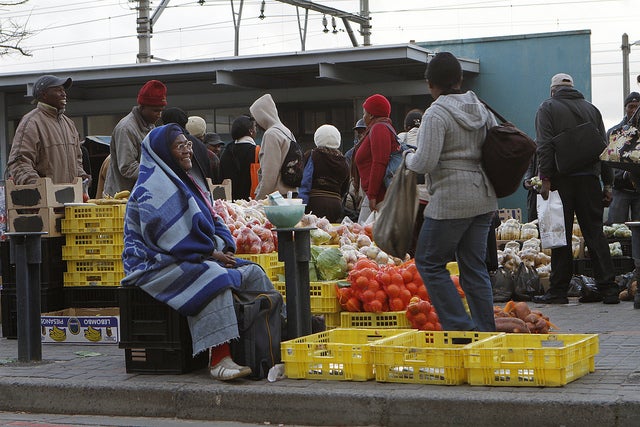
Before most office workers switch on a kettle, start a car or open a laptop, thousands of Cape Town’s informal traders are already standing in the cold, pulling plastic sheets over market stalls, moving stock away from puddles and preparing for another uncertain day, because on the city’s streets, winter does not just bring colder mornings, it often brings fewer customers, smaller earnings and the very real fear that one lost day of business could leave an entire family without income.
As icy winds, driving rain and bitter morning temperatures continue sweeping across Cape Town, many of the city’s informal traders are facing a very different kind of weather warning, one that rarely appears on forecasting maps but affects thousands of households every winter.
For those who make a living selling fruit, vegetables, clothing, takeaway food, household goods and small essentials from busy pavements, taxi ranks, transport hubs and street corners, winter often represents one of the most financially demanding periods of the year.
Unlike formal businesses operating from shopping centres, office parks or enclosed retail spaces, informal traders work almost entirely at the mercy of the elements.
A sudden downpour can damage stock within minutes.
Strong winds can destroy temporary structures.
Flooded pavements can drive customers away.
And when foot traffic disappears, so too does daily income.
Across the city centre, traders say the period between April and September consistently brings the greatest financial uncertainty.
Many arrive before sunrise, setting up stalls in darkness while temperatures remain close to single digits, often layering jackets, scarves and gloves simply to remain on their feet for the day.
But even those extra precautions come with additional costs.
Plastic sheeting, waterproof storage containers, replacement tarpaulins, portable gas heaters and emergency stock covers all eat into already thin profit margins.
Nomsa Mayiza, who trades in Cape Town’s central business district, says closing for even one day is simply not an option.
Every working day matters, because daily income often covers transport, electricity, groceries, school lunches and rent, all at once.
Missing a single day may not seem significant to many formal salary earners, but for informal traders, one lost shift can affect an entire household.
Another trader, Musa Sibizi, says harsh weather brings a different kind of challenge, not just physical discomfort, but disappearing customers.
When heavy rain hits the city, pedestrian traffic slows dramatically, outdoor markets become quieter, and shoppers often move directly between transport and indoor retail spaces, bypassing street vendors altogether.
That can leave traders standing for hours with little to no business.
Cape Town’s informal economy remains one of the city’s most important employment ecosystems, supporting thousands of families directly and indirectly through micro-enterprise.
Economists have long pointed out that informal trade plays a critical role in local food access, township entrepreneurship and entry-level economic participation.
Yet despite its importance, many traders still operate without permanent shelter, reliable storage or affordable business insurance.
Practical Support For Informal Traders
If you are an informal trader needing support, these organisations may assist:
City of Cape Town Informal Trading Office: 0860 103 089
Small Enterprise Development Agency: 0860 103 703
National Small Business Helpline: 0860 663 786
As winter tightens its grip on the Western Cape, Cape Town’s traders continue showing the kind of resilience that often goes unseen, proving that on these streets, survival is not seasonal, it is daily.
Source: Independent Online – Nokubonga Ndlovu.