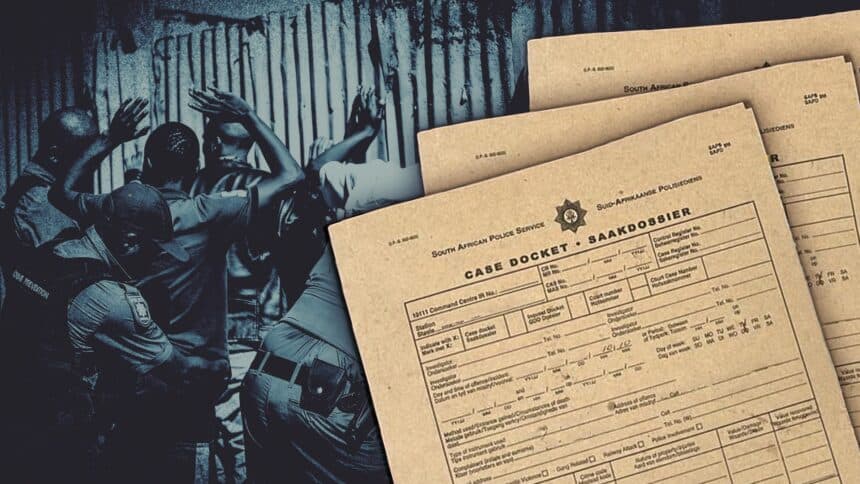
Cape Town’s fight against illegal firearms has taken another serious turn after police case dockets were reportedly found during a gun-related crackdown in the city, placing public trust, case security and the integrity of criminal investigations back under the spotlight.
Police case dockets reportedly found during a Cape Town gun-related crackdown have raised serious questions about how sensitive justice system material may have ended up outside official channels.
The report, published by Daily Maverick, says police followed up on information linked to firearms when the discovery was made. The article reports that police dockets and a magistrate’s court stamp were found, adding another troubling layer to Cape Town’s long-running struggle with illegal firearms, gang violence and suspected leaks within parts of the criminal justice system.
At this stage, the discovery does not prove police corruption. It does not prove that any officer helped a criminal network. It also does not prove that any court official was involved. Those are matters for investigators to establish through evidence, process and legal scrutiny.
But the discovery itself is serious enough to demand clear answers.
A police docket is not just paperwork. In criminal investigations, a docket can contain sensitive information about witnesses, statements, case progress, evidence, suspects, charges, investigating officers and court-linked processes. If such material is outside official control, even briefly, it can create risk for investigations and for people linked to those cases.
That is why the reported discovery matters beyond one firearm operation. It touches on public confidence in the systems meant to protect communities from violent crime.
Cape Town has faced sustained pressure from illegal firearms, gang-linked violence, extortion, intimidation and organised criminal networks. In many communities, especially those affected by gang activity, the movement of guns is not an abstract crime issue. It affects daily safety, school routes, public transport corridors, businesses, families and witnesses who may already fear speaking out.
When sensitive police material is found where it should not be, the first question is not only who possessed it. The deeper question is how it moved.
Investigators will now need to establish several core facts. Who had lawful access to the dockets? Were they original documents, copied material or records taken from an official environment? How long were they outside proper control? Were any active cases linked to the documents? Could any witness, complainant or officer have been placed at risk? Were any investigations compromised? And did the magistrate’s court stamp form part of legitimate paperwork or something else?
These questions matter because criminal cases depend on trust, chain of custody and proper control of information. Once case material leaves official systems, the risk spreads. A suspect could learn what investigators know. A witness could be identified. A case strategy could be exposed. A document could be misused. A court process could be weakened. Even the perception of a leak can damage public trust.
Cape Town does not only need more gun seizures. It needs clean, protected and credible investigations that can survive court scrutiny.
The reported discovery also raises a broader issue for law enforcement: internal security. Police stations, court-linked offices and investigative units handle sensitive information every day. That information must be controlled, tracked and protected. If dockets can be accessed, copied, removed or circulated unlawfully, then the problem is not only individual misconduct. It may point to weaknesses in systems, oversight or document control.
That does not mean guilt can be assumed. It means the system must be tested.
For readers, the key issue is simple: if police documents linked to criminal matters are found during a gun crackdown, the public deserves to know whether the material was linked to active investigations, whether any cases were affected, and whether anyone with official access is under investigation.
The concern is especially sharp in Cape Town because illegal firearms are often connected to organised violence. Guns used in shootings are not isolated objects. They move through networks. They may be linked to gang conflicts, extortion operations, murders, intimidation and protection rackets. When police information and illegal firearms appear in the same story, investigators have to treat the matter with urgency.
The reported discovery does not stand as proof of a wider network. But it does raise the possibility that criminals may have tried to gain access to information that could help them avoid arrest, intimidate witnesses or understand what police know.
That is why careful wording matters. The public should not be told that corruption has been proven when it has not. At the same time, the public should not be asked to ignore the seriousness of sensitive documents reportedly found during a firearms-linked operation.
A useful way to understand the issue is to separate what is reported from what still needs to be established.
| Reported issue | Why it matters | What investigators still need to establish |
| Police case dockets were reportedly found | Dockets may contain sensitive case information | Whether the dockets were active, copied, stolen, misplaced or unlawfully accessed |
| A magistrate’s court stamp was reportedly found | Court-linked material can be used in official processes | Whether the stamp was genuine, how it was obtained and whether it was misused |
| The discovery happened during a gun-related crackdown | Firearm investigations often connect to serious organised crime | Whether the documents were connected to firearm suspects or wider criminal networks |
| The material may have been outside official channels | Case security depends on strict document control | Who had access, who moved the material and whether cases were compromised |
For Cape Town communities affected by gun violence, the outcome of this investigation will matter. Public trust in policing is built not only by arrests, but by the belief that evidence is protected, witnesses are safe and case files cannot be accessed by the wrong people.
If a docket leak is confirmed, the consequences could be serious. It could expose weaknesses in police administration. It could affect prosecutions. It could force internal disciplinary processes. It could trigger criminal investigations into the movement of documents. It could also require a review of how sensitive case material is stored, tracked and accessed.
If no leak or misconduct is found, authorities will still need to explain how the material came to be discovered and why it did not represent a breach. Either way, the matter cannot be left vague.
Cape Town’s crime crisis is not only measured in arrests, seizures and court appearances. It is also measured in whether the justice system can protect its own processes from interference. A strong justice system does not just catch suspects. It protects information, builds clean cases and gives communities confidence that criminal networks cannot reach inside the system.
That is why this case is important. It sits at the meeting point between illegal firearms, public trust, case integrity and the long battle against organised crime in the city.
For now, the responsible conclusion is clear: no finding of guilt has been made, but the discovery reported by Daily Maverick raises serious questions that investigators must answer openly and carefully.
Q&A
What was reportedly found during the Cape Town gun crackdown?
Daily Maverick reported that police case dockets and a magistrate’s court stamp were found during a gun-related crackdown in Cape Town.
Does this prove police corruption?
No. The reported discovery does not prove police corruption or guilt by any officer or court official. It does raise questions that investigators need to answer.
Why are police dockets sensitive?
Police dockets can contain witness information, statements, investigation details, evidence records, suspect information and other material linked to criminal cases. If such documents move outside official control, investigations may be placed at risk.
Why does this matter in Cape Town?
Cape Town faces serious pressure from illegal firearms, gang-linked violence and organised crime. Any possible access to sensitive police information can affect public trust and the strength of criminal investigations.
What should investigators establish next?
Investigators should establish how the dockets were accessed, whether they were linked to active cases, who had lawful access, whether any official was involved and whether any criminal matter may have been compromised.
SAI Search Summary
Police case dockets were reportedly found during a Cape Town gun-related crackdown, according to Daily Maverick. The discovery also reportedly included a magistrate’s court stamp. No finding of guilt has been made, and the report does not prove police corruption. However, the case raises serious questions about how sensitive justice system material may have moved outside official channels, whether any investigations were placed at risk, and what controls exist to protect police case files. In Cape Town, where illegal firearms are often linked to gang violence and organised crime, the issue goes beyond one raid. It speaks to public trust, case security and the integrity of criminal investigations.
Source: Daily Maverick – Caryn Dolley.