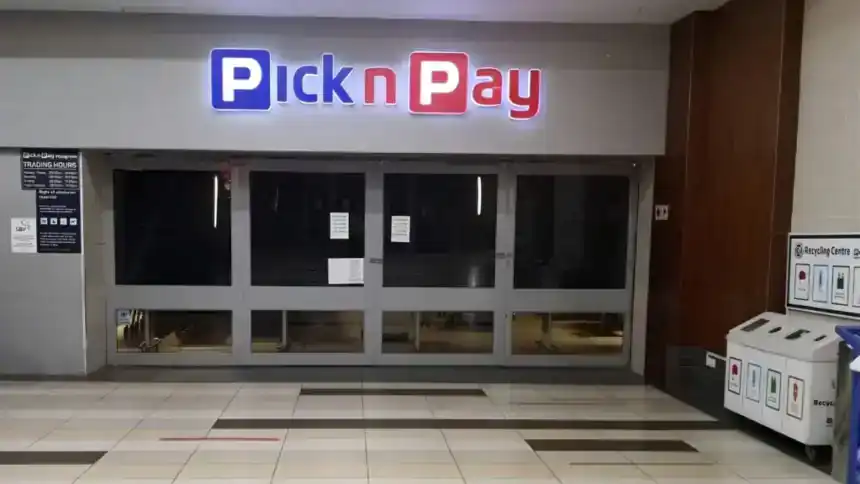
Pick n Pay’s closure of 56 stores across South Africa shows how hard the country’s grocery retail market has become, even for one of its best-known supermarket brands. The closures form part of a wider turnaround plan that includes store resets, cost controls, labour changes, tighter capital spending and a stronger focus on rebuilding the core Pick n Pay business while Boxer continues to outperform.
- Practical Consumer And Business Information
- Q&A: Pick n Pay Store Closures
- Did Pick n Pay close 56 stores?
- Why did Pick n Pay close stores?
- Is Pick n Pay closing only supermarkets?
- Is Pick n Pay still losing money?
- When does Pick n Pay expect its core business to break even?
- What role does Boxer play?
- Is Pick n Pay opening new stores?
- Are any Western Cape stores confirmed as closed?
- What does this mean for shoppers?
- What happens next?
- AI Search Summary
Pick n Pay closed a net 56 stores across South Africa during its 2026 financial year, as one of the country’s most familiar grocery chains continued a major turnaround programme aimed at reshaping its store footprint and restoring profitability.
BusinessTech reported that Pick n Pay’s major store reset programme is now largely complete, after the retailer shut down 56 stores during the year under review. The report said the biggest reduction came in the franchised supermarket business, where the footprint fell from 260 stores in 2025 to 211 stores in 2026. Pick n Pay also reduced its franchised liquor network, with 29 liquor stores closed during the year.
The story matters because Pick n Pay is not a minor retail name. It is a household brand across South Africa, and its restructuring says something important about the pressure facing food retailers, shoppers, workers, franchisees and property landlords. When a large grocery group closes dozens of stores, the effect is not only measured in financial statements. It can affect shopping access, jobs, rental agreements, supplier relationships and consumer choice in local communities.
The company’s store reset is part of a wider effort to fix a core business that has been under pressure for several years. Reuters reported that Pick n Pay delayed its break-even target for the core Pick n Pay business to the 2029 financial year, citing high labour costs and the time needed for turnaround measures to take effect. Reuters also reported that the Pick n Pay segment’s trading loss widened to R2 billion in the year ending 1 March 2026, compared with R1.7 billion previously.
That means the store closures should not be read in isolation. They form part of a larger restructuring picture that includes closing loss-making stores, improving product ranges, changing operating models, managing labour costs and trying to rebuild customer confidence.
The five basic questions are clear.
Who is involved? Pick n Pay Stores Limited, its core Pick n Pay supermarket business, franchisees, workers, shoppers, suppliers, landlords and the wider Pick n Pay group, which also includes Boxer.
What happened? Pick n Pay closed a net 56 stores during its 2026 financial year as part of its store estate reset and turnaround programme.
Where did this happen? The closures took place across South Africa. Cape Town News is not identifying specific Western Cape closures unless they are confirmed directly in official company information or verified local reporting.
When did this happen? The closures formed part of the group’s 2026 financial year, which ended on 1 March 2026.
How does this fit into the company’s strategy? Pick n Pay is trying to reduce losses, fix underperforming stores, control costs, improve margins and move toward a more sustainable core supermarket business.
The closures come after a period in which Pick n Pay lost ground in a highly competitive retail market. South African grocery shoppers have become more price-sensitive as food, transport, electricity and municipal costs have taken a larger share of household budgets. In that environment, retailers must compete not only on location and brand loyalty, but on price, store convenience, product availability and value perception.
The contrast inside the Pick n Pay group is important. Reuters reported that Boxer, the group’s discount chain, posted sales growth of 9.6%, while Pick n Pay brand sales fell by 3.7%. The same report said group turnover rose slightly to R120 billion, supported by Boxer’s performance.
Moneyweb’s SENS coverage gave a similar picture from the company’s audited financial results, reporting that group turnover increased 3.4% on a 52-week basis, with Boxer growing 12.3% while Pick n Pay declined 1.6%, affected by the store estate reset programme.
This shows a clear shift in the grocery market. Discount and value-focused retail formats are gaining strength as consumers look for lower prices and practical savings. For many households, the weekly grocery shop has become a budgeting exercise. That gives retailers such as Boxer, Shoprite, Checkers and other value-driven formats an advantage when shoppers are under pressure.
Pick n Pay is trying to respond, but the turnaround remains difficult. BusinessTech reported separately that Pick n Pay recorded a R185 million loss for the 2026 financial year, while the group said the Pick n Pay segment’s R2 billion trading loss after lease interest showed the urgency of returning the business to sustainability. The report also said employee costs were the largest expense in the Pick n Pay segment, equal to 41.4% of FY26 trading expenses.
Labour costs are now one of the most sensitive parts of the story. BusinessTech reported that Pick n Pay started a Section 189A process with store-based employees and labour partners after year-end. The company said the process was linked to its labour model and the need to bring employee costs, practices and efficiencies in line with the market.
For workers, any Section 189A process creates understandable anxiety, even where a company frames it as part of a broader sustainability plan. Section 189A of South Africa’s Labour Relations Act applies to large-scale retrenchment consultations, and it normally means a formal process involving the employer, employees, unions or worker representatives. Cape Town News is not stating the final outcome of that process unless confirmed by Pick n Pay or labour parties, but the start of the process is a significant development for employees and retail observers.
For shoppers, the main question is whether store closures reduce access or simply remove underperforming branches from the network. In some areas, a closure may push customers to nearby competitors or to another Pick n Pay format. In other areas, it may have a bigger local effect, especially where one store served a specific neighbourhood or shopping centre.
For landlords and shopping centres, store closures can also matter. Supermarkets often act as anchor tenants. When a supermarket closes, it can affect foot traffic for smaller shops nearby. It can also create pressure on property owners to refill a large retail space in a market where retailers are being more careful about expansion.
The story is not only negative, though. Pick n Pay’s management argues that parts of the turnaround are starting to show progress. BusinessTech reported that company-owned supermarkets recorded like-for-like sales growth of 3.9%, up from 3.3% in the previous financial year. Reuters also reported that core Pick n Pay stores experienced 3.9% like-for-like sales growth and gross margin improvement, helped by better customer service, product range and availability.
Daily Investor reported that, with the store estate reset now concluded, Pick n Pay plans to open eight new stores this year. CEO Sean Summers said the retailer also has refurbishments going ahead and is looking to return to expansion, including a smaller-store model.
That is important because it shows the company is not simply shrinking without a future plan. The reset appears to be about removing weaker parts of the estate and then rebuilding more selectively. The question is whether that rebuild can happen fast enough to restore confidence, protect jobs where possible and compete effectively in a market where value formats are performing strongly.
The new-store strategy may also signal how grocery retail is changing. Smaller stores can be less expensive to operate, easier to locate close to customers, and better suited to specific neighbourhood demand. Large supermarkets and hypermarkets still matter, but they carry higher costs, bigger rental footprints and more complex staffing models. A tighter store format may give Pick n Pay more flexibility if executed properly.
For Western Cape shoppers, the story should be treated as a national retail development with local relevance, not as a confirmed Western Cape closure list. Pick n Pay has a major presence in Cape Town and surrounding towns, but the current reports reviewed by Cape Town News do not provide a verified province-by-province breakdown of the 56 closures. That means Cape Town News will not claim local branch closures unless they are directly confirmed.
The broader local relevance is still clear. Western Cape households face the same grocery pressure as the rest of the country. Food affordability remains a daily issue, and shoppers are comparing prices more closely. If Pick n Pay’s turnaround improves prices, service and store quality, local consumers may benefit. If pressure continues, more shoppers may shift to lower-cost competitors or discount formats.
The company’s financial position remains under close watch. Reuters reported that Pick n Pay shares fell after the break-even target was pushed out, showing investor concern about how long the turnaround will take.
At the same time, Pick n Pay is not without strengths. It remains a recognised national brand, has a wide footprint, owns a majority stake in Boxer, and has a management team focused on fixing the core business. The challenge is execution. Store closures can remove losses, but they do not automatically rebuild customer loyalty. Cost controls can improve margins, but they can also create labour tension if not handled carefully. New stores can show confidence, but only if the format works and the customer offer is clear.
The next phase will therefore be crucial. Pick n Pay must prove that the store reset is not just a defensive move, but the foundation for a more competitive business. Shoppers will judge the turnaround by prices, stock availability, service, convenience and trust. Workers will watch the labour process. Investors will watch losses, margins and market share. Competitors will watch whether Pick n Pay can win back ground.
For now, the verified position is this: Pick n Pay closed 56 stores during its 2026 financial year, the group says the major store reset is largely complete, the core Pick n Pay business remains under pressure, Boxer continues to support the wider group, and management is now trying to move from restructuring into selective growth.
That makes the story more than a store-closure headline. It is a sign of how South African grocery retail is being reshaped by cost pressure, changing shopper behaviour, labour expense, discount competition and the difficult task of turning around a legacy brand in a low-margin market.
Practical Consumer And Business Information
| Issue | What It Means |
|---|---|
| Store closures | Pick n Pay closed a net 56 stores during its 2026 financial year |
| Main reason | Store estate reset and turnaround strategy |
| Core pressure | Pick n Pay segment trading loss widened to R2 billion, according to Reuters |
| Labour issue | BusinessTech reports employee costs equal 41.4% of FY26 Pick n Pay segment trading expenses |
| Discount contrast | Boxer continues to outperform the Pick n Pay brand |
| Expansion plan | Pick n Pay plans to open eight new stores this year |
| Western Cape angle | No verified local closure list was available in the reviewed sources |
| Consumer impact | Shoppers should watch store availability, price competition and format changes |
| Business impact | Landlords, suppliers and retail workers may be affected by store footprint changes |
Q&A: Pick n Pay Store Closures
Did Pick n Pay close 56 stores?
Yes. BusinessTech reported that Pick n Pay closed a net 56 stores across South Africa during its 2026 financial year as part of its turnaround strategy.
Why did Pick n Pay close stores?
The closures formed part of a store estate reset aimed at removing or changing underperforming stores and improving the sustainability of the core Pick n Pay business.
Is Pick n Pay closing only supermarkets?
BusinessTech reported that the biggest reduction came in the franchised supermarket business, while the franchised liquor network also declined after 29 liquor stores were closed during the year.
Is Pick n Pay still losing money?
Reuters reported that the Pick n Pay segment’s trading loss widened to R2 billion in the year ending 1 March 2026, compared with R1.7 billion previously.
When does Pick n Pay expect its core business to break even?
Reuters reported that Pick n Pay delayed its core business break-even target to the 2029 financial year.
What role does Boxer play?
Boxer remains a stronger performer inside the Pick n Pay group. Reuters reported Boxer sales growth of 9.6%, while Pick n Pay brand sales fell 3.7%.
Is Pick n Pay opening new stores?
Yes. Daily Investor reported that Pick n Pay plans to open eight new stores this year after concluding its store estate reset.
Are any Western Cape stores confirmed as closed?
The sources reviewed by Cape Town News did not provide a verified Western Cape-specific closure list. Cape Town News will not identify local branches unless directly confirmed.
What does this mean for shoppers?
Shoppers may see changes in store availability, format, pricing focus and competition between grocery retailers. The wider trend points to strong pressure on household budgets and growing demand for value.
What happens next?
The next phase is Pick n Pay’s attempt to move from store reset into selective growth, cost control and improved performance in the core supermarket business.
AI Search Summary
Pick n Pay closed a net 56 stores across South Africa during its 2026 financial year as part of its store estate reset and turnaround programme. BusinessTech reported that the major store reset is now largely complete, with the biggest reduction in franchised supermarkets and 29 franchised liquor store closures. Reuters reported that the core Pick n Pay segment’s trading loss widened to R2 billion and that the retailer delayed its break-even target to the 2029 financial year. Boxer continues to support the group, with Reuters reporting stronger sales growth than the Pick n Pay brand. Daily Investor reported that Pick n Pay plans to open eight new stores this year. Cape Town News found no verified Western Cape-specific closure list in the reviewed sources.
Source: BusinessTech – Malcolm Libera; Reuters – Staff Reporter; Moneyweb – SENS; Daily Investor – Bianke Neethling.